Conostegia xalapensis
(Bonpl.) D. Don ex DC.
Lengua de gato
iNaturalist· cc-by
(c) Alexis López Hernández, some rights reserved (CC BY)
iNaturalist· cc-by
(c) Alexis López Hernández, some rights reserved (CC BY)
iNaturalist· cc-by
(c) Alexis López Hernández, some rights reserved (CC BY)
Description
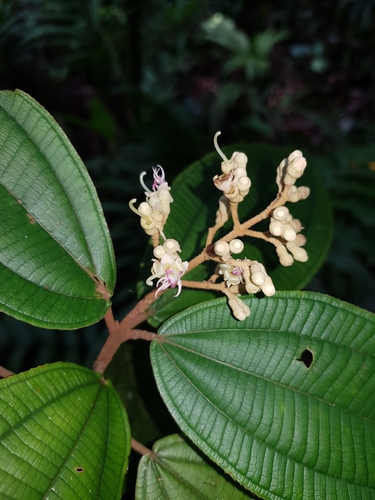
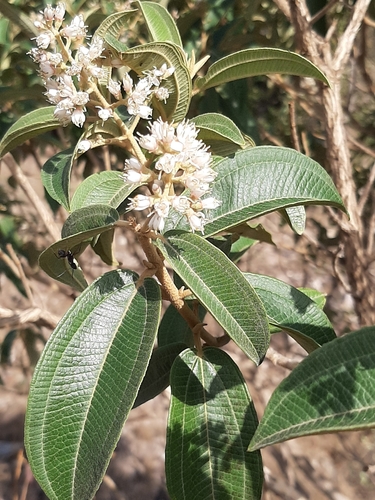
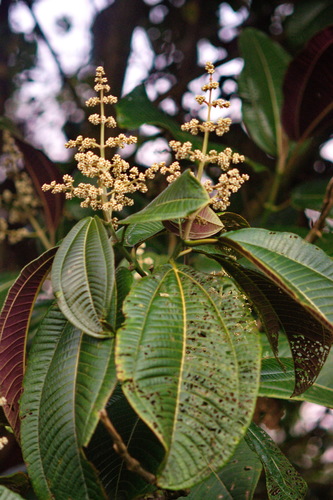
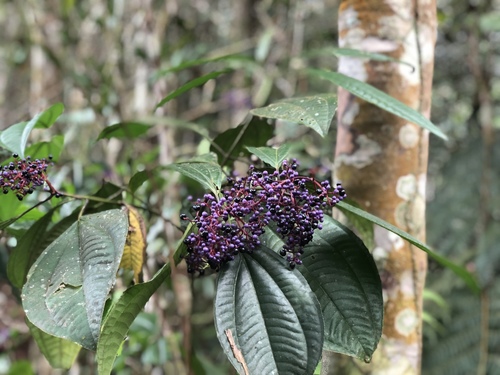
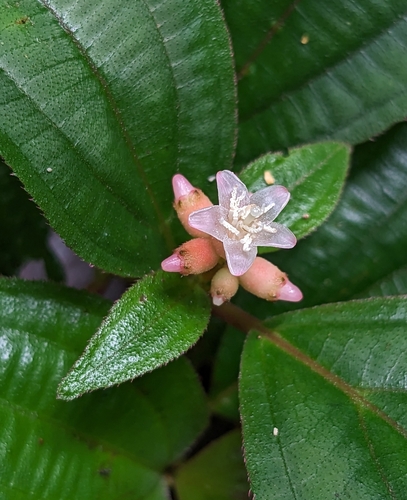
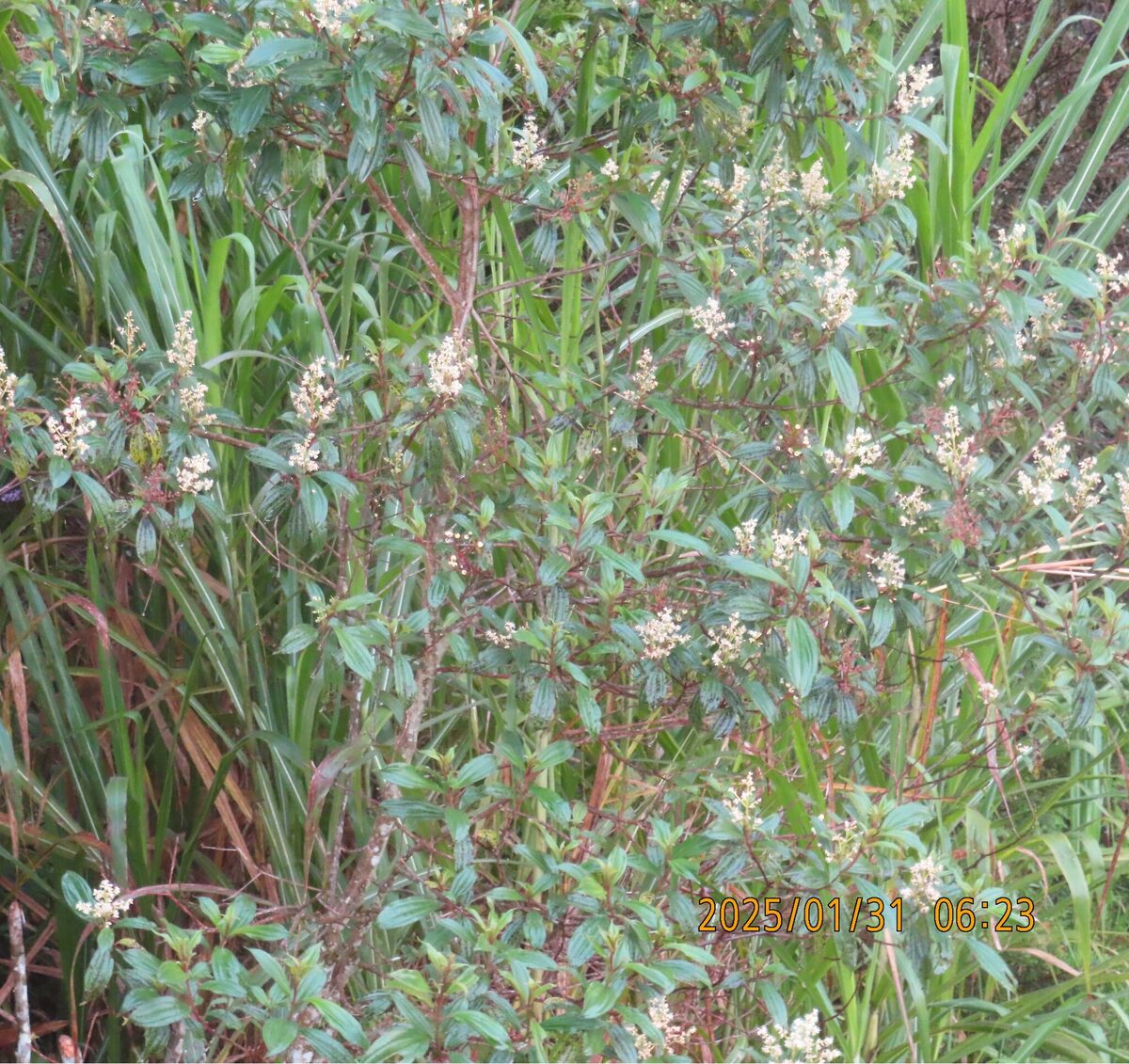
A tree. It is usually about 10 m tall but can be 20 m all. The bark is brown with vertical cracks. The leaves are simple, opposite and narrow. They have teeth along the edge. The leaf size varies. They can be 10 cm long or longer. There are 3 main veins along the leaf with many cross veins. There is a rusty brown covering over many parts of the plant. This includes the underneath of the leaves. The flowers are in clusters at the tips of the branches. They have 5-7 white petals. These are 5 mm long. The fruit is purple-black and 1 cm across. It has many seeds. The fruit are edible.
Edible Uses
Fruit. A good flavour. The dark blue or purple fruits somewhat resemble blueberries (Vaccinium spp.) in appearance.
Distribution
A tropical plant. In Costa Rica it grows from sea level to 1,500 m altitude. It grows in gaps in the forest.
Where It Grows
Belize, Caribbean, Central America, Colombia, Costa Rica, Cuba, El Salvador, Guatemala, Honduras, Mexico, Nicaragua, North America, Panama, South America, West Indies,
Cultivation
A plant of the lowland moist tropics. Plants can flower and fruit throughout the year.
Synonyms
Also Known As
Capulin de cotorro, Capulincillo, Chicab, Chibate, Conco negritos, Dos caras, Lala comun, Lengua de vaca, Maria, Mora, Nigua, Nigua grande, Papelillo, Pasita, Popu, Quito manteca, Raspa lengua, Serita, Tecopulin, Tesuate, Teshuate, Texhuate, Tezhualillo
References (17)
- Condit, R., et al, 2011, Trees of Panama and Costa Rica. Princeton Field Guides. p 300 (As Conostegia xalapensis)
- Cruz, I. M., et al, 2015, Edible fruits and seeds in the State of Mexico. Revista Mexicana de Ciencias Agricolas. Vol. 6. Num. 2 pp 331-346
- Fouqué, A., 1972, Espèces fruitières d'Amérique tropicale. Institut français de recherches fruitierès outre-mer
- Gonzalez-Espinosa, M. et al, 2011, The Red List of Mexican Cloud Forest Trees. Flora and Fauna International, Cambridge. p 107
- Grandtner, M. M. & Chevrette, J., 2013, Dictionary of Trees, Volume 2: South America: Nomenclature, Taxonomy and Ecology. Academic Press p 157
Show all 17 references Hide references
- Heywood, V.H., Brummitt, R.K., Culham, A., and Seberg, O. 2007, Flowering Plant Families of the World. Royal Botanical Gardens, Kew. p 207
- Kermath, B. M., et al, 2014, Food Plants in the Americas: A survey of the domesticated, cultivated and wild plants used for Human food in North, Central and South America and the Caribbean. On line draft. p 258
- Kew Plants of the World Online
- Mabberley, D.J. 1990. The plant-book: a portable dictionary of the higher plants. Cambridge University Press. NY.
- NYBG herbarium "edible"
- Pascual-Mendoza, S. et al, 2021, Traditional knowledge of edible plants in an indigenous community in the Sierra Norte of Oaxaca, Mexico. Plant Biosystems - An International Journal Dealing with all Aspects of Plant Biology
- Piedra-Malagón, E. M., et al, 2022, Edible native plants of the Gulf of Mexico Province. Biodiversity Data Journal 10: e80565 p 25
- Roa, J. A. G. & Boada, D. S. G., 2018, Fundación para el Fortalecimiento de la Fruticultura y Plantas Alimenticias no Convencionales en Colombia.
- Segura, S., et al, 2018, The edible fruit species in Mexico. Genet Resour Crop Evol (2018) 65:1767–1793
- Wiersema, J. H. & Leon, B., 2013, World Economic Plants. A Standard Reference CRC Press. 2nd Ed. p 196
- World Checklist of Useful Plant Species 2020. Royal Botanic Gardens, Kew
- Zuchowski W., 2007, Tropical Plants of Costa Rica. A Zona Tropical Publication, Comstock Publishing. p 55