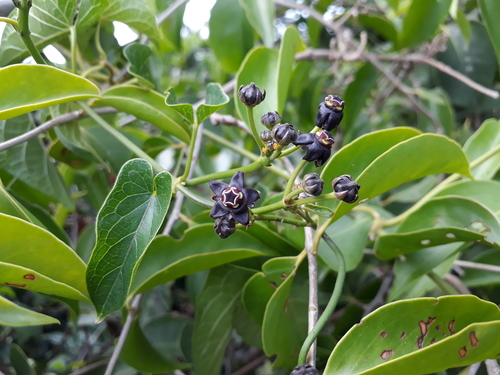
Hoodia gordonii
(Masson) Sweet ex Decne.
Queen of the Namib, African hats
iNaturalist· cc-by-nc
(c) Colin Ralston, some rights reserved (CC BY-NC), uploaded by Colin Ralston
iNaturalist· cc-by-sa
(c) Margaret Moore, some rights reserved (CC BY-SA)
iNaturalist· cc-by-sa
(c) Margaret Moore, some rights reserved (CC BY-SA)
Summary
Source: WikipediaHoodia gordonii, also known as Bushman's hat, is a leafless spiny succulent plant supposed to have therapeutic properties in folk medicine. It grows naturally in Botswana, South Africa and Namibia. The species became internationally known and threatened by collectors, after a marketing campaign falsely claimed that it was an appetite suppressant for weight loss. The flowers smell like rotten meat and are pollinated mainly by flies. The indigenous San people of the Namib desert call this plant ǁhoba (pronounced [kǁʰɔbɑ] – the initial sound is a lateral click).
Description
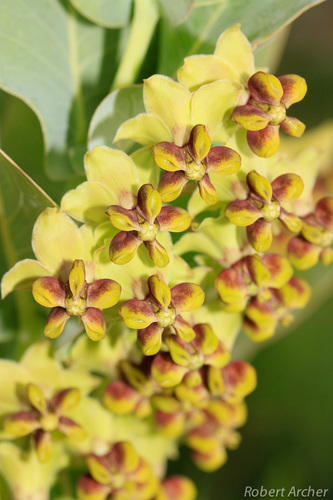
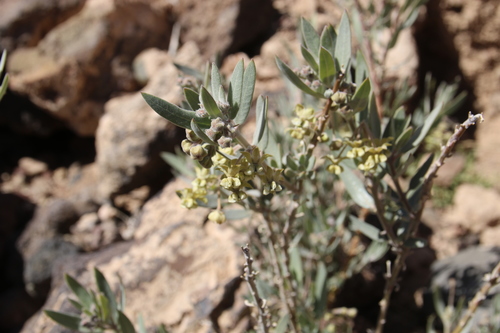
A succulent herb or shrub. It grows about 80 cm high. The stems are 305 cm thick. The flowers are star shaped or bell shaped. They are 1-17 cm across. They are dull brown colour and have a bad smell like rotten meat. This attracts flies to pollinate the plant.
Edible Uses
The stems are eaten fresh as food, chewed to reduce appetite, though they have a bitter taste.
Traditional Uses
The stems are chewed to reduce the desire for food. They are eaten fresh as a food. They have a bitter taste.
This uses section is brief — help expand it
Medicinal Uses
The stems are traditionally chewed to reduce the desire for food, and the plant is used medicinally as an appetite suppressant, currently being developed by a pharmaceutical company.
Distribution
A tropical plant. It grows in deserts in Botswana. It grows in sands. They need high temperatures, high light and low moisture. It cannot tolerate frost. In southern Africa it grows between 250-1,200 m altitude. It can grow in arid places.
Where It Grows
Africa, Botswana, Chile, Namibia, South Africa, Southern Africa, South America,
Cultivation
Plants can be grown by seed. They can also be grown by cuttings.
Notes
There are 13 Hoodia species. It is used in medicine as an appetite suppressant. It is being developed by a pharmaceutical company.
Synonyms
Also Known As
Bitterghaap, Ghoba, Wilde ghaap
References (12)
- A. L. P. P. de Candolle, Prodr. 8:665. 1844
- Grubben, G. J. H. and Denton, O. A. (eds), 2004, Plant Resources of Tropical Africa 2. Vegetables. PROTA, Wageningen, Netherlands. p 330
- Marinelli, J. (Ed), 2004, Plant. DK. p 344
- Heywood, V.H., Brummitt, R.K., Culham, A., and Seberg, O. 2007, Flowering Plant Families of the World. Royal Botanical Gardens, Kew. p 40
- Kew, Plants of the World on Line
Show all 12 references Hide references
- Jansen, P.C.M., 2004. Hoodia currorii (Hook.) Decne. [Internet] Record from Protabase. Grubben, G.J.H. & Denton, O.A. (Editors). PROTA (Plant Resources of Tropical Africa), Wageningen, Netherlands. < http://database.prota.org/search.htm>. Accessed 16 October 2009.
- Royal Botanic Gardens, Kew (1999). Survey of Economic Plants for Arid and Semi-Arid Lands (SEPASAL) database. Published on the Internet; http://www.rbgkew.org.uk/ceb/sepasal/internet [Accessed 30th March 2011]
- Ruiters-Welcome, A. K., 2019, Food plants of southern Africa. Ph.D. thesis. Univ. of Johannesburg p 24
- van Wyk, Be., & Gericke, N., 2007, People's plants. A Guide to Useful Plants of Southern Africa. Briza. p 70
- van Wyk, B-E., 2011, The potential of South African plants in the development of new food and beverage products. South African Journal of Botany 77 (2011) 857–868
- Welcome, A. K. & Van Wyk, B.-E., 2019, An inventory and analysis of the food plants of southern Africa. South African Journal of Botany 122 (2019) 136–179
- World Checklist of Useful Plant Species 2020. Royal Botanic Gardens, Kew