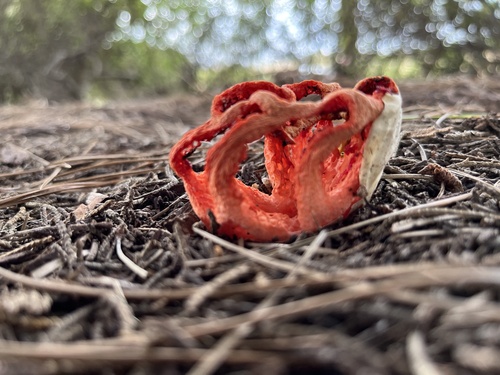
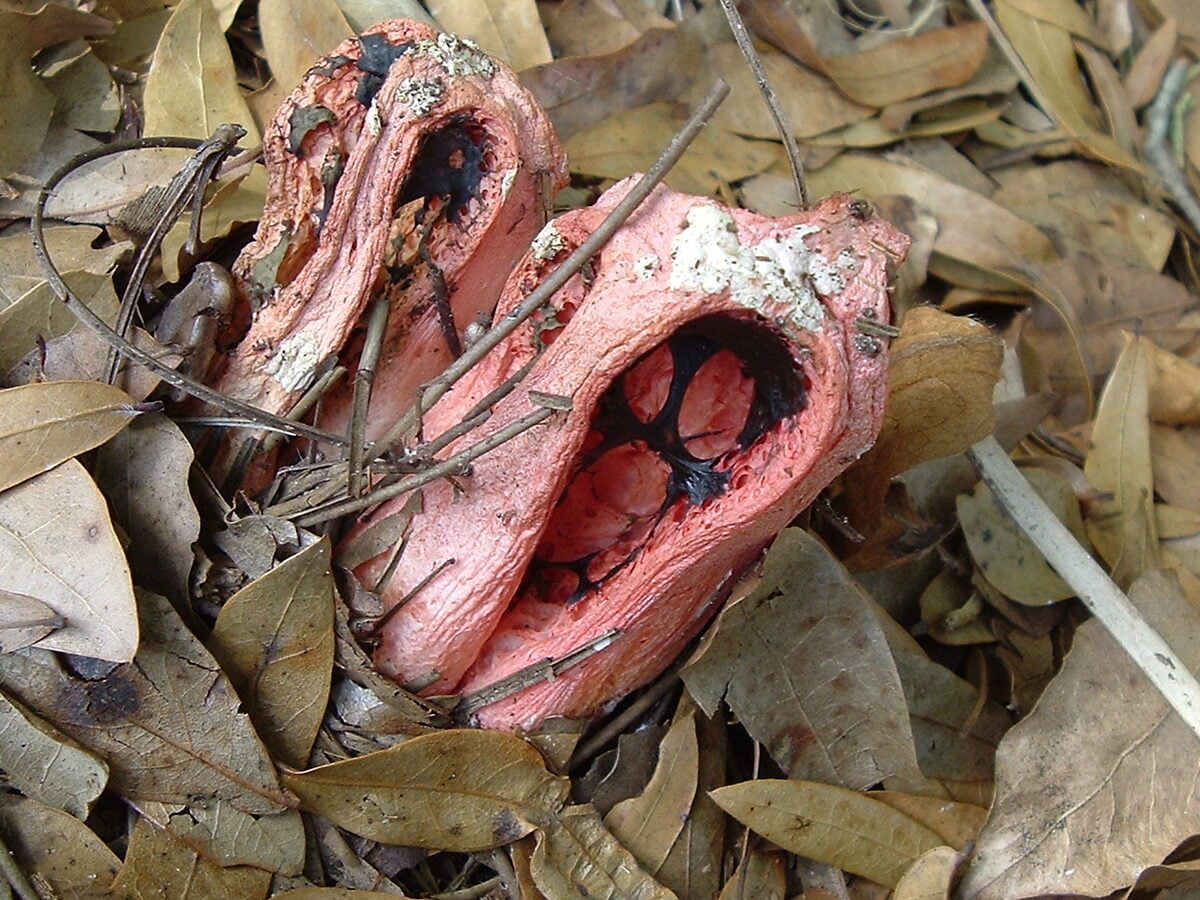
Clathrus archeri
(Berk.) Dring
Red tentacle fungus
iNaturalist· cc-by-nc
(c) Nicolas Schwab, some rights reserved (CC BY-NC), uploaded by Nicolas Schwab
iNaturalist· cc-by-nc
(c) spacelargo, some rights reserved (CC BY-NC), uploaded by spacelargo
iNaturalist· cc-by-nc
(c) robynnejean, some rights reserved (CC BY-NC)
Summary
Source: WikipediaClathrus archeri (synonyms Lysurus archeri, Anthurus archeri, Pseudocolus archeri), commonly known as octopus stinkhorn or devil's fingers, is a fungus which has a global distribution. This species was first described in 1980 in a collection from Tasmania. The young fungus erupts from a suberumpent egg by forming into four to seven elongated slender arms initially erect and attached at the top. The arms then unfold to reveal a pinkish-red interior covered with a dark-olive spore-containing gleba. In maturity it smells like putrid flesh.
Description
Red tentacle fungus is a mushroom found in temperate regions.
This description is brief — help expand it
Edible Uses
The very young egg-like cap can be eaten, though older parts develop a very bad odour and should be avoided.
Traditional Uses
The very young egg like cap can be eaten. Older parts have a very bad odour.
This uses section is brief — help expand it
Distribution
It is a temperate plant.
Where It Grows
Asia, Australia*, Britain, Europe, India,
Synonyms
References (4)
- Fuhrer, B., 2005, A field guide to Australian Fungi. Bloomings Books. p 231
- Hall, I. R., et al, 2003, Edible and Poisonous Mushrooms of the World. Timber Press. p 293
- Kaufmann, B. et al, 1999, The Great Encyclopedia of Mushrooms. Konemann. p 191
- Li, H., et al, 2020, Reviewing the world’s edible mushroom species: A new evidence-based classification system. Compr Rev Food Sci Food Saf. 2021;20:1982–2014.