Passiflora tarminiana
Coppens & V. E. Barney
Banana passion flower
iNaturalist· cc-by-nc
(c) Bird Explorers, some rights reserved (CC BY-NC), uploaded by Bird Explorers
iNaturalist· cc0
no rights reserved
iNaturalist· cc-by-nc
(c) coqwallon, some rights reserved (CC BY-NC)
Summary
Source: WikipediaPassiflora tarminiana (or banana passionfruit) is a species of passionfruit. The yellow fruits are edible and their resemblance to small, straight bananas has given it the name banana passionfruit in some countries. It is native to the uplands of tropical South America and is now cultivated in many countries. In Hawaii and New Zealand it is now considered an invasive species. It was given the name banana passionfruit in New Zealand, where passionfruit are also prevalent. In Hawaii, it is called banana poka. In its Latin American homeland, it is known as curuba, curuba de Castilla, or curuba sabanera blanca (Colombia); taxo, tacso, tagso, tauso (Ecuador); parcha, taxo (Venezuela), tumbo or curuba (Bolivia); tacso, tumbo, tumbo del norte, trompos, tintin, porocsho or purpur (Peru). Passiflora tarminiana belongs to the Tacsonia subgenus of Passiflora. It has been known under a number of different names and was only formally described in 2001.
Description
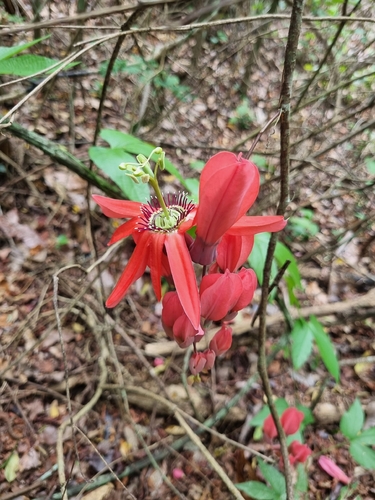
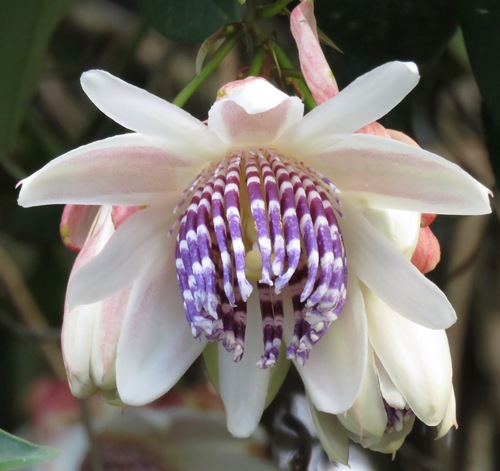
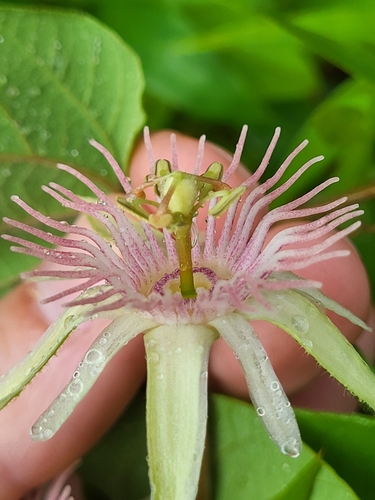
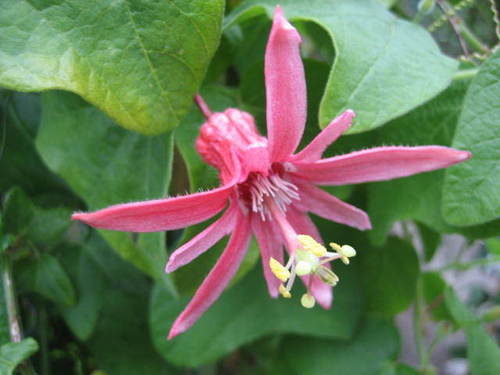
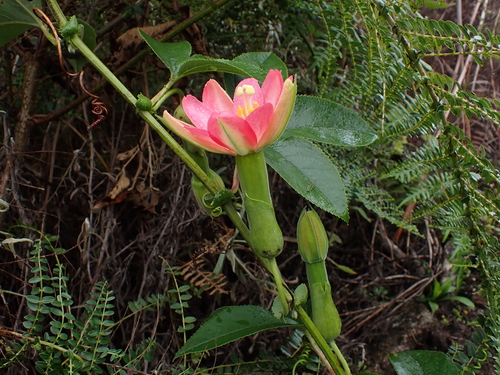
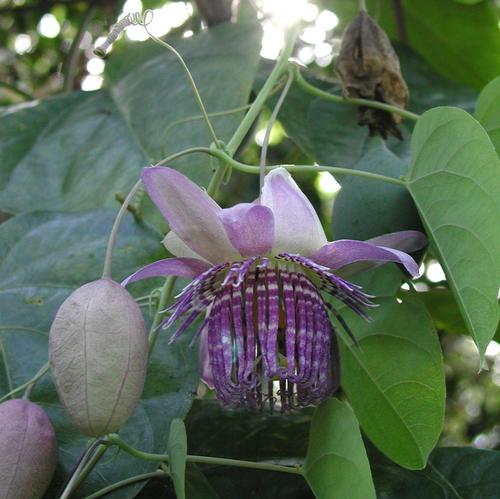
A vine. The flowers are large and pink and hang down. The fruit are banana like.
This description is brief — help expand it
Edible Uses
The fruit can be eaten raw or used in ice creams, fruit salads, pies, and jellies, and is highly prized for its juice. The yellow, oblong, aromatic fruits measure about 100–140mm long and 35–45mm wide and are deep yellow to orange in colour. The pulp is less aromatic and tart than that of the pale yellow fruits of Passiflora tripartita mollissima, and is considered somewhat inferior in flavour to that variety.
Medicinal Uses
None known.
Distribution
It is a temperate plant. Tasmania Herbarium.
Where It Grows
Andes, Australia, Bolivia, Central America, Colombia, Ecuador, Guatemala, Hawaii, Mexico, New Zealand, North America, Pacific, Peru, South Africa, Southern Africa, South America, Tasmania, USA, Venezuela,
Cultivation
The plant grows well at elevations between 2,000 - 3,000 metres or even more in the tropics, succeeding at lower elevations as it moves away from the Equator. Requires a humus-rich, moist but well-drained soil and a position in dappled shade where it can grow up towards the sun. Passiflora species tend to flower and fruit more freely when grown in soils of only moderate fertility. Prefers a circumneutral soil, disliking very acid or very alkaline conditions. Prefers a pH in the range 6 - 7, tolerating 4.3 - 8. A vigorous and disease-resistant species, it has escaped from cultivation in some areas, particularly New Zealand and Hawaii. It can invade native habitats, especially woodlands, and has been declared a noxious weed in both Hawaii and new Zealand. The plant shows more resistance to pests and diseases than the related Passiflora tripartita mollissima. This species hybridizes easily with other species in the subgenus Tacsonia. Hybrids with Passiflora mixta and Passiflora tripartita are fertile and show intermediate phenotypes. Hybrids with Passiflora cumbalensis can also produce fertile seed.
Propagation
Seed is best sown as soon as it is ripe, together with the pulp, which helps break down the seed coat and speeds germination. Stored seed should be soaked for 24 hours in warm water; germination can be further accelerated by mixing the seed with the juice of a fresh passion fruit of any species. Even so, stored seed can take up to 12 months to germinate. Place the seed tray in a shady position at around 19–24°C. Prick seedlings out into individual containers as soon as they are large enough to handle and plant out when sufficiently established. Take cuttings of young shoots at the nodes. Layering is very easy; air layering is also suitable.
Other Uses
None known.
Other Information
It is cultivated.
Synonyms
Also Known As
Badea, Curuba, Gullan, Plataforma, Taksu, Tumbo
References (12)
- Coppens d’Eeckenbrugge, G., V. E. Barney., P.M. Jorgensen, and J. M. MacDougal, 2001, Passiflora tarminiana, a new cultivated species of Passiflora subgenus Tacsonia (Passifloraceae). Novon 1:8-15
- Gori, B., et al, 2022, Understanding the diversity and biogeography of Colombian edible plants. Scientific Reports 12:7835
- Lopez-Diago, D. & Garcia, N., 2021, Wild edible fruits of Colombia. Biota ColomBiana 22 (2) p 47
- Marinelli, J. (Ed), 2004, Plant. DK. p 465
- Novon 11:9. 2002
Show all 12 references Hide references
- Roa, J. A. G. & Boada, D. S. G., 2018, Fundación para el Fortalecimiento de la Fruticultura y Plantas Alimenticias no Convencionales en Colombia.
- Segura, S., et al, 2018, The edible fruit species in Mexico. Genet Resour Crop Evol (2018) 65:1767–1793
- Tasmanian Herbarium Vascular Plants list p 43
- Torre, de la, L., et al, 2008, Enciclopedia de las Plantas Útiles del Ecuador. Herbario QCA. Pontificia Universidad Católica del Ecuador. p 488
- Ulmer, T., & MacDougal, J.M., 2004, Passiflora Passionflowers of the World. Timber Press. p 68
- Wiersema, J. H. & Leon, B., 2013, World Economic Plants. A Standard Reference CRC Press. 2nd Ed. p 500
- World Checklist of Useful Plant Species 2020. Royal Botanic Gardens, Kew