Rheum ribes
Linn.
Currant-fruited rhubarb, Rawash
iNaturalist· cc-by-nc
(c) Shahrzad Fattahi, some rights reserved (CC BY-NC)
iNaturalist· cc-by-nc
(c) Shahrzad Fattahi, some rights reserved (CC BY-NC)
iNaturalist· cc-by-nc
(c) Shahrzad Fattahi, some rights reserved (CC BY-NC)
Summary
Source: WikipediaRheum ribes, the Syrian rhubarb or currant-fruited rhubarb, or warty-leaved rhubarb, is an edible wild rhubarb species in the genus Rheum. It grows between 1000 and 4000 m on dunite rocks, among stones and slopes, and is now distributed in the temperate and subtropical regions of the world, chiefly in Western Asia (Turkey, Syria, Lebanon, Iran, Azerbaijan, Armenia) to Afghanistan and Pakistan and also in ladakh(Kargil) region of India. The Syrian rhubarb is a partially commercial vegetable collected from wild patches in Eastern and Southern Anatolia, Kurdistan, and partly Northwestern Iran in early spring. Rheum ribes is considered as a valuable medicinal species in herbal medicine.
Description
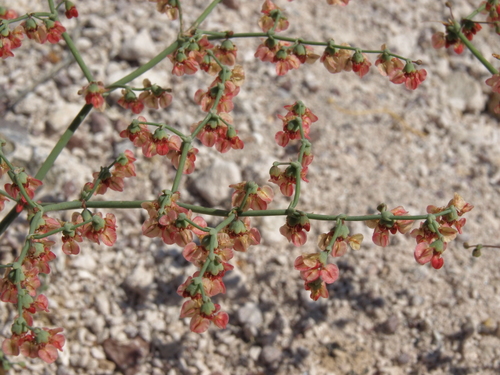
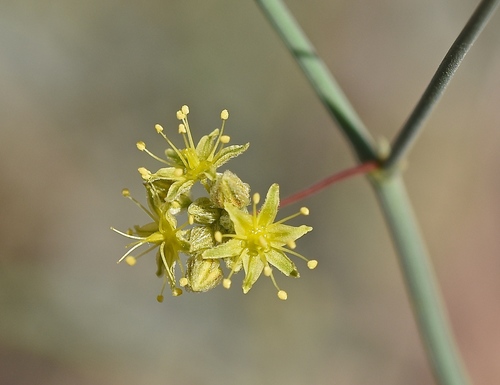
A herb. It keeps growing from year to year. The stems are solid and warty. The leaf stalks are rough. The leaf blade is 30-50 cm long by 25-40 cm wide. They are heart shaped.
Edible Uses
The leaf stem is eaten cooked, and is also consumed raw by local people.
Traditional Uses
The leaf stalks are used as a vegetable. They are made into pies and preserves. They have the favour of currants. The outer part of the stem is removed and then eaten raw. The leaves are used for sarma in Turkey. They are rolled around a filling of rice or minced meat. The root is used as a hot drink.
Medicinal Uses
None known
Known Hazards
Although no specific mention has been seen for this species, the leaves of some if not all members of this genus contain significant quantities of oxalic acid and should not be eaten in any quantity. Oxalic acid can lock up certain minerals in the body, especially calcium, leading to nutritional deficiency. The content of oxalic acid will be reduced if the plant is cooked. People with a tendency to rheumatism, arthritis, gout, kidney stones or hyperacidity should take especial caution if including this plant in their diet since it can aggravate their condition.
Distribution
It is a temperate plant. In Pakistan it grows between 1,000-4,000 m altitude.
Where It Grows
Afghanistan, Azerbaijan, Europe, France, Iran, Iraq, Lebanon, Mediterranean, Middle East, Pakistan, Russia, Syria, Turkey, Türkiye,
Cultivation
Prefers a deep, fertile, moderately heavy, humus rich, moisture retentive, well-drained soil in sun or semi-shade. Grows well in heavy clay soils. Best grown in a dry position, where it can be very long-lived. Hardy to about -20°c according to one report whilst another says that plants are somewhat tender in Britain. Plants in this genus seem to be immune to the predations of rabbits. Hybridizes freely with other members of this genus.
Propagation
Seed is best sown in autumn in a shaded cold frame, though spring sowing in a cold frame is also possible. Once seedlings are large enough to handle, prick them out into individual pots and grow them on in a greenhouse or cold frame through their first winter, then plant out in spring. For division, work in early spring or autumn, splitting the rootstock with a sharp spade or knife and ensuring at least one growth bud per division. Larger divisions can go directly into their permanent positions; smaller ones are better potted up and grown on in light shade in a cold frame until well established before planting out in late spring or early summer.
Other Uses
None known Special Uses
Other Information
They are sold at local markets.
Also Known As
Isgin, Iskin, Kap, Revas, Rewas, Rewes, Ribes, Rives
References (19)
- Ahmad, S. A. & Askari, A. A., 2015, Ethnobotany of the Hawraman Region of Kurdistan Iraq. Harvard Papers in Botany, Vol. 20, No. 1, 2015, pp. 85–89
- Cakir, E. A., 2017, Traditional knowledge of wild edible plants of Iğdır Province (East Anatolia, Turkey). Acta Soc Bot Pol. 2017;86(4):3568
- Dogan, A. & Tuzlaci, E., 2015, Wild Edible Plants of Pertek (Tunceli-Turkey). Marmara Pharmaceutical Journal 19: 126-135
- Dogan, Y., 2012, Traditionally used wild edible greens in the Aegean Region of Turkey. Acta Societatis Botanicorum Poloniae 81(4): 329-342
- Dogan, Y. et al, 2013, Wild Edible Plants sold in the Local Markets of Izmir, Turkey. Pak. J. Bot. 45(S1): 177-184
Show all 19 references Hide references
- Dogan, Y., et al, 2015, Of the importance of a leaf: the ethnobotany of sarma in Turkey and the Balkans. Journal of Ethnobiology and Ethnomedicine, 11:56
- Ertug, F, Yenen Bitkiler. Resimli Türkiye Florası -I- Flora of Turkey - Ethnobotany supplement
- Facciola, S., 1998, Cornucopia 2: a Source Book of Edible Plants. Kampong Publications, p 186
- Flora of Pakistan. www.eFloras.org
- Hedrick, U.P., 1919, (Ed.), Sturtevant's edible plants of the world. p 557
- Ibadullayeva, S., et al, 2011, Protection of some rare and endangered vegetable plants in the flora of the Nakhichevan AR. International Journal of Biodiversity and Conservation Vol. 3(6), pp. 224-229
- Marinelli, J. (Ed), 2004, Plant. DK. p 193
- Mukemre, M., et al, 2016, Survey of wild food plants for human consumption in villages of Catak, (Van-Turkey), Indian Journal of Traditional Knowledge. Vol. 15(2) pp. 183-191
- Pieroni, A., et al, 2017, The spring has arrived: traditional wild vegetables gathered by Yarsanis (Ahl-e Haqq) and Sunni Muslims in Western Hawraman, SE Kurdistan (Iraq). Acta Soc Bot Pol 86(1):3519
- Polat, R., et al, 2015, Survey of wild food plants for human consumption in Elazig (Turkey). Indian Journal of Traditional Knowledge. Vol. 1(1): 69-75
- Polat, R., et al, 2017, Survey of wild food plants for human consumption in Bingol, (Turkey). Indian Journal of Traditional Knowledge. Vol. 16(3) July 2017, pp. 378-384
- Rivera, D. et al, 2006, Gathered Mediterranean Food Plants - Ethnobotanical Investigations and Historical Development, in Heinrich M, Müller WE, Galli C (eds): Local Mediterranean Food Plants and Nutraceuticals. Forum Nutr. Basel, Karger, 2006, vol 59, pp 18–74
- Sp. pl. 1:372. 1753
- Sulamain, N., et al, 2023, The Importance of Becoming Tamed: Wild Food Plants as Possible Novel Crops in Selected Food-Insecure Regions. Horticulturae 2023,9,171.