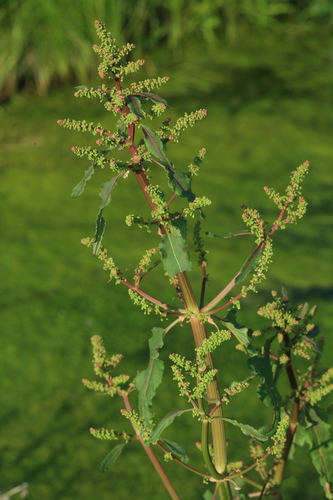
Rheum palmatum
Linn.
Pieplant, Chinese rhubarb, Chinghai rhubarb
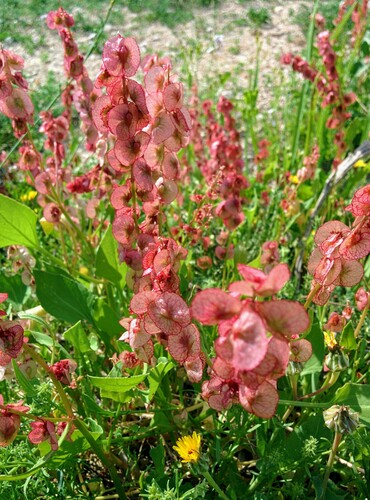
iNaturalist· cc-by-nc-sa
(c) London Permaculture, some rights reserved (CC BY-NC-SA)
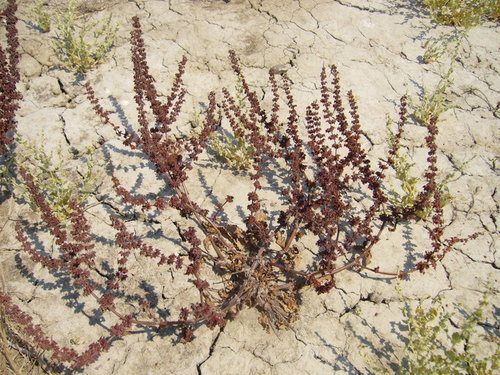
iNaturalist· cc-by-nc
(c) reinderw, some rights reserved (CC BY-NC)
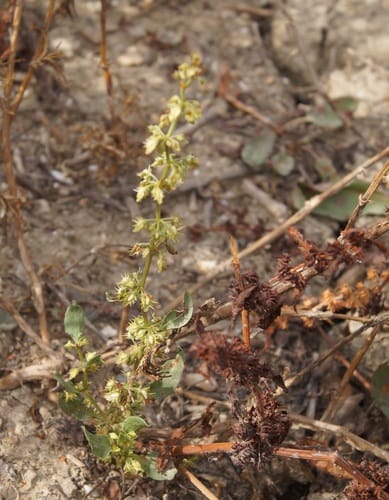
iNaturalist· cc-by-nc
(c) reinderw, some rights reserved (CC BY-NC)
Summary
Source: WikipediaRheum palmatum is a species of flowering plant in the knotweed family Polygonaceae. It is commonly called Chinese rhubarb, ornamental rhubarb, Turkey rhubarb or East Indian rhubarb. Rheum palmatum is a herbaceous perennial related to the edible rhubarb. It is primarily used in traditional medicine, and as an ornamental subject in the garden.
Description
A plant that keeps growing from year to year. It grows 1.5-2.4 m high and spreads 1.5 m wide. It has a thick rhizome. The leaf stalks are thick and fleshy. The leaves have deep lobes and teeth. They are 100 cm wide. The young leaves are purplish-red. The flowers are in fluffy panicles. They flowers are small and pink. They grow on tall stems. The fruit have 3 wings.
Edible Uses
The leaf stem can be eaten raw or cooked. It is considered superior in flavour to common rhubarb and quite tender, with an agreeably acid taste. It is sometimes used as a cooked fruit substitute.
Traditional Uses
The leaf stalks are sometimes eaten or made into wine or preserves. The rhizomes are used in medicine.
This uses section is brief — help expand it
Medicinal Uses
Known in China as Da Huang, Chinese rhubarb has a long and proven history of herbal use, with its primary effect being a positive and balancing action on the whole digestive system. It is one of the most widely used herbs in Chinese medicine, and its action is considered safe and gentle enough for children. The plant is also an ingredient in the North American formula called essiac, used as a popular treatment for cancer, though its effectiveness has never been reliably proven or disproven as controlled studies have not been carried out. The other herbs in that formula are Arctium lappa, Ulmus rubra, and Rumex acetosella. The root is anticholesterolemic, antiseptic, antispasmodic, antitumor, aperient, astringent, cholagogue, demulcent, diuretic, laxative, purgative, stomachic, and tonic. The roots contain anthraquinones, which produce a purgative effect, alongside tannins and bitters that have the opposite astringent effect. Small doses act as an astringent tonic to the digestive system; larger doses act as a mild laxative. The root is taken internally for chronic constipation, diarrhoea, liver and gall bladder complaints, haemorrhoids, menstrual problems, and skin eruptions due to an accumulation of toxins. It is not prescribed for pregnant or lactating women, nor for patients with intestinal obstruction. Externally, the root is used in the treatment of burns. Roots are harvested in October from plants at least six years old and dried for later use. A homeopathic remedy prepared from the dried root is used especially for diarrhoea in teething children. The German Commission E Monographs approve Rheum palmatum for the treatment of constipation.
Known Hazards
The leaves are poisonous. This report probably refers to high levels of oxalic acid found in the leaves. Perfectly safe in moderate quantities, oxalic acid can lock up certain minerals (especially calcium) in the body, leading to nutritional deficiency. Cooking the plant will reduce its content of oxalic acid. People with a tendency to rheumatism, arthritis, gout, kidney stones or hyperacidity should take especial caution if including this plant in their diet since it can aggravate their condition. Laxative action side-effect with long term use may lead to electrolyte imbalances. Increase in aldosterone secretion, passage of albumin and blood in urine and intestinal movement loss.
Distribution
It is a temperate plant. It grows between 1,500-4,400 m above sea level. It suits hardiness zones 6-9. In Sichuan and Yunnan.
Where It Grows
Asia, Australia, Britain, Canada, China*, Colombia, Europe, Indochina, Mongolia, North America, SE Asia, Tasmania, Tibet, Vietnam,
Cultivation
Prefers a deep, fertile, moderately heavy, humus rich, moisture retentive, well-drained soil in sun or semi-shade. Grows well in heavy clay soils. Plants can be grown in quite coarse grass, which can be cut annually in the autumn. Hardy to at least -15°c. A very ornamental plant, there is at least one named variety. Hybridizes freely with other members of this genus. The sub-species R. palmatum tanguticum is cultivated as a medicinal plant in China, it was at one time a popular purgative in Europe. Plants in this genus seem to be immune to the predations of rabbits. Turkish rhubarb is a good companion plant for columbine (Aquilegia spp).
Propagation
Seed is best sown in autumn in a shaded cold frame, though spring sowing in a cold frame is also possible. Once seedlings are large enough to handle, prick them out into individual pots and grow them on in a greenhouse or cold frame through their first winter, then plant out in spring. For division, work in early spring or autumn, splitting the rootstock with a sharp spade or knife and ensuring at least one growth bud per division. Larger divisions can go directly into their permanent positions; smaller ones are better potted up and grown on in light shade in a cold frame until well established before planting out in late spring or early summer.
Other Uses
An insect spray can be made from the leaves, which is also said to help prevent clubroot in brassicas. The cultivar 'Atrosanguineum' works well as ground cover in a sunny position, and other forms can be used similarly, planted approximately 1.8 metres apart in each direction.
Notes
It is used in medicine.
Synonyms
Also Known As
Daihoang chuongdiep
References (17)
- Bianchini, F., Corbetta, F., and Pistoia, M., 1975, Fruits of the Earth. Cassell. p 212
- Boesi, A., 2014, Traditional knowledge of wild food plants in a few Tibetan communities. Journal of Ethnobiology and Ethnomedicine 10:75
- Cundall, P., (ed.), 2004, Gardening Australia: flora: the gardener's bible. ABC Books. p 1141
- Facciola, S., 1998, Cornucopia 2: a Source Book of Edible Plants. Kampong Publications, p 186
- Flora of China @ efloras.org Volume 5
Show all 17 references Hide references
- Hedrick, U.P., 1919, (Ed.), Sturtevant's edible plants of the world. p 557
- Hibbert, M., 2002, The Aussie Plant Finder 2002, Florilegium. p 246
- Hu, Shiu-ying, 2005, Food Plants of China. The Chinese University Press. p 373
- Jackes, D. A., 2007, Edible Forest Gardens
- Kang, J. et al, 2016, Wild food plants and fungi used in the mycophilous Tibetan community of Zhagana (Tewo Country, Gansu, China) Journal of Ethnobiology and Ethnomedicine. 12:21
- Kew Plants of the World Online
- Marinelli, J. (Ed), 2004, Plant. DK. p 193
- Syst. nat. ed. 10, 2:1010. 1759
- Tanaka,
- van Wyk, B., 2005, Food Plants of the World. An illustrated guide. Timber press. p 320
- Wiersema, J. H. & Leon, B., 2013, World Economic Plants. A Standard Reference CRC Press. 2nd Ed. p 583
- World Checklist of Useful Plant Species 2020. Royal Botanic Gardens, Kew