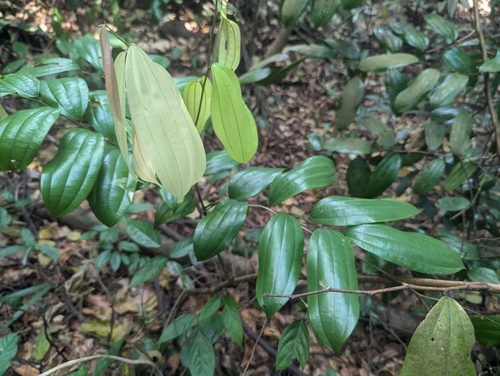
Berchemia discolor
(Klotzsch) Hemsley
Bird plum, Brown ivory, Mountain date
iNaturalist· cc-by-nc
(c) Thorsten Stamer, some rights reserved (CC BY-NC)
iNaturalist· cc-by-nc
(c) Thorsten Stamer, some rights reserved (CC BY-NC)
iNaturalist· cc-by-nc
(c) Thorsten Stamer, some rights reserved (CC BY-NC)
Description
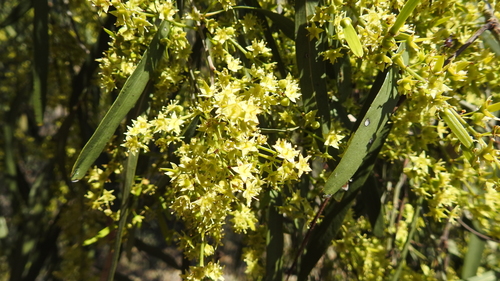
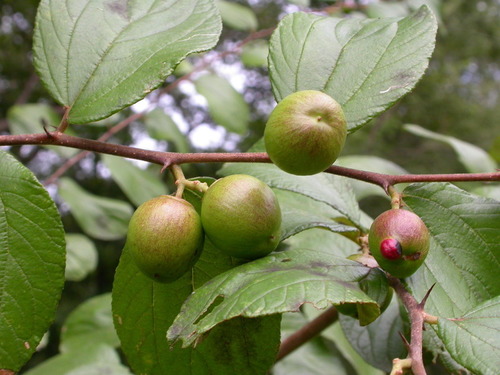
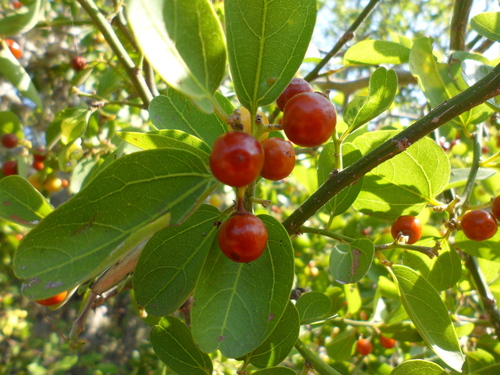
A tree. It grows 12-18 m tall. It usually loses its leaves during the year. The branches are spreading. The crown is dense and round. The leaves are simple and nearly opposite. They are dark green above and paler underneath. They are 2.5-10 cm long and 8 cm wide. They are oval with pointed tips. The flowers are in small stalked clusters in the axils of leaves. The fruit are like small pointed plums. They are about 2 cm long. They are yellow or red. They have a sweet yellow pulp and a kernel with 2 seeds. The fruit are edible.
Edible Uses
The sweet yellow fruit pulp is eaten raw or dried, and dried fruit can be stored long-term. The fruit are used to flavor porridge, made into biscuit dough with millet seeds, fermented into alcoholic drinks, or processed into juice, jam, and sweets.
Traditional Uses
The ripe fruit are eaten raw or dry. They are also used to flavour porridge. The dried fruit can be stored. The dried fruit (after the kernel is removed) are pounded with millet seeds and made into a biscuit dough and baked. The fruit are also fermented into an alcoholic drink. Caution: Alcohol is a cause of cancer. The fruit can be used for juice, jam and sweets.
Medicinal Uses
Not mentioned in available data.
Known Hazards
Phyllogeiton discolor is also used as a dye, fodder, ornamental tree and as herbal medicine to treat several human and animal diseases and ailments. For instance, the Himba people cook the bark against nausea and diarrhoea.
Distribution
A tropical plant. It grows in dry forest. It grows at low altitude in South Africa. In East Africa it grows from sea level to 1,600 m altitude. It is damaged by frost or cold winds. It is drought resistant. It grows in areas with an annual rainfall between 300-635 mm. It can grow in arid places. It is often on termite mounds. It grows in the lowlands and along rivers. It grows in Miombo woodlands.
Where It Grows
Africa, Angola, Botswana, Central Africa, Congo, East Africa, Eswatini, Ethiopia, Kenya, Madagascar, Malawi, Middle East, Mozambique, Namibia, Saudi Arabia, Somalia, South Africa, Southern Africa, South Sudan, Sudan, Swaziland, Tanzania, Uganda, Yemen, Zambia, Zimbabwe,
Cultivation
Plants can be grown from fresh seeds. The seeds germinate easily. Seedlings can then be transplanted. Seeds can also be sown directly in the field. Plants can also be grown from root suckers.
Propagation
Seed - germination takes some time due to the hard seed coat, it can be sped up by scarifying the seed or immersing it in hot water and then allowing the water to cool for 12 hours. Root suckers.
Other Uses
A resin is obtained from the heartwood. It can be used as a glue. A black dye, popular with basket makers, is produced from the powdered heartwood and the roots. A red dye is obtained from the bark. A whitewash produced from the wood ash is used for painting houses. The heartwood is yellow-brown with a reddish tinge, the sapwood is pale brown. The wood is very hard, heavy and fine grained. It is excellent for making furniture such as tables, chairs and benches and is also used in making poles, pestles and hair combs. The plant can be grown as a windbreak.
Production
Plants grow very slowly. When dry, the fruit can be stored for a long time. Fruit are normally available in the wet season.
Other Information
The fruit are popular. They are sold in markets.
Notes
There are 12 Berchemia species. They are very high in sugar. The Vit C content of the pulp is 65 mg/100g.
Synonyms
Also Known As
Borodoke, Bruin-ivoor, Datcha, Deen, Dheen, Edume, Jajaba, Jejeba, Jejjeba, Kisaaya, Kisanawa, Losy, M'yaxa, Mgandum, Mkulu, Mkuni, Mnago, Mogokgoma, Montsintsila, Motsensela, Mozinzila, Mtaci, Mtata, Muapu, Muchuk, Mugaramhanga, Munhacha, Munie, Munye, Munyii, Munyinyi, Munzinzila, Mutatya, Muthwana, Muwe, Muzingila, Muzinzila, Nhire, Nyahumbu, Nyii, Nyiri, Nzaaya, Nzanawa, Omuye, Ooko, Pau-rosa, Qanantab, Santaiti, Sarikomanga, Tinhirra, Tsiandalana, Umcaga, Umncaga, Umnyi, Umzinzila, Uvuka, Vavanga, Yeyebito
References (73)
- Addis, G., Asfaw, Z & Woldu, Z., 2013, Ethnobotany of Wild and Semi-wild Edible Plants of Konso Ethnic Community, South Ethiopia. Ethnobotany Research and Applications. 11:121-141
- Addis, G., et al, 2013, The Role of Wild and Semi-wild Edible Plants in Household Food Sovereignty in Hamer and Konso Communities, South Ethiopia. Ethnobotany Research & Applications. 11:251-271
- Alfarhan, A. H., 2005, Flora of Jizan Region. AR 17-7. King andulaziz City for Science and Technology (KACST). p 259
- Asfaw, Z. and Tadesse, M., 2001, Prospects for Sustainable Use and Development of Wild Food Plants in Ethiopia. Economic Botany, Vol. 55, No. 1, pp. 47-62
- Awodoyin, R.O., Olubode, O.S., Ogbu, J.U., Balogun, R.B., Nwawuisi, J.U. and Orji, K.O., 2015, Indigenous Fruit Trees of Tropical Africa: Status, Opportunity for Development and Biodiversity Management. Agricultural Sciences, 6, 31-41
Show all 73 references Hide references
- Bahru, T., et al, 2013, Wild Edible Plants: Sustainable Use and Management by Indigenous Communities in and the Buffer Area of Awah National Park, Ethiopia. Ethiop. J. Sci., 36(2): 93-108
- Beche D, Gebeyehu G, Feyisa K., 2016, Indigenous Utilization and Management of Useful Plants in and around Awash National Park, Ethiopia. J Plant Biol Soil Health. 3(1):12.
- Bekele-Tesemma A., Birnie, A., & Tengnas, B., 1993, Useful Trees and Shrubs for Ethiopia. Regional Soil Conservation Unit. Technical Handbook No 5. p 106
- Bircher, A. G. & Bircher, W. H., 2000, Encyclopedia of Fruit Trees and Edible Flowering Plants in Egypt and the Subtropics. AUC Press. p 58
- Campbell, B. M., 1987, The Use of Wild Fruits in Zimbabwe. Economic Botany 41(3): 375-385
- Cunningham, 1985,
- Ethiopia: Famine Food Field Guide. http://www.africa.upenn.edu/faminefood/category3.htm
- Facciola, S., 1998, Cornucopia 2: a Source Book of Edible Plants. Kampong Publications, p 190
- FAO. 1983, Food and fruit-bearing forest species 1: Examples from Eastern Africa. FAO Food and Forestry Paper 44/1 p 19
- Feyssa, D. H., et al, 2011, Seasonal availability an consumption of wild edible plants in semiarid Ethiopia; Implications to food security and climate change adaptation. Journal of Horticulture and Forestry 3(5): 138-149
- Flora Zambesiaca. http://apps.kew.org/efloras
- Food Composition Tables for use in Africa FAO http://www.fao.org/infoods/directory No. 871
- Fowler, D. G., 2007, Zambian Plants: Their Vernacular Names and Uses. Kew. p 53
- Fox, F. W. & Young, M. E. N., 1982, Food from the Veld. Delta Books. p 312
- Global Plants JSTOR
- Goode, P., 1989, Edible Plants of Uganda. FAO p 30
- Grivetti, L. E., 1980, Agricultural development: present and potential role of edible wild plants. Part 2: Sub-Saharan Africa, Report to the Department of State Agency for International Development. p 71
- Ichikawa, M., 1980, The Utilization of Wild Food Plants by the Suiei Dorobo in Northern Kenya. J. Anthrop. Soc. Nippon. 88(1): 25-48
- INFOODS:FAO/INFOODS Databases
- Jardin, C., 1970, List of Foods Used In Africa, FAO Nutrition Information Document Series No 2.p 123
- Long, C., 2005, Swaziland's Flora - siSwati names and Uses http://www.sntc.org.sz/flora/
- Lovett, J. C. et al, Field Guide to the Moist Forest Trees of Tanzania. p 125
- Lulekal, E., et al, 2011, Wild edible plants in Ethiopia: a review on their potential to combat food insecurity. Afrika Focus - Vol. 24, No 2. pp 71-121
- Magwede, K., van Wyk, B.-E., & van Wyk, A. E., 2019, An inventory of Vhavenḓa useful plants. South African Journal of Botany 122 (2019) 57–89
- Malaisse, F., 1997, Se nourrir en floret claire africaine. Approche ecologique et nutritionnelle. CTA., p 57
- Malaisse, F., 2010, How to live and survive in Zambezian open forest (Miombo Ecoregion). Les Presses Agronomiques de Gembloux.
- Mannheimer, C. A. & Curtis. B.A. (eds), 2009, Le Roux and Muller's Field Guide to the Trees and Shrubs of Namibia. Windhoek: Macmillan Education Namibia. p 306
- Maroyi, A., 2011, The Gathering and Consumption of Wild Edible Plants in Nhema Communal Area, Midlands Province, Zimbabwe. Ecology of Food and Nutrition 50:6, 506-525
- Maroyi, A. & Cheikhyoussef, A., 2017, Traditional knowledge of wild edible fruit in southern Africa: A comparative use patterns in Namibia and Zimbabwe. Indian Journal of Traditional Knowledge. 16(3): 385-392
- Mashile, S. P., et al, 2019, Indigenous fruit plants species of the Mapulana of Ehlanzeni district in Mpumalanga province, South Africa. South African Journal of Botany 122 (2019) 180–183
- Maundu, P. et al, 1999, Traditional Food Plants of Kenya. National Museum of Kenya. p 74
- Mpasiwakomu, R. A., 2017, The Diversity and Utilization of Wild Edible and Medicinal Plant Species found in Uvinza Miombo Woodlands, Tanzania. M. Sc. thesis University of Tanzania.
- Msuya, T. S., et al, 2010, Availability, Preference and Consumption of Indigenous Foods in the Eastern Arc Mountains, Tanzania, Ecology of Food and Nutrition, 49:3, 208-227
- Mbuya, L.P., Msanga, H.P., Ruffo, C.K., Birnie, A & Tengnas, B., 1994, Useful Trees and Shrubs for Tanzania. Regional Soil Conservation Unit. Technical Handbook No 6. p 122
- Motlhanka, D. M. & Makhabu, S. W., 2011, Medicinal and edible wild fruit plants of Botswana as emerging new crop opportunities. Journal of Medicinal Plants Research Vol. 5(10), pp. 1836-1842
- Mpasiwakomu, R. A., 2017, The Diversity and Utilization of Wild Edible and Medicinal Plant Species found in Uvinza Miombo Woodlands, Tanzania. M. Sc. thesis University of Tanzania.
- Mutie, F. G., 2020, Conservation of Wild Food Plants and Their Potential for Combatting Food Insecurity in Kenya as Exemplified by the Drylands of Kitui County. Plants 2020, 9, 1017
- Mutie, F. M., et al, 2023, Important Medicinal and Food Taxa (Orders and Families) in Kenya, Based on Three Quantitative Approaches. Plants 2023, 12, 1145 (As Phyllogeiton discolor)
- Neelo, J., et al, 2015, Ethnobotanical Survey of Woody Plants in Shorobe and Xobe Villages, Northwest Region of Botswana. Ethnobotany Research & Applications 14:367-379
- Neudeck, L. et al, 2012, The Contribution of Edible Wild Plants to Food Security, Dietary Diversity and Income of Households in Shorobe Village, Northern Botswana. Ethnobotany Research & Applications 10:449-462
- Njana, M. A., et al, 2013, Are miombo woodlands vital to livelihoods of rural households? Evidence from Urumwa and surrounding communities, Tabora, Tanzania. Forests, Trees and Livelihoods, 22:2, 124-140
- D. Oliver, Fl. trop. Afr. 1:381. 1868
- Palgrave, K.C., 1996, Trees of Southern Africa. Struik Publishers. p 552
- Palmer, E and Pitman, N., 1972, Trees of Southern Africa. Vol. 2. A.A. Balkema, Cape Town p 1395
- Peters, C. R., O'Brien, E. M., and Drummond, R.B., 1992, Edible Wild plants of Sub-saharan Africa. Kew. p 165
- Plowes, N. J. & Taylor, F. W., 1997, The Processing of Indigenous Fruits and other Wildfoods of Southern Africa. in Smartt, L. & Haq. (Eds) Domestication, Production and Utilization of New Crops. ICUC p 186
- Rodin, 1985,
- Roodt, V., 1998, Trees & Shrubs of the Okavango Delta. Medicinal Uses and Nutritional value. The Shell Field Guide Series: Part 1. Shell Botswana. p 111
- Royal Botanic Gardens, Kew (1999). Survey of Economic Plants for Arid and Semi-Arid Lands (SEPASAL) database. Published on the Internet; http://www.rbgkew.org.uk/ceb/sepasal/internet [Accessed 6th June 2011]
- Ruffo, C. K., Birnie, A. & Tengnas, B., 2002, Edible Wild Plants of Tanzania. RELMA p 160
- Ruiters-Welcome, A. K., 2019, Food plants of southern Africa. Ph.D. thesis. Univ. of Johannesburg p 93
- Schatz, G.E., 2001, Generic Tree Flora of Madagascar. Royal Botanical Gardens, Kew and Missouri Botanical Garden. p 309
- Schmidt, E., Lotter, M., & McCleland, W., 2007, Trees and shrubs of Mpumalanga and Kruger National Park. Jacana Media p 378
- Scudder, 1971,
- Shumsky, S., et al, 2014, Institutional factors affecting wild edible plant (WEP) harvest and consumption in semi-arid Kenya. Land Use Policy 38(2014) 48-69
- Swaziland's Flora Database http://www.sntc.org.sz/flora
- Termote, C., et al, 2014, Assessing the potential of wild foods to reduce the cost of a nutritionally adequate diet: An example from eastern Baringo District, Kenya. Food and Nutrition Bulletin, vol. 35, no. 4
- Tredgold, M.H., 1986, Food Plants of Zimbabwe. Mambo Press. p 86
- van Wyk, Be, & Gericke, N., 2007, People's plants. A Guide to Useful Plants of Southern Africa. Briza. p 36
- van Wyk, B, van Wyk, P, and van Wyk B., 2000, Photographic guide to Trees of Southern Africa. Briza. p 10, 62
- van Wyk, B-E., 2011, The potential of South African plants in the development of new food and beverage products. South African Journal of Botany 77 (2011) 857–868
- Venter, F & J., 2009, Making the most of Indigenous Trees. Briza. p 66
- Wehmeyer, A. S, 1986, Edible Wild Plants of Southern Africa. Data on the Nutrient Contents of over 300 species
- Welcome, A. K. & Van Wyk, B.-E., 2019, An inventory and analysis of the food plants of southern Africa. South African Journal of Botany 122 (2019) 136–179
- Williamson, J., 2005, Useful Plants of Malawi. 3rd. Edition. Mdadzi Book Trust. p 36
- World Checklist of Useful Plant Species 2020. Royal Botanic Gardens, Kew
- www.worldagroforestrycentre.org/treedb/
- www.zimbabweflora.co.zw 2011