Berberis holstii
Engl.
Muthundi
iNaturalist· cc-by-nc
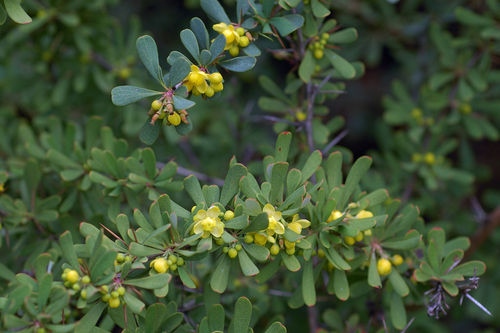
(c) Berit Gehrke, some rights reserved (CC BY-NC), uploaded by Berit Gehrke
iNaturalist· cc-by-nc
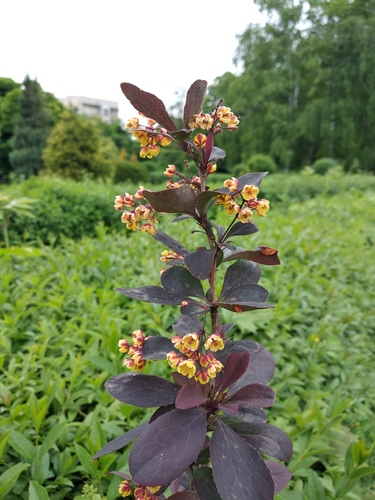
(c) Jerome Viard, some rights reserved (CC BY-NC)
Summary
Source: WikipediaBerberis holstii is a spiny evergreen shrub assigned to the barberry family, with simple leaves, hanging panicles with a few yellow flowers and eventually blackish-blue berries. It is one out of only species of Berberis that grow in the wild in Africa, where it can be found at high altitudes (above 2000 m) in Tanzania, Uganda, Kenya, Ethiopia, Somalia, and Malawi. It is also reported from Yemen and Oman. In Malawi it is known as Kayunga, while in Ethiopia it is called Gewo, Yeset af in Amharic, as well as Zinkila, a name also used in the Afar language, and Godxantool in the Somali language.
Description
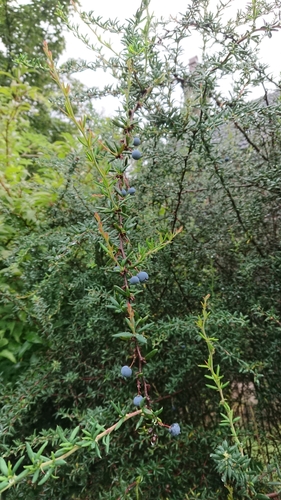
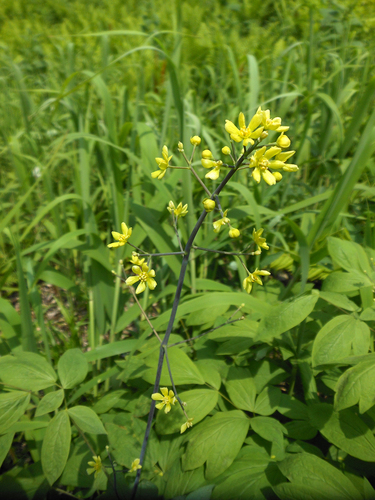
A shrub. It grows 3 m high. It has spines divided into 3 parts. These can be 3 cm long. The leaves are in bunches and have 3 leaflets. They are very small. The flowers are yellow and several occur in a group. These groups can be 7 cm long. The fruit are red to blue-black. They are oval and 8-12 mm long by 6-7 mm wide. The seeds are 6 mm long by 3 mm wide.
Edible Uses
The fruit are eaten as a snack food, especially by children.
Traditional Uses
The fruit are eaten as a snack food.
This uses section is brief — help expand it
Medicinal Uses
Berberis holstii is used as firewood, for making hedges, and cut branches are reported to be useful in the construction of barriers that are difficult for rodents to pass. It is also used in traditional medicine against a host of ailments, including coughing, pneumonia, malaria, stomach ache, and STDs, as an infusion of the root. One study found that alkaloid extracts of the roots showed significant activity against a strain of the malaria parasite, Plasmodium falciparum, as well as good activity against a strain of HIV, while not being cytotoxic.
Distribution
A tropical plant. It grows at the edges of the forest. In East Africa it grows between 1,500-3,450 m altitude. It can grow in arid places.
Where It Grows
Africa, East Africa, Ethiopia, Kenya, Malawi, Somalia, Tanzania, Uganda, Zambia,
Other Information
The fruit are eaten especially by children.
Notes
There are about 450-500 Berberis species.
Synonyms
Also Known As
Kamukururi, Kipsoroin, Mukekenye, Murage, Olekikuuni
References (9)
- Bekele-Tesemma A., Birnie, A., & Tengnas, B., 1993, Useful Trees and Shrubs for Ethiopia. Regional Soil Conservation Unit. Technical Handbook No 5. p 104
- Fowler, D. G., 2007, Zambian Plants: Their Vernacular Names and Uses. Kew. p 77
- Glover, et al, 1966b,
- Grivetti, L. E., 1980, Agricultural development: present and potential role of edible wild plants. Part 2: Sub-Saharan Africa, Report to the Department of State Agency for International Development. p 44
- Jardin, C., 1970, List of Foods Used In Africa, FAO Nutrition Information Document Series No 2.p 122
Show all 9 references Hide references
- Peters, C. R., O'Brien, E. M., and Drummond, R.B., 1992, Edible Wild plants of Sub-saharan Africa. Kew. p 69
- Royal Botanic Gardens, Kew (1999). Survey of Economic Plants for Arid and Semi-Arid Lands (SEPASAL) database. Published on the Internet; http://www.rbgkew.org.uk/ceb/sepasal/internet [Accessed 4th April 2011]
- White, F., Dowsett-Lemaire, F. and Chapman, J. D., 2001, Evergreen Forest Flora of Malawi. Kew. p 167
- World Checklist of Useful Plant Species 2020. Royal Botanic Gardens, Kew