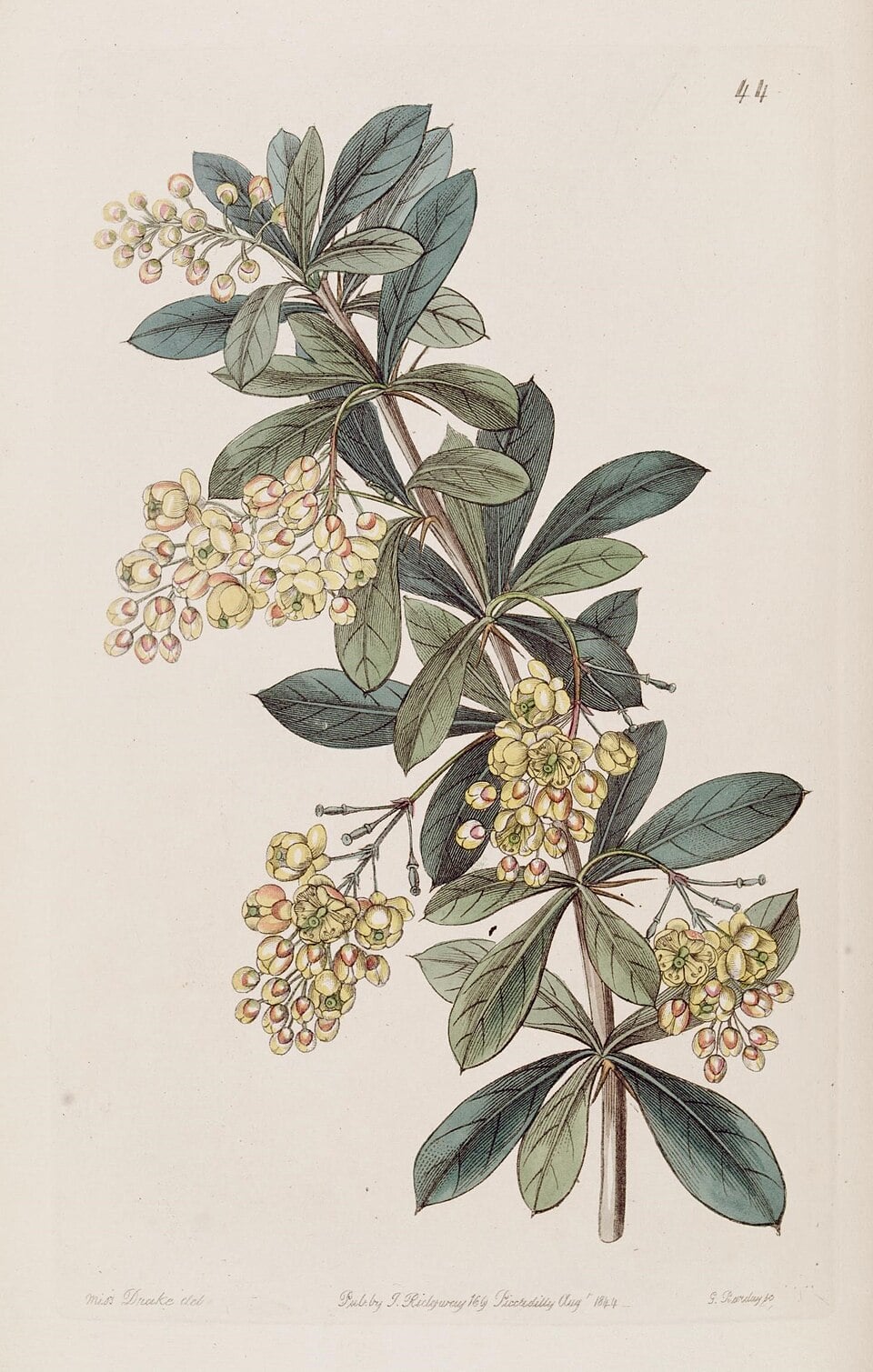
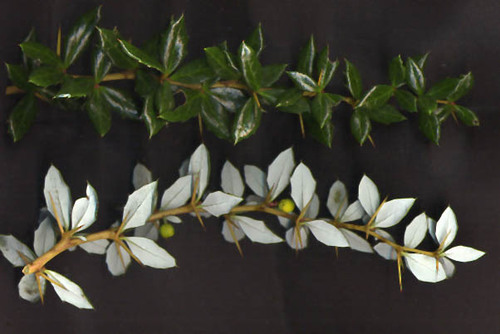
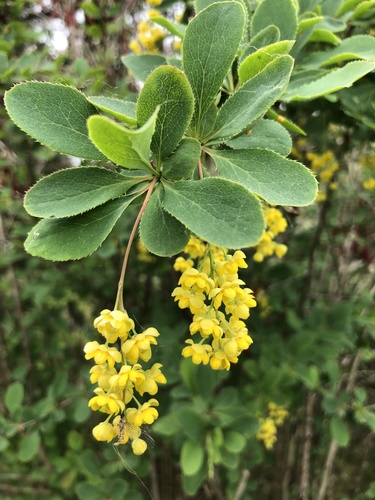
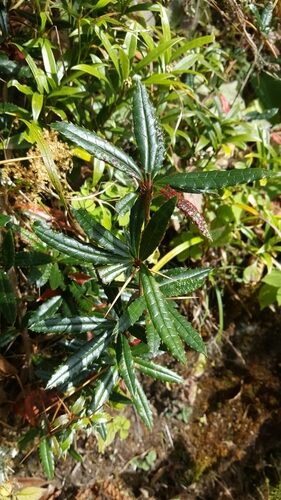
Berberis empetrifolia
Lam.
Fuegian barberry, Crown barberry
iNaturalist· cc-by-nc
(c) Jeff Bisbee, some rights reserved (CC BY-NC), uploaded by Jeff Bisbee
iNaturalist· cc-by-nc
(c) Leandro Ayué, some rights reserved (CC BY-NC), uploaded by Leandro Ayué
iNaturalist· cc-by-nc
(c) orlandomontes, some rights reserved (CC BY-NC), uploaded by orlandomontes
Summary
Source: WikipediaBerberis empetrifolia, sometimes called heath barberry, is a low, somewhat spiny shrub belonging to the barberries in the family Berberidaceae. The local names in Chile are zarcilla, monte negro and uva de la cordillera. It has small narrow entire leaves, and small yolk-colored flowers and later globose blue-black berries. The species is native to south of 30ºS in Argentina and Chile, where it grows on sunny, often gravelly soils, and is sometimes planted as an ornamental elsewhere in temperate climates.
Description
It is an evergreen shrub. It is spreading and almost lies along the ground. It grows to 45 cm high and spreads 60 cm across. There are spines on the branches. The leaves are dark green above and grey underneath. They have spines at their tips. The flowers are deep yellow. They occur singly or in pairs in the axils of the upper leaves. The fruit is black with a blue bloom.
Edible Uses
Edible Parts: Fruit Edible Uses: Fruit - raw or cooked. The fruits are about 7mm long.
Traditional Uses
The fruit pulp is eaten raw.
This uses section is brief — help expand it
Medicinal Uses
Antibacterial Cancer Dysentery Berberine, universally present in rhizomes of Berberis species, has marked antibacterial effects. Since it is not appreciably absorbed by the body, it is used orally in the treatment of various enteric infections, especially bacterial dysentery. It should not be used with Glycyrrhiza species (Liquorice) because this nullifies the effects of the berberine. Berberine has also shown antitumour activity.
Distribution
It is a temperate plant. In Chile it grows from sea level to 2,000 m above sea level. In Argentina it grows to 3,500 m above sea level. It is in humid areas with constant rain. It suits hardiness zones 7-10. It can tolerate frost and snow.
Where It Grows
Argentina, Australia, Central America, Chile, Panama, South America,
Cultivation
Prefers a warm moist loamy soil and light shade but it is by no means fastidious, succeeding in thin, dry and shallow soils. Grows well in heavy clay soils. Plants are hardy to about -15°c. Hybridizes freely with other members of this genus. Plants can be pruned back quite severely, they resprout well from the base.
Propagation
Seed - best sown as soon as it is ripe in a cold frame, when it should germinate in late winter or early spring. Seed from over-ripe fruit will take longer to germinate, whilst stored seed may require cold stratification and should be sown in a cold frame as early in the year as possible. The seedlings are subject to damping off, so should be kept well ventilated. When the seedlings are large enough to handle, prick them out into individual pots and grow them on in a cold frame. If growth is sufficient, it can be possible to plant them out into their permanent positions in the autumn, but generally it is best to leave them in the cold frame for the winter and plant them out in late spring or early summer of the following year. Cuttings of half-ripe wood, July/August in a frame. Pot up in the spring. Cuttings of mature wood of the current season's growth, preferably with a heel, October/November in a frame.
Other Uses
Dye A yellow dye is obtained from the root and bark. Special Uses
Notes
There are about 450-500 Berberis species.
Also Known As
Calafate, Calafatillo, Palo amarillo
References (11)
- Bircher, A. G. & Bircher, W. H., 2000, Encyclopedia of Fruit Trees and Edible Flowering Plants in Egypt and the Subtropics. AUC Press. p 57
- Chamorro, M. F., & Ladio, A., 2020, Native and exotic plants with edible fleshy fruits utilized in Patagonia and their role as sources of local functional foods. BMC Complementary Medicine and Therapies. 20:155
- Cundall, P., (ed.), 2004, Gardening Australia: flora: the gardener's bible. ABC Books. p 229
- Etherington, K., & Imwold, D., (Eds), 2001, Botanica's Trees & Shrubs. The illustrated A-Z of over 8500 trees and shrubs. Random House, Australia. p 124
- Fouqué, A. 1972. Espèces fruitières d'Amérique tropicale. Institut français de recherches fruitierès outre-mer (ifac)
Show all 11 references Hide references
- Hedrick, U.P., 1919, (Ed.), Sturtevant's edible plants of the world. p 98
- Leon-Lobos, P., et al, 2022, Patterns of Traditional and Modern Uses of Wild Edible Native Plants of Chile: Challenges and Future Perspectives. Plants (Basel) v 11 (6) Table S1
- Plants for a Future database, The Field, Penpol, Lostwithiel, Cornwall, PL22 0NG, UK. http://www.scs.leeds.ac.uk/pfaf/
- Tabl. encycl. 1(vol. 2):391, t. 253, fig. 4. 1792
- Velasquez, P. & Montenegro, G., 2017, Chilean Endemic/Native Plant Resources as Functional and Superfoods. Chp. 6 in Superfood and Functional Food - An Overview of Their Processing and Utilization
- www.chileflora.com