Berberis aggregata
C. K. Schneid.
Salmon barberry
iNaturalist· cc-by-sa
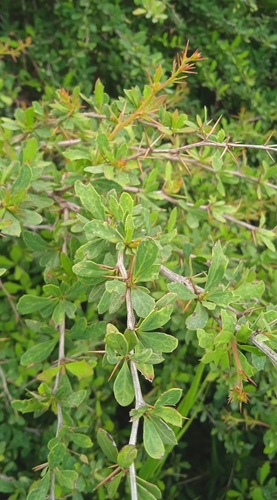
(c) Salicyna, some rights reserved (CC BY-SA)
iNaturalist· cc-by-nc
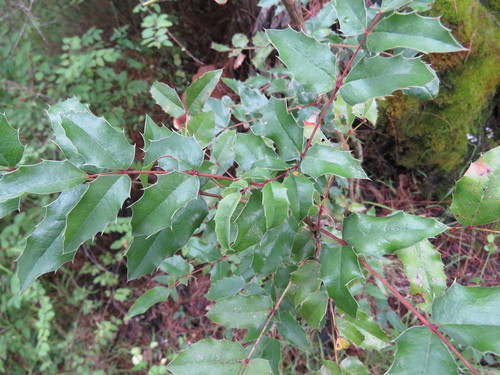
(c) Edita Jakubauskaitė, some rights reserved (CC BY-NC), uploaded by Edita Jakubauskaitė
iNaturalist· cc-by-sa
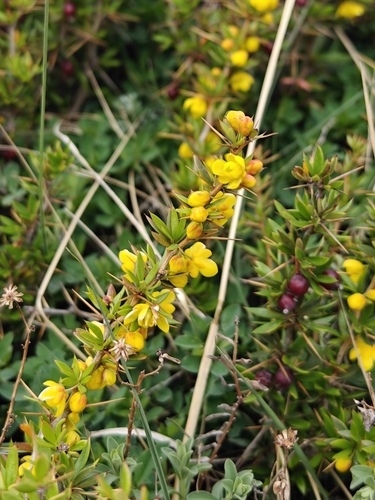
(c) SK53, some rights reserved (CC BY-SA), uploaded by SK53
Summary
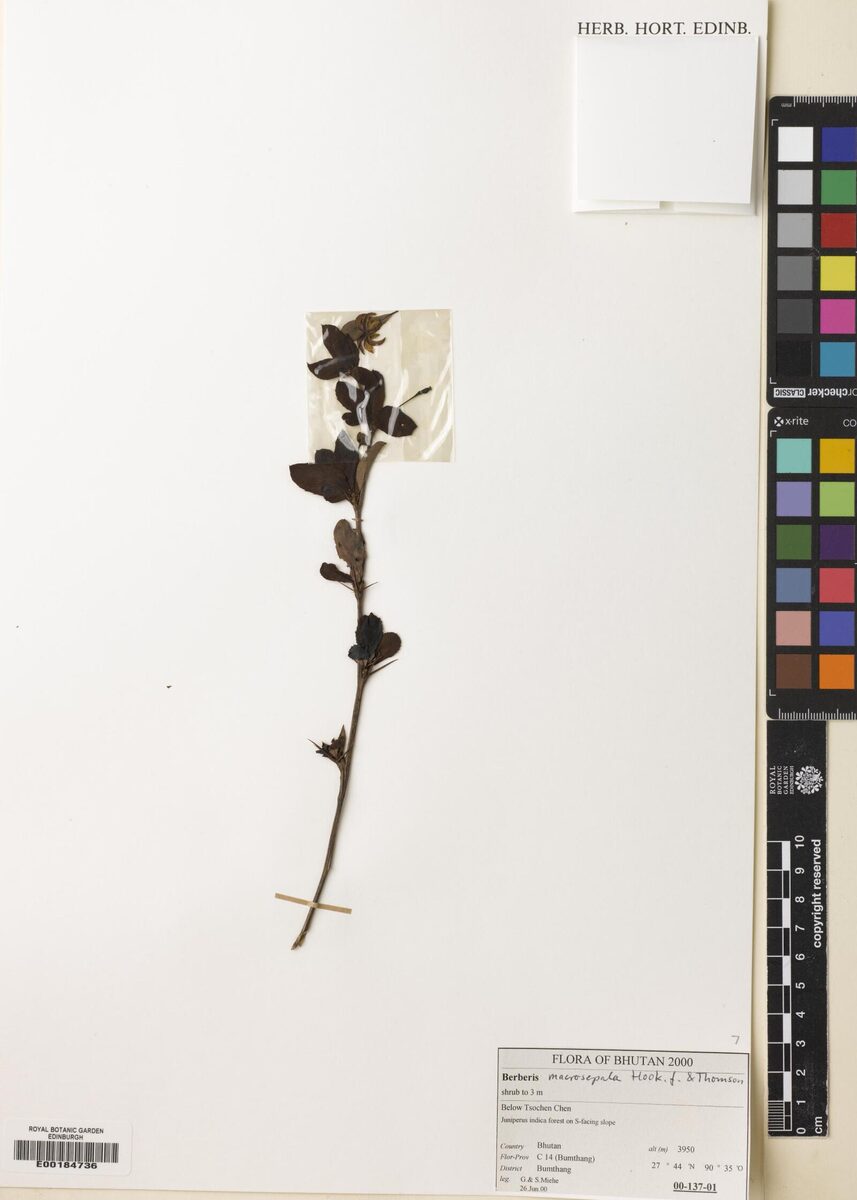
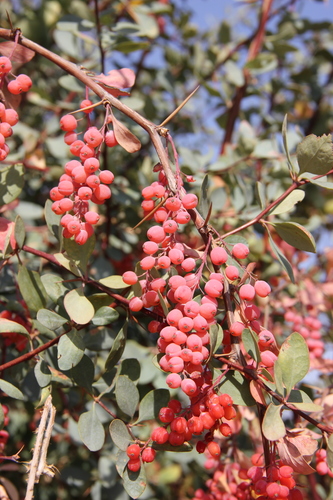
Source: WikipediaBerberis aggregata, the clustered barberry, is a shrub native to western China (Gansu, Hubei, Qinghai, Shanxi, Sichuan). It grows at elevations of 1000–3500 m. Berberis aggregata is a shrub up to 3 m tall with spines along the younger branches. Leaves are ovate, up to 25 mm long, dark green on the upper surface, much lighter underneath. Flowers are borne tightly clustered in a panicle of as many as 25 flowers. Berries are red, spherical, about 7 mm in diameter.
Description
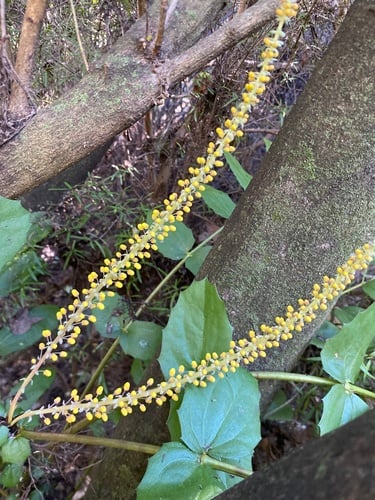
A deciduous shrub. It grows 1.5 m high. It spreads 1.8 m wide. The leaves are oblong. They have teeth at the tip. The leaves are grey-green and 30 mm long. The leaves turn deep red in autumn. The flowers are pale yellow. They are in clusters in the axils of leaves. These are 2.5 cm long. The fruit are red with a grey bloom. They are 6 mm across.
Edible Uses
Edible Parts: Fruit Edible Uses: Fruit - raw or cooked. A fairly acid lemony flavour, it can be eaten in quantity by those who like acid fruits - children seem particularly keen on it. A very reliable cropper, the fruit is abundant along the stems[1, K]. The fruit is about 7mm in diameter.
Traditional Uses
The fruit can be eaten fresh or used in preserves, desserts and sauces.
This uses section is brief — help expand it
Medicinal Uses
Antibacterial Cancer Dysentery Berberine, universally present in rhizomes of Berberis species, has marked antibacterial effects. Since it is not appreciably absorbed by the body, it is used orally in the treatment of various enteric infections, especially bacterial dysentery. It should not be used with Glycyrrhiza species (Liquorice) because this nullifies the effects of the berberine. Berberine has also shown antitumour activity.
Distribution
It is a temperate plant. It can grow in sun or light shade. It is best with moist, well-drained alkaline soil. It is resistant to drought and frost. It suits hardiness zones 6-9. In Sichuan.
Where It Grows
Asia, Australia, China*,
Cultivation
It prefers warm, moist, loamy soil, but it is by no means fastidious, succeeding in thin, dry and shallow soils. Grows well in heavy clay soils. Succeeds in full sun or light shade. Hybridizes freely with other members of this genus, especially the closely related B. wilsonae. The true species is seldom seen in gardens, having been replaced with its hybrid progeny. The seedling 'Sibbertoft Coral' is very closely related to B. aggregata and fruits well in Britain. Plants can be pruned back severely and resprout well from the base. Barberry is a moderately fast-growing plant, often reaching maturity in 3 to 5 years, depending on the species and growing conditions. The berries are typically harvested in late summer to early autumn, when they are ripe. Barberry generally flowers in spring, depending on the species and local climate.
Propagation
Seed - best sown as soon as it is ripe in a cold frame, when it should germinate in late winter or early spring. Seed from over-ripe fruit will take longer to germinate, whilst stored seed may require cold stratification and should be sown in a cold frame as early in the year as possible. The seedlings are subject to damping off, so should be kept well ventilated. When the seedlings are large enough to handle, prick them out into individual pots and grow them on in a cold frame. If growth is sufficient, it can be possible to plant them out into their permanent positions in the autumn, but generally it is best to leave them in the cold frame for the winter and plant them out in late spring or early summer of the following year. Cuttings of half-ripe wood, July/August in a frame. Cuttings of mature wood of the current season's growth, preferably with a heel, October/November in a frame. Layering.
Other Uses
Dye Agroforestry uses: Barberry can be used as a hedge, providing dense foliage that offers shelter for wildlife. Additionally, its deep roots can help stabilize soil. A yellow dye is obtained from the root. 1. Nectary - Flowers rich in nectar and pollen: Yes – Barberry flowers are small but rich in nectar and pollen, attracting bees and other pollinators. 2. Wildlife - Food (Fruit, Seeds, Leaf litter, Shelter, Nesting, Roosting): Yes – Barberry produces edible berries that are a food source for birds and other wildlife. The dense, thorny branches provide good shelter and protection for nesting and roosting birds. 3. Invertebrate Shelter (Overwintering sites, Leaf litter, Groundcover): Yes – The dense structure of Barberry shrubs and their leaf litter can offer overwintering sites and shelter for invertebrates. 4. Pest Confuser (Smell): No – Barberry is not known for emitting a smell that confuses pests. Special Uses Food Forest
Notes
There are about 450-500 Berberis species.
Synonyms
References (6)
- Bodkin, F., 1991, Encyclopedia Botanica. Cornstalk publishing, p 141
- Bull. Herb. Boissier ser. 2, 8:203. 1908
- Etherington, K., & Imwold, D., (Eds), 2001, Botanica's Trees & Shrubs. The illustrated A-Z of over 8500 trees and shrubs. Random House, Australia. p 123
- Lord, E.E., & Willis, J.H., 1999, Shrubs and Trees for Australian gardens. Lothian. p 206
- Lyle, S., 2006, Discovering fruit and nuts. Land Links. p 91
Show all 6 references Hide references
- Plants for a Future database, The Field, Penpol, Lostwithiel, Cornwall, PL22 0NG, UK. http://www.scs.leeds.ac.uk/pfaf/