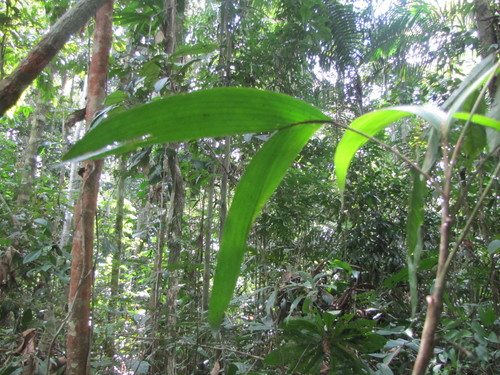
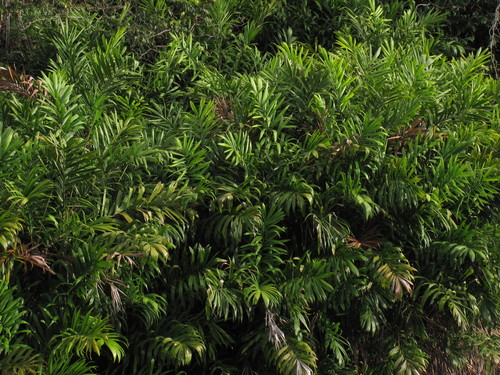
Calamus erectus
Roxb.
Erect rattan
iNaturalist· cc-by-nc
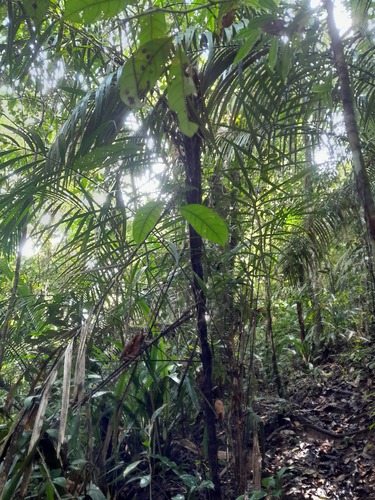
(c) Jungle Man Tshewang, some rights reserved (CC BY-NC), uploaded by Jungle Man Tshewang
iNaturalist· cc-by-nc
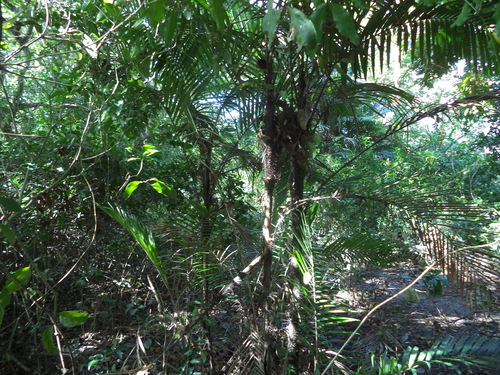
(c) Jungle Man Tshewang, some rights reserved (CC BY-NC), uploaded by Jungle Man Tshewang
iNaturalist· cc-by-nc
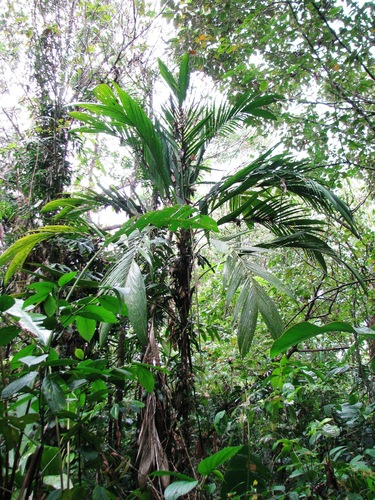
(c) Jungle Man Tshewang, some rights reserved (CC BY-NC), uploaded by Jungle Man Tshewang
Summary
Source: WikipediaCalamus erectus, also known as viagra palm and locally as tynriew, tara, and zhi li sheng teng, is a flowering shrub in the family Arecaceae. The specific epithet (erectus) refers to the plant's habit of growing straight rather than creeping or climbing like many species of the genus Calamus.
Description
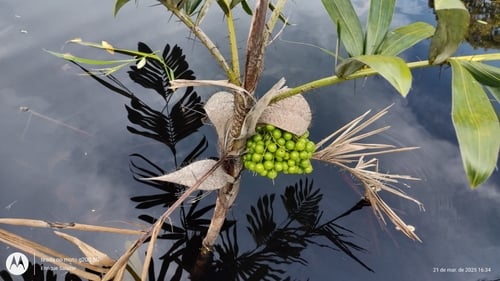
A rattan. It is a large cane. It grows 6 m long and can be 5 cm across. The stem form tufts and are erect and have spines. The spines are flat and straight. The leaves are alternate and divided. The segments taper. The leaflets are spaced at equal distances. The middle ones are 60-80 cm long by 4-5 cm wide. The fruit is oval and has flattened scales. It is 3-5 cm long by 2-3 cm wide.
Edible Uses
The ripe fruit are eaten raw or pickled. The seeds are used as a betel nut substitute. The soft fleshy inner section of young shoots is cooked as a vegetable or used in chutney.
Traditional Uses
The seeds are used as a substitute for betel nut. The ripe fruit are eaten raw. They are also pickled. The soft fleshy inner section of the young shoots is cooked and eaten as a vegetable. It is also used in chutney.
Medicinal Uses
The plant is cultivated experimentally in several locations across India and Bangladesh, and is cultivated in several botanical gardens, especially in the Indian Botanic Garden in Howrah. Although the canes are not useful for making furniture due to the short internodes, the Mising people of the Assam plains used strong canes of Calamus erectus along with split Dendrocalamus bamboo to make huts and used the leaves as thatch. The stems and leaves are also used by them to make poultry houses. In Bangladesh, the seeds are chewed in the place of betel nuts. It is sometimes used in folk medicine, as it is considered to hold antioxidant and anti-diabetic properties. It is offered to the Gods of the Sanamahism religion during the Lunar New Year celebration rituals known as Cheiraoba. The young shoots and leaves are eaten as a vegetable and have a bitter flavor when raw.
Distribution
A tropical plant. In Laos it grows in evergreen forest. It grows between 600-1,600 m altitude. In Yunnan.
Where It Grows
Asia, Bangladesh, Bhutan, China, Himalayas, India, Indochina, Indonesia, Laos, Myanmar, Nepal, Northeastern India, SE Asia, Sikkim, Thailand,
Cultivation
Plants can be grown from seeds.
Propagation
Seed - it has a fairly short viability and is best sown as soon as it is ripe.
Other Uses
The thick stem is not flexible. It is used in construction and in furniture making. The erect and slender stems of certain non-climbing species are used entire and cut into pieces of appropriate length to make handles, rods, walking canes and the like. Their chief merit, apart from their toughness, their elasticity, and the beauty of their surface, lies in the extraordinary length of their internodes, a single one of these being sufficient to make a very elegant walking cane. Collecting and preparing the stems is very simple. The stem is cut near the ground, the most recent growth at the top of the plant is removed and then, handling it from the upper end, the stem is forcibly drawn in the opposite direction between two pieces of wood, thus removing the spiny coverings. The leaves are used for thatching.
Production
In Sikkim fruit are produced in March.
Notes
There are 375-400 Calamus species. There are 175 species in tropical Asia.
Synonyms
Also Known As
Aghawi, Betphal, Bettoni, Chingpi ngeh, Chingpingek, Hrui-phi, Kadam-bet, Khi sian, Phekre, Pre, Raidang bet, Raigongang, Raisok, Rhong, Rotan tegak, Soh-thri, Sokmil, Tara, Tare, Tarea, Tekhra, Thaing-kyein, Theru, Uhdum bizi, Viagra palm, Wai namsay
References (32)
- Ambasta S.P. (Ed.), 2000, The Useful Plants of India. CSIR India. p 95
- Angami, A., et al, 2006, Status and potential of wild edible plants of Arunachal Pradesh. Indian Journal of Traditional Knowledge 5(4) October 2006, pp 541-550
- BARC, 2016, State of Biodiversity for Food and Agriculture in Bangladesh. Bangladesh Agricultural Research Council.
- Chase, P. & Singh, O. P., 2016, Bioresources of Nagaland: A Case of Wild 4 Edible Fruits in Khonoma Village Forest. in J. Purkayastha (ed.), Bioprospecting of Indigenous Bioresources of North-East India. p 50
- Dransfield, J., et al, 2004, A preliminary checklist to Thai Palms. Thai For. Bull. (Bot.) 32:32-72
Show all 32 references Hide references
- Ethnobotany of Karbis. Chapter 4 in p 103
- Evans, T. D., et al, 2002, A Synopsis of the Rattans (Arecaceae: Calamoideae) of Laos and Neighbouring Parts of Indochina. Kew Bulletin, Vol. 57, No. 1 (2002), pp. 1-84
- Gangte, H. E., et al, 2013, Wild Edible Plants used by the Zou Tribe in Manipur, India. International Journal of Scientific and Research Publications, Volume 3, Issue 5
- Gangwar, A. K. & Ramakrishnan, P. S., 1990, Ethnobotanical Notes on Some Tribes of Arunachal Pradesh, Northeastern India. Economic Botany, Vol. 44, No. 1 pp. 94-105
- Ghosh, C. & Das A. P., 2011, Some useful and poisonous tea garden weeds from the Darjiling District of West Bengal, India. Pleione 5(1): 91 - 114
- Guite, C., 2016, A study of wild edible plants associated with the Paite tribe of Manipur, India, International Journal of Current Research. Vol. 8, Issue, 11, pp. 40927-40932
- Jeeva, S., 2009, Horticultural potential of wild edible fruits used by the Khasi tribes of Meghalaya. Journal or Horticulture and Forestry Vol. 1(9) pp. 182-192
- Kar, A., et al, 2013, Wild Edible Plant Resources used by the Mizos of Mizoram, India. Kathmandu University Journal of Science, Engineering and Technology. Vol. 9, No. 1, July, 2013, 106-126
- Majumdar, K and Datta, N., 2009, Traditional wild edible fruits for the forest dwellers of Tripura, India. Pleione 3(2) 167-178
- Medhi, P. & Borthakur, S. K., 2012, Phytoresources from North Cachur Hills of Assam -3: Edible plants sold at Hflong market. Indian Journal of Natural Products and Resources. 3(1) pp 84-109
- Medhi, P., Sarma, A and Borthakur, S. K., 2014, Wild edible plants from the Dima Hasao district of Assam, India. Pleione 8(1): 133-148
- Mozhui, R., et al, 2011, Wild edible fruits used by the tribals of Dimapur district of Nagaland, India. Pleione 5(1): 56 - 64.
- Murtem, G. & Chaudhrey, P., 2016, An ethnobotanical note on wild edible plants of Upper Eastern Himalaya, India. Brazilian Journal of Biological Sciences, 2016, v. 3, no. 5, p. 63-81
- Pandey, Y., Upadhyay, S. & Bhatt, S. S., 2018, Phyto-chemical constituent os some wild edible fruits of Sikkim Himalaya. Journal of Pharmacognosy and Phytochemistry 2018; 7(3): 1045-1047
- Partha, P., 2014, Ethnobotany of the Laleng (Patra) Community in Bangladesh. Journal of Pharmacognosy and Phytochemistry. 2(6):173-184
- Patiri, B. & Borah, A., 2007, Wild Edible Plants of Assam. Geethaki Publishers. p 149
- Sarma, H., et al, 2010, Updated Estimates of Wild Edible and Threatened Plants of Assam: A Meta-analysis. International Journal of Botany 6(4): 414-423
- Savita, et al, 2006, Studies on wild edible plants of ethnic people in east Sikkim. Asian J. of Bio Sci. (2006) Vol. 1 No. 2 : 117-125
- Sawian, J. T., et al, 2007, Wild edible plants of Meghalaya, North-east India. Natural Product Radiance Vol. 6(5): p 414
- Singh, B., et al, 2012, Wild edible plants used by Garo tribes of Nokrek Biosphere Reserve in Meghalaya, India. Indian Journal of Traditional Knowledge. 11(1) pp 166-171
- Singh, V. B., et al, (Ed.) Horticulture for Sustainable Income and Environmental Protection. Vol. 1 p 214
- Sukarya, D. G., (Ed.) 2013, 3,500 Plant Species of the Botanic Gardens of Indonesia. LIPI p 762
- Sundriyal, M., et al, 1998, Wild edibles and other useful plants from the Sikkim Himalaya, India. Oecologia Montana 7:43-54
- Sundriyal, M., et al, 2004, Dietary Use of Wild Plant Resources in the Sikkim Himalaya, India. Economic Botany 58(4) pp 626-638
- Taram, M., et al, 2018, Wild Food Plant Resources of Komkar Adi Tribe of Upper Siang District in Arunachal Pradesh, India. Bulletin of Arunachal Forest Research, Vol. 33(2), 27-35
- Teron, R. & Borthakur, S. K., 2016, Edible Medicines: An Exploration of Medicinal Plants in Dietary Practices of Karbi Tribal Population of Assam, Northeast India. In Mondal, N. & Sen, J.(Ed.) Nutrition and Health among tribal populations of India. p 149
- Uprety, Y., et al, 2016, Traditional use and management of NTFPs in Kangchenjunga Landscape: implications for conservation and livelihoods. Journal of Ethnobiology and Ethnomedicine (2016) 12:19