Beilschmiedia mannii
(Meisn.) Benth. et Hook.f.
Spicy cedar
gbif· cc-by
Royal Botanic Gardens, Kew
gbif· cc-by
Royal Botanic Gardens, Kew
gbif· cc-by
Royal Botanic Gardens, Kew
Description
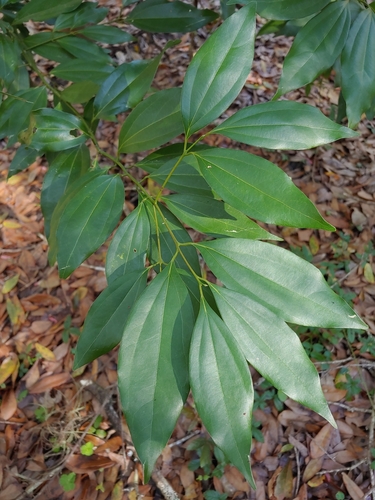
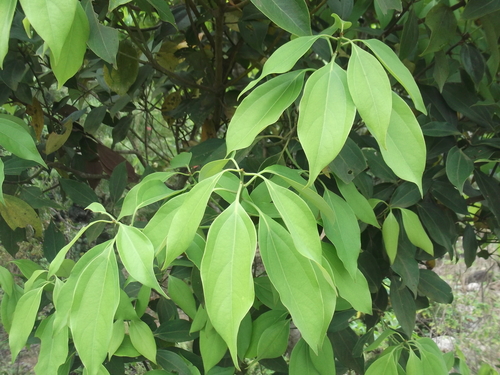
A tree. It grows up to 10-35 m high. The trunk does not have branches for 20 m. The trunk is straight and 100 cm across. There are heavy root swellings near the base. The young branches are hairy. The leaves are 7-26 cm long by 4-10 cm wide. They are simple and alternate almost opposite. The leaves have a smell when crushed. The flowers are in a group 4-15 cm long in the axils of leaves. The flowers are small and green. The fruit is a narrow berry. It is 2-6 cm long by 2-3 cm wide.
Edible Uses
The flowers flavor rice dishes. The unripe fruit is eaten and used in sauces. The seeds are roasted, ground, and eaten in soups and with vegetables, or pressed to yield an edible oil. The leaves are used in soups. Seeds are commonly sold in West African markets.
Traditional Uses
The flowers are used to flavour rice. The fruit is eaten and is used in sauces. The seeds are roasted and ground then eaten. It is added to soups and vegetables. The seeds yield an edible oil. The leaves are used in soup.
Medicinal Uses
The pounded fruits are used to treat coughs, bronchitis, intercostal pain, rheumatism and dysentery. A decoction of the bark and leaves is used as a lotion to treat headache. The bark contains traces of alkaloids, the leaves traces of flavones.
Distribution
A tropical plant. It grows in evergreen forest. It can grow in shade. It sometimes grows in marshy situations. In Nigeria it has been recorded at 1,500 m above sea level.
Where It Grows
Africa, Benin, Cameroon, Central Africa, Central African Republic, CAR, Congo, Côte d'Ivoire, East Africa, Gabon, Ghana, Guinea, Guinée, Guinea-Bissau, Ivory Coast, Liberia, Malawi, Nigeria, Sahara, Sierra Leone, Togo, West Africa,
Cultivation
Plants are grown by seed. Seedlings are transplanted.
Propagation
Seed - A germination rate of about 80% can be expected within 21 - 30 days.
Other Uses
The heartwood is reddish-yellow to red, with a persistent spicy smell, and is distinctly demarcated from the pale yellow or cream-coloured, nearly odourless sapwood. The grain is straight; texture moderately fine. The wood is resistant to fungal and insect attack and durable even in contact with the soil or with fresh water. It is easy to work with all tools and finishes well; glues well. An attractive wood, it can be used as a substitute for mahogany (Swietenia spp.) and bosse (Guarea spp.). It is used for construction, planks, door frames, interior and exterior joinery, furniture, cabinet work, stairs, flooring, vehicle frames, canoes, carpentry, plywood, and other purposes requiring an attractive appearance. The tree is sometimes planted to provide shade for coffee plantations.
Other Information
The seeds are commonly sold in West African markets.
Notes
There are about 100-250 Beilschmeidia species. They are in the tropics.
Synonyms
Also Known As
Bile, Gbonyonnon wien, Gbu-gby nyennoh, Ghoko nisa, Kanda, Moukouzo, Oah, Quenhdeh, Poupouizo, Wollor
References (23)
- Abbiw, D.K., 1990, Useful Plants of Ghana. West African uses of wild and cultivated plants. Intermediate Technology Publications and the Royal Botanic Gardens, Kew. p 46
- Bircher, A. G. & Bircher, W. H., 2000, Encyclopedia of Fruit Trees and Edible Flowering Plants in Egypt and the Subtropics. AUC Press. p 56
- Burkill, H. M., 1985, The useful plants of west tropical Africa, Vol. 3. Kew.
- Busson, 1965,
- Chapman, J. D. & Chapman, H. M., 2001, The Forest Flora of Taraba and Andamawa States, Nigeria. WWF & University of Canterbury. p 180
Show all 23 references Hide references
- Dalziel, J. M., 1937, The Useful plants of west tropical Africa. Crown Agents for the Colonies London.
- Diop, A. l., et al, 2021, Cultural importance of wild edible plants in three sympatric communities: Agni, Akyé and Gwa in the Department of Alépé (Southeast of Côte d’Ivoire). Ethnobotany Research and Applications 22:35. p 6
- Food Composition Tables for use in Africa FAO http://www.fao.org/infoods/directory No. 1036
- INFOODSUpdatedFGU-list.xls
- Grivetti, L. E., 1980, Agricultural development: present and potential role of edible wild plants. Part 2: Sub-Saharan Africa, Report to the Department of State Agency for International Development. p 26
- Hawthorne, W.& Marshall, C., 2013, Nimba Western Area Iron Ore Concentrator Mining Project Environmental and Social Impact Assessment. AcelorMittel Liberia. p 461
- Hwang, L. C., et al, 2020, Traditional Botanical Uses of Non-Timber Forest Products (NTFP) in Seven Counties in Liberia. ACS Symposium Series; American Chemical Society: Washington, DC, 2020.
- Jardin, C., 1970, List of Foods Used In Africa, FAO Nutrition Information Document Series No 2.p 39, 122
- Jusu, A. & Cuni-Sanchez, A., 2017, Priority indigenous fruit trees in the African rainforest zone: insights from Sierra Leone. Genet Resour Crop Evol (2017) 64:745–760
- Keay, R.W.J., 1989, Trees of Nigeria. Clarendon Press, Oxford. p 34
- Manvell, A., 2011, Use of Non-Timber Forest Products around Sapo National Park, Liberia (Report B) p 19
- Menninger, E.A., 1977, Edible Nuts of the World. Horticultural Books. Florida p 10
- Nyunaï, N., 2008. Beilschmiedia mannii (Meisn.) Benth. & Hook.f. [Internet] Record from Protabase. Louppe, D., Oteng-Amoako, A.A. & Brink, M. (Editors). PROTA (Plant Resources of Tropical Africa / Ressources végétales de l’Afrique tropicale), Wageningen, Netherlands. < http://database.prota.org/search.htm>. Accessed 14 October 2009.
- Peters, C. R., O'Brien, E. M., and Drummond, R.B., 1992, Edible Wild plants of Sub-saharan Africa. Kew. p 119
- Seidemann J., 2005, World Spice Plants. Economic Usage, Botany, Taxonomy. Springer. p 64
- Vivien, J., & Faure, J.J., 1996, Fruitiers Sauvages d'Afrique. Especes du Cameroun. CTA p 182
- Wickens, G.E., 1995, Edible Nuts. FAO Non-wood forest products. FAO, Rome. p 138
- World Checklist of Useful Plant Species 2020. Royal Botanic Gardens, Kew