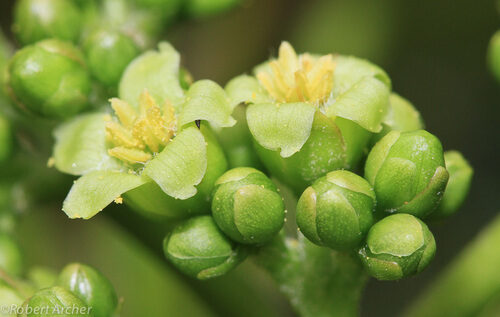
Baliospermum solanifolium
(Burm.) Suresh.
iNaturalist· cc-by-nc
(c) Shiwalee Samant, some rights reserved (CC BY-NC), uploaded by Shiwalee Samant
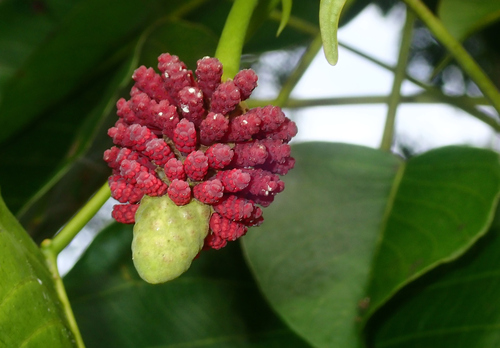
iNaturalist· cc-by-nc
(c) Digwikan Rahmajati, some rights reserved (CC BY-NC)
iNaturalist· cc-by-sa
(c) Dinesh Valke, some rights reserved (CC BY-SA)
Summary
Source: WikipediaBaliospermum solanifolium, synonym Baliospermum montanum, is a plant in the family Euphorbiaceae. It is commonly known as red physic nut, wild castor, wild croton or wild sultan seed. It is a stout undershrub with numerous flowers.
Description
A stout shrub. It is woody and grows 1-2 m high. The stems are fairly stout and have few branches. The leaves vary in shape and size. They are 2-11 cm long by 1-6 cm wide. There can be lobes and teeth around the edge.
Edible Uses
The leaves are cooked and eaten as a vegetable.
Traditional Uses
The leaves are cooked and eaten as a vegetable. CAUTION: They are claimed to cause diarrhoea.
This uses section is brief — help expand it
Medicinal Uses
Compounds isolated from this plant include steroids, triterpenoids, diterpenes, glycosides, saponins, alkaloids, and polyphenols. The stems and leaves had the highest total phenolic content, which can be attributed to the existence of tannins in this plant.
Known Hazards
A popular medicinal herb, Baliospermum solanifolium needs to be used with caution since it is a drastic purgative. In larger doses the seeds are an acro-narcotic poison.
Distribution
A tropical plant. In Pakistan it grows between 600-1,200 m altitude.
Where It Grows
Asia, Bangladesh, Bhutan, Cambodia, China, Himalayas, India, Indochina, Indonesia, Laos, Malaysia, Myanmar, Nepal, Northeastern India, Pakistan, SE Asia, Thailand, Vietnam,
Cultivation
Plants are usually monoecious, but dioecious forms are also found at times.
Notes
It is used in medicine.
Synonyms
Also Known As
Adal-adal, Akar kara nasi, Kasingsat, Maharaja lela, Parok hanthu, Piriya, Pririya, Srintil, Terap kompong, Tongtek ton-di
References (6)
- Ambasta S.P. (Ed.), 2000, The Useful Plants of India. CSIR India. p 66 (As Baliospermum montanum)
- Burkill, I.H., 1966, A Dictionary of the Economic Products of the Malay Peninsula. Ministry of Agriculture and Cooperatives, Kuala Lumpur, Malaysia. Vol 1 (A-H) p 291 (As Baliospermum montanum)
- Murtem, G. & Chaudhrey, P., 2016, An ethnobotanical note on wild edible plants of Upper Eastern Himalaya, India. Brazilian Journal of Biological Sciences, 2016, v. 3, no. 5, p. 63-81 (As Baliospermum montanum)
- Srivastava, R. C., 2010, Traditional knowledge of Nyishi (Daffla) tribe of Arunachal Pradesh. Indian Journal of Traditional Knowledge. 9(1):26-37 (As Baliospermum montanum)
- Teron, R. & Borthakur, S. K., 2016, Edible Medicines: An Exploration of Medicinal Plants in Dietary Practices of Karbi Tribal Population of Assam, Northeast India. In Mondal, N. & Sen, J.(Ed.) Nutrition and Health among tribal populations of India. p 151 (As Baliospermum montanum)
Show all 6 references Hide references
- Thothathri, K., & Pal, G.D., 1987, Further Contribution to the Ethnobotany of Subansiri District, Aranchal Pradesh. J. Econ. Tax. Bot. Vol. 10 No. 1 pp 149-157 (As Baliospermum montanum)