Marsilea minuta
L.
Water clover, Clover fern
iNaturalist· cc-by-nc
(c) Howard Horne, some rights reserved (CC BY-NC), uploaded by Howard Horne
iNaturalist· cc-by-nc-sa
(c) Sarah Kelsey, some rights reserved (CC BY-NC-SA), uploaded by Sarah Kelsey
iNaturalist· cc-by-nc-sa
(c) Sarah Kelsey, some rights reserved (CC BY-NC-SA), uploaded by Sarah Kelsey
Summary
Source: WikipediaMarsilea minuta, or dwarf waterclover is a species of aquatic fern in the family Marsileaceae. It is not to be confused with Marsilea minuta E.Fourn. 1880, which is a synonym for Marsilea vestita. Other common names include gelid waterklawer, small water clover, airy pepperwort, and pepperwort, though the lattermost also applies to plants in the genus Lepidium. In French it is called marsilea à quatre feuilles (literally "four-leafed marsilea") and petite marsilée (literally "little Marsilea"), the latter appearing to be a calque with the Latin botanical name. In Chinese it is 南国田字草 (nan guo tian zi cao), literally "southern field word grass," referencing the similarity of the leaflet shape to the Chinese character for "field." The Koch Rajbongshi people and Garo people call it shusni shak. It is called 'শুশনি শাক' (shushni shak) in Bengali. In parts of India it can be called sunisanakka. In Indonesian it is semanggi (literally "clover"), but this name also applies to Marsilea crenata. In Japanese it is nangokudenjiso and in Thai it is phakwaen. In Malaysian it is tapak itik (literally "duck footprints"). In the Philippines it is kaya-kayapuan (literally "so crowded").
Description
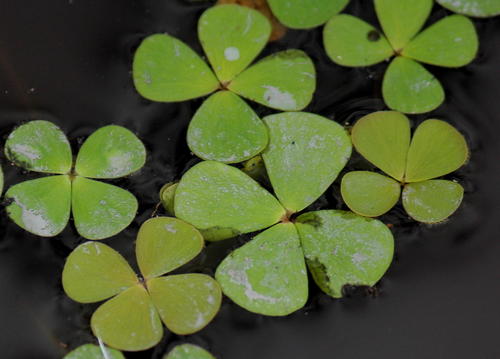
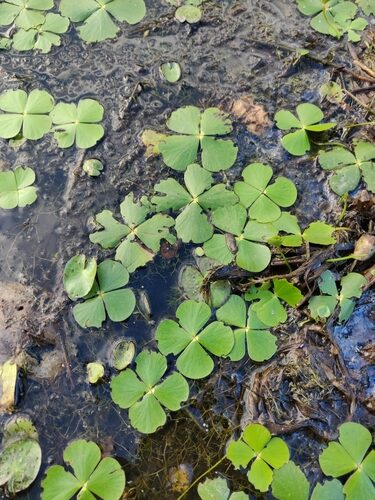
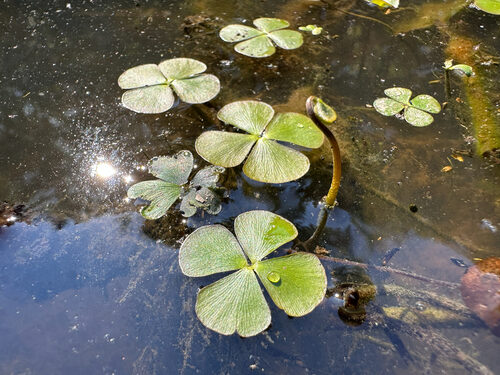
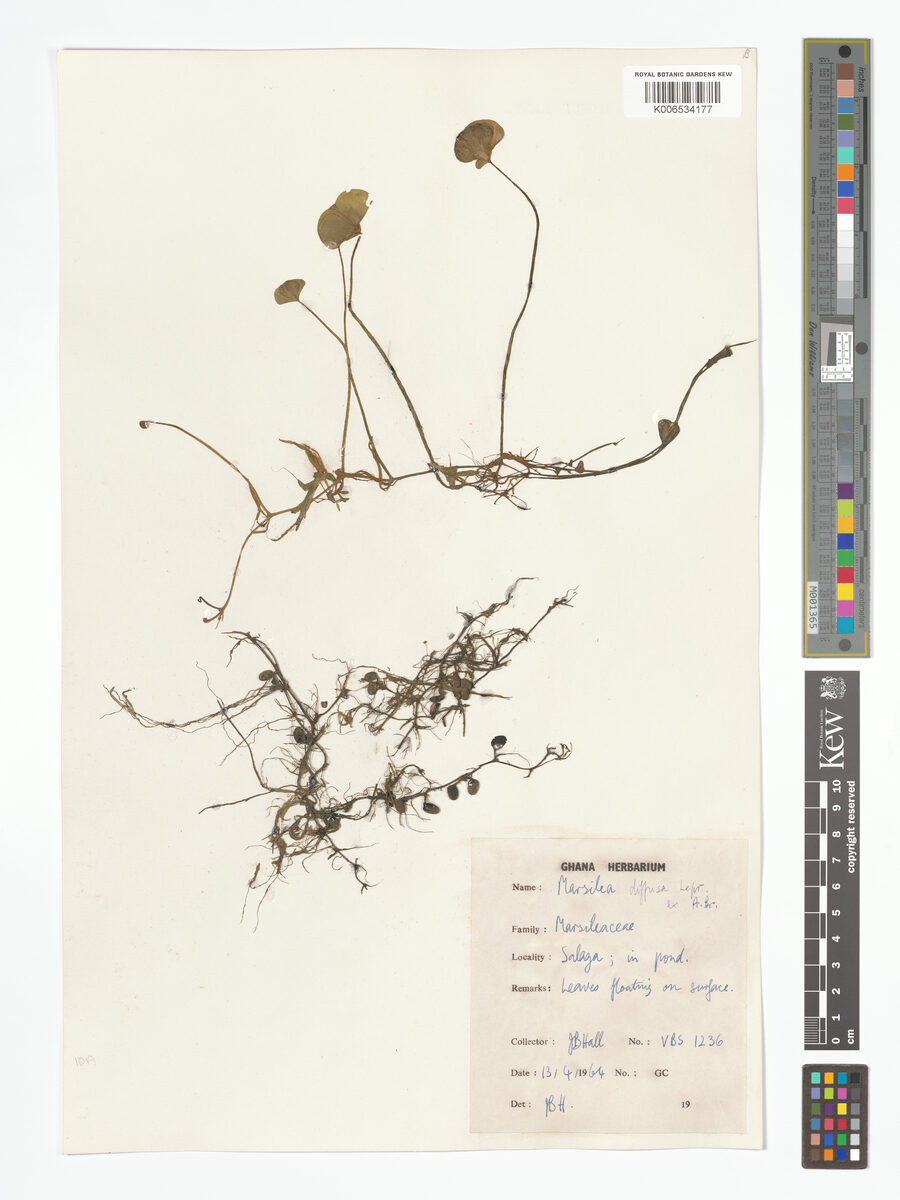
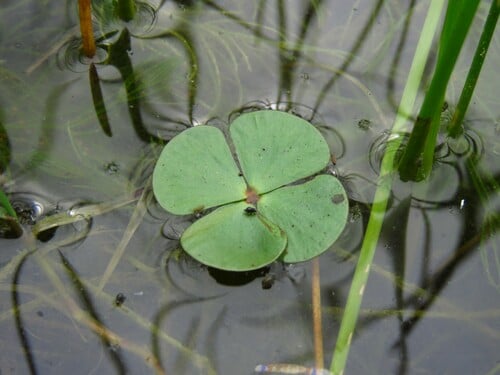
A small fern. It grows in water or damp locations. It has creeping rhizomes. The fronds float. It has four leaflets. These are rounded or delta shaped and 1-2.5 cm long and wide. They are at the top of a slender leaf stalk. It only forms spore bodies in water.
Edible Uses
The very tender stalks and leaves are used as a pot herb, cooked, fried, and sold in markets.
Traditional Uses
The very tender stalks and leaves are used as a pot herb. They are cooked and eaten. They are also fried.
This uses section is brief — help expand it
Medicinal Uses
It is eaten in India, Sri Lanka, and in Bangladesh. In China it is used as forage. It has a raw protein content of 3.3%. The plant is used traditionally in China for edema, skin injuries, snakebite, and inflammation. In Mymensingh District it is traditionally used to treat cough, headache, hypertension, sleep disorders, and respiratory diseases. It is combined with Nardostachys jatamansi and after development by Asima Chatterjee sold as an ayurvedic treatment for epilepsy called Ayush-56. However, Ayush-56 does not show encouraging results in treating the disease. It is also used as a phytoremediator of arsenic while growing with rice plants.
Distribution
A tropical plant. It grows in swamps and stagnant pools. It is rare in Swaziland. In Bangladesh it grows in ditches and rice paddies. It grows in wetlands. In southern China it grows in rice fields and in ditches between 100-1,400 m above sea level.
Where It Grows
Africa, Asia, Bangladesh, Botswana, Brazil, Burkina Faso, Caribbean, China, Comoros, East Africa, Eswatini, Gambia, Guinea, Guinée, Guinea-Bissau, India, Indochina, Laos, Madagascar, Mozambique, Myanmar, Nigeria, Northeastern India, Pakistan, SE Asia, Senegal, South Africa, Southern Africa, Swaziland, Trinidad and Tobago, USA, Vietnam, West Africa,
Cultivation
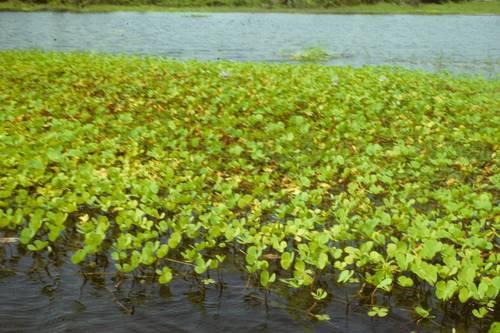
The plant can become a nuisance in wet rice fields, because it forms large and dense colonies.
Other Information
Leaves are sold in markets.
Synonyms
Also Known As
Araikeerai, Chabarchilu, Chatom ara, Chick-lintakura, Chilo, Chitigina soppu, Dhel manimuni, Godhi, Guersel, Ishing-yensang, Kundo arxa, Mudugotamara, Paflu, Pani tengesi, Reu-reua, Sunsunia, Sun-suniya, Sushni, Susni, Susnishak, Tengesi, Tripattra, Zarzuri
References (31)
- Ambasta, S.P. (Ed.), 2000, The Useful Plants of India. CSIR India. p 357
- Azam, F. M. S., et al, 2014, Are Famine Food Plants Also Ethnomedicinal Plants? An Ethnomedicinal Appraisal of Famine Food Plants of Two Districts of Bangladesh. Evidence-Based Complementary and Alternative Medicine Volume 2014, Article ID 741712, 28 pages
- Bandyopadhyay, S. et al, 2009, Wild edible plants of Koch Bihar district, West Bengal. Natural Products Radiance 8(1) 64-72
- Bandyopadhyay, S., et al, 2012, A Census of Wild Edible Plants from Howrah District, West Bengal, India. Proceedings of UGC sponsored National Seminar 2012
- Behera K. K., et al, 2008, Wild Edible Plants of Mayurbhanj District, Orissa, India. J. Econ. Taxon. Bot. Vol. 32 (Suppl.) pp 305-314
Show all 31 references Hide references
- Biswas, K. & Das, A. P., 2011, Documentation of wild leafy vegetables from the tribal dominated parts of Malda District of Paschimbanga, India. Recent Studies in Biodiversity and Traditional Knowledge in India 301 - 306. 2011.
- Chauhan, S. H., et al, 2018, Consumption patterns of wild edibles by the Vasavas: a case study from Gujarat, India. Journal of Ethnobiology and Ethnomedicine (2018) 14:5
- Chowdhury, A. & Das, A. P., 2014, Conservation through sustainable utilization of wetland leafy vegetables of Terai and Duars, West Bengal, India. International Journal of Advanced Life Sciences (IJALS), 7(4) p 655
- Chowdhury, M. & Mukherjee, R., 2012, Wild Edible Plants Consumed by Local Communities of Maldah of West Bengal, India. Indian J.Sci.Res.3(2) : 163-170
- Grubben, G. J. H. and Denton, O. A. (eds), 2004, Plant Resources of Tropical Africa 2. Vegetables. PROTA, Wageningen, Netherlands. p 379
- Gul, A., et al, 2016, Traditional, medicinal and food uses of Pteridophytes of district Mansehra (Pakistan) and their some adjacent areas. International Journal of Biosciences Vol. 9, No. 5 p. 116-133
- Hossain, U. & Rahman, A., 2018, Study and quantitative analysis of wild vegetable floral diversity available in Barisal district, Bangladesh. Asian J. Med. Biol. Res. 2018, 4 (4), 362-371
- Islam, M., 1983, Utilisation of Certain Ferns and Fern Allies in the North-Eastern Region, India. J.Econ. Tax. Bot. Vol.4.No.3 pp 861-
- Jain et al, 2011, Dietary Use and Conservation Concern of Edible Wetland Plants at Indo-Burma Hotspot: A Case Study from Northeast India. Journal of Ethnobiology and Ethnomedicine 7:29 p 6
- Kumar, R. & Saikia, P., 2020, Wild edible plants of Jharkhand and their utilitarian perspectives. Indian Journal of Traditional Knowledge Vol 19 (2), April 2020, pp 237-250
- Mant. pl. 2:308. 1771
- Marandi, R. R. & Britto, S. J., 2015, Medicinal Properties of Edible Weeds of Crop Fields and Wild plants Eaten by Oraon Tribals of Latehar District, Jharkhand. International Journal of Life Science and Pharma Research. Vo. 5. (2) April 2015
- Maroyi, A., 2014, Not just minor wild edible forest products: consumption of pteridophytes in sub-Saharan Africa. Journal of Ethnobiology and Ethnomedicine. 10:78
- Mishra, N., et al, 2016, Indigenous knowledge in utilization of wetland plants in Bhadrak district, Odisha, India. Indian Journal of Natural Products and Resources. Vol. 7(1) pp. 82-89
- Pagag, K. & Borthakur, S.K., 2012, Wild edible wetland plants from Lakhimpur district of Assam, India. Pleione 6(2): 322 - 327
- Patiri, B. & Borah, A., 2007, Wild Edible Plants of Assam. Geethaki Publishers. p 163
- Sakar, A. & Das, A. P., 2018, The traditional knowledge on edible wild leafy vegetables of Rabha Tribe in Duars of North Bengal: a potential reinforcement to food security. Pleione 12(2): 275 - 281. 2018.
- Sarker, S. K., & Enayet Hossain, A. B. M., 2009, Pteridophytes of Greater Mymensingh District of Bangladesh used as Vegetables and Medicines. Bangladesh J. Plant Taxon. 16(1) 47-56. p 52
- Setshogo, M. P., 2005, Preliminary checklist of the plants of Botswana. Southern African Botanical Diversity Network Report No. 37. SABONET, Pretoria and Gaborone.
- Sharma, B.D., & Lakshminarasimhan, P., 1986, Ethnobotanical Studies on the Tribals of Nasik District (Maharashtra). J. Econ. Tax. Bot. Vol. 8 No. 2 pp 439-446
- Singh, G. & Kumar, J., 2014, Studies on Indigenous Traditional Knowledge of some Aquatic and Marshy Wild Edible Plants used by the Munda Tribe of District Khunti, Jharkhand, India. International Journal of Bioassays. 3(2), 1738-1743
- Sinha, R. & Lakra, V., 2007, Edible weeds of tribals in Jharkhand, Orissa and West Bengal. Indian Journal of Traditional Knowledge 6(1) January 2007 pp 217-222
- Swapna, M. M. et al, 2011, A review on the medicinal and edible aspects of aquatic and wetland plants of India. J. Med. Plants Res. 5 (33) pp. 7163-7176
- Swaziland's Flora Database http://www.sntc.org.sz/flora
- World Checklist of Useful Plant Species 2020. Royal Botanic Gardens, Kew
- www.eFloras.org Flora of China