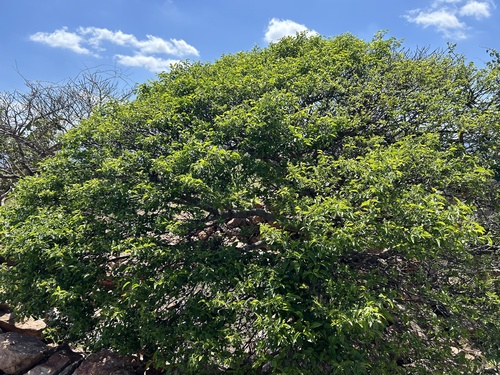
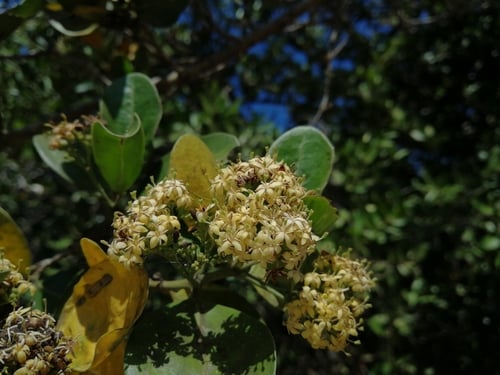
Borreria articularis
(L. f.) F. N. Williams
Shaggy button weed
wikimedia· cc-by-sa
Wikimedia Commons - UPLB MNH Digital Archives
wikimedia· cc-by-sa
Wikimedia Commons - UPLB MNH Digital Archives
Description
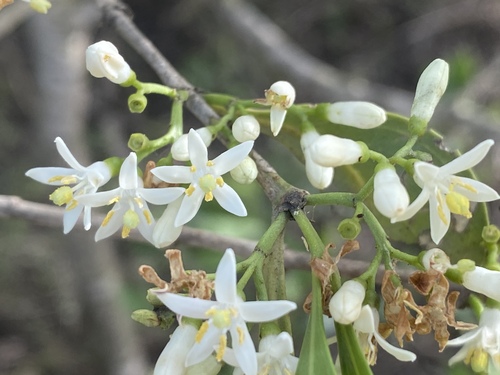
A herb. It keeps growing from year to year. It can be erect or lie over. The stems are woody at the base. The stems are angled and have hairs. The leaves are 2-3 cm long by about 1 cm wide. They are sword shaped. The flowers are pink, blue or violet. The fruit is a capsule 3 mm long. The seeds are brown. They are 3 mm long by 1 mm wide.
Edible Uses
The seeds are used as a coffee substitute. The leaves are traditionally boiled with spices or stir-fried in oil and eaten as a famine food. Roots are used to make tea.
Traditional Uses
The seeds are used as a substitute for coffee. The leaves are used as a famine food. They are boiled with spices or stir-fried in oil.
This uses section is brief — help expand it
Medicinal Uses
No medicinal uses mentioned in available data.
Known Hazards
No hazards mentioned in available data.
Distribution
It is a tropical plant. It grows in open sandy places.
Where It Grows
Asia, Australia, Bangladesh, China, East Africa, Himalayas, India, Indonesia, Madagascar, Malaysia, Nauritiusm Myanmar, Pakistan, SE Asia, Singapore, Sri Lanka, Taiwan, Vietnam,
Notes
There are about 150 Borreria species. There is confusion over the name between Borreria and Spermacoce with several different authorities.
Synonyms
Also Known As
Bulu lutung, Ganthi, Ganthiu, Gempur watu, Ghatuiaghass, Kertas watu, Ketumbit okar, Kharsatshankhlo, Rumput sumpu, Rumput susur
References (14)
- Ambasta, S.P. (Ed.), 2000, The Useful Plants of India. CSIR India. p 78 (As Borreria articularis)
- Bircher, A. G. & Bircher, W. H., 2000, Encyclopedia of Fruit Trees and Edible Flowering Plants in Egypt and the Subtropics. AUC Press. p 61 (As Borreria articularis)
- Bull. Herb. Boissier ser. 2, 5:956. 1905 (As Borreria articularis)
- Burkill, I.H., 1966, A Dictionary of the Economic Products of the Malay Peninsula. Ministry of Agriculture and Cooperatives, Kuala Lumpur, Malaysia. Vol 1 (A-H) p 356 (As Borreria articularis)
- Chauhan, S. H., et al, 2018, Consumption patterns of wild edibles by the Vasavas: a case study from Gujarat, India. Journal of Ethnobiology and Ethnomedicine (2018) 14:57
Show all 14 references Hide references
- Dobriyal, M. J. R. & Dobriyal, R., 2014, Non Wood Forest Produce an Option for Ethnic Food and Nutritional Security in India. Int. J. of Usuf. Mngt. 15(1):17-37 (As Borreria articularis)
- Flora of Pakistan. www.eFloras.org (As Borreria articularis)
- Kumar, R. & Saikia, P., 2020, Wild edible plants of Jharkhand and their utilitarian perspectives. Indian Journal of Traditional Knowledge Vol 19 (2), April 2020, pp 237-250 (As Spermacoce articularis)
- Martin, F.W. & Ruberte, R.M., 1979, Edible Leaves of the Tropics. Antillian College Press, Mayaguez, Puerto Rico. p 217 (As Spermacoce hispida)
- Shah, G.L. et al, 1981, An account of the Ethnobotany of Saurashtra in Gujarat State (India). J. Econ. Tax. Bot. Vol 2 pp 173-182 (As Borreria articularis)
- Singh, H.B., Arora R.K.,1978, Wild edible Plants of India. Indian Council of Agricultural Research, New Delhi. p 84 (As Borreria hispida)
- WATT (As Borreria articularis)
- WATT, (As Spermacoce hispida)
- Wild edible plants of Himachal Pradesh (As Borreria articularis)