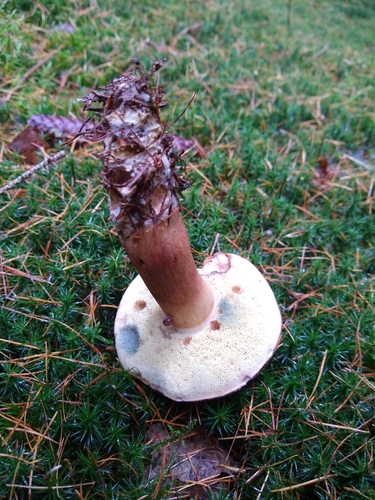
Boletus pinophilus var. fuscoruber
(Forqu. ap. Quel.) Cetto
Rosso
iNaturalist· cc-by-nc
(c) Tatyana Zarubo, some rights reserved (CC BY-NC), uploaded by Tatyana Zarubo
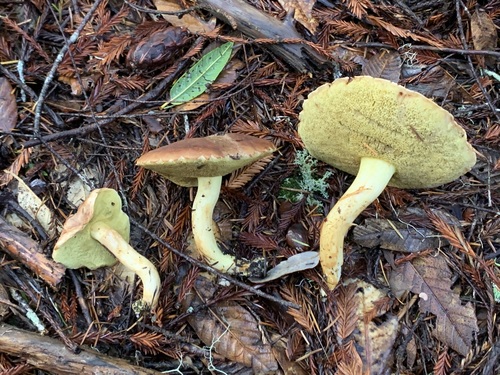
iNaturalist· cc-by
(c) Alan Rockefeller, some rights reserved (CC BY), uploaded by Alan Rockefeller
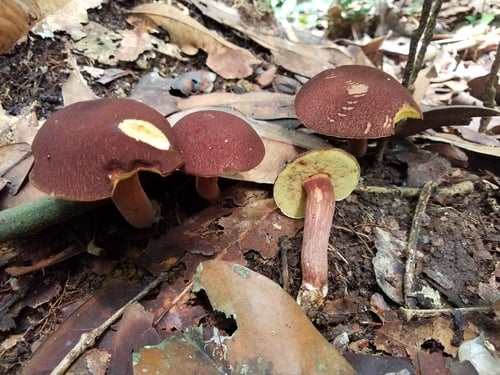
iNaturalist· cc-by-nc
(c) Kari Pihlaviita, some rights reserved (CC BY-NC)
Summary
Source: WikipediaBoletus pinophilus, commonly known as the pine bolete or pinewood king bolete, is a basidiomycete fungus of the genus Boletus. Described by Italian naturalist Carlo Vittadini in 1835, B. pinophilus was for many years considered a subspecies or form of the porcini mushroom B. edulis before genetic studies confirmed its distinct status. In 2008, B. pinophilus in western North America were reclassified as a new species, B. rex-veris. The fungus produces spore-bearing fruit bodies (i.e. mushrooms) above ground under pine trees in summer and autumn. It has a red-brown to maroon-coloured cap and a large and bulbous stipe, covered with coarse orange-red reticulation. As with other boletes, the size of the fruiting body is variable. The fungus is found throughout Europe and western Asia. It grows predominantly in coniferous forests on sandy soil, forming ectomycorrhizal associations in symbiosis with living trees by enveloping the tree's underground roots with sheaths of fungal tissue. Host trees include various species of pine, the European silver fir and European spruce, as well as deciduous trees such as chestnut trees, oak and beech. B. pinophilus is edible, and may be preserved and cooked.
Description
A mushroom. It grows near Abies and Picea trees.
This description is brief — help expand it
Edible Uses
Boletus pinophilus is edible and may be used fresh, preserved, dried and cooked in a manner similar to that of other edible boletes. It is highly regarded and can be quite expensive in central Mexico, and is often sold dried there. The flesh is white, soft in mature specimens and does not change colour upon bruising. The taste and smell is pleasant. People of La Malinche have likened the flavour to pork and pork crackling. It is easily misidentified as the porcini B. edulis, due to the similar habitat and appearance. It is a highly regarded food item, especially across the southern European regions of Portugal, the Basque Country and Navarre in Spain, France, Italy, Bulgaria and Serbia. In the vicinity of Borgotaro in the Province of Parma of northern Italy, the four species B. edulis, B. aereus, B. reticulatus, and B. pinophilus have been recognised for their superior taste and officially termed Fungo di Borgotaro. Here, these mushrooms have been collected and exported commercially for centuries. It is a commonly eaten mushroom in Turkey, especially in the Marmara and Western Black Sea regions, and is exported to Europe. It is sold commercially in Finland. Fresh mushrooms are up to 90% water, and rich in carbohydrates. Unsaturated alcohols are a major component of the aroma of porcini mushrooms; 1-Octen-3-ol, 2-octen-1-ol, 3-Octanone, (E)-2-octenal, oct-1-en-3-one and 1,7,7-trimethyl-heptan-2-one, 2-propenoic acid and 1,3-octadiene are the main volatile compounds in B. pinophilus. B. pinophilus is known to be a bioaccumulator of the heavy metals mercury, cadmium and selenium. To reduce exposure, authorities recommend avoiding mushrooms from polluted areas such as those near mines, smelters, roadways, incinerators and disposal sites. Furthermore, pores should be removed as they contain the highest concentrations of pollutants.
Traditional Uses
The fruiting body is used in salads, roasted, fried, stewed and in sauces and pickled in oil.
This uses section is brief — help expand it
Distribution
It is a temperate plant.
Where It Grows
Britain, Europe, Finland, France, Italy, Mediterranean,
Synonyms
References (1)
- Pieroni, A., 1999, Gathered wild food plants in the Upper Valley of the Serchio River (Garfagnana), Central Italy. Economic Botany 53(3) pp 327-341