Phyllostachys bambusoides
Siebold & Zucc.
Giant timber bamboo, Japanese timber bamboo
iNaturalist· cc-by
(c) Lyrae, some rights reserved (CC BY)
iNaturalist· cc-by
(c) Lyrae, some rights reserved (CC BY)
iNaturalist· cc-by
(c) Lyrae, some rights reserved (CC BY)
Summary
Source: WikipediaPhyllostachys bambusoides, commonly called madake, giant timber bamboo, or Japanese timber bamboo, is a species of flowering plant in the bamboo subfamily of the grass family Poaceae, native to China, and possibly also to Japan.
Description
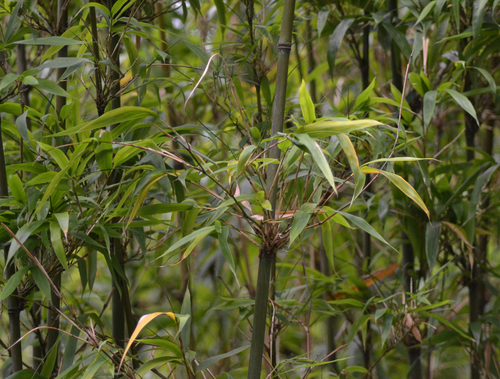
A bamboo. It grows up to 30 m tall. The culms can be 20 cm across. They are glossy dark green. The leaves are 9-20 cm long by 2-4.5 cm wide. The shoots are 45-48 cm long and 2-3 cm wide.
Edible Uses
The young shoots are cooked as a vegetable, harvested in spring when about 8cm above ground and cut around 5cm below soil level. They are large but noticeably acrid when raw and require boiling in a generous amount of water or in several changes of water. The shoots contain approximately 2.1% protein, 0.3% fat, 3.2% carbohydrate, and 0.9% ash.
Traditional Uses
The young shoots are eaten as a vegetable. They need to be cooked in several changes of water to remove bitterness. They are also used for pickles.
This uses section is brief — help expand it
Medicinal Uses
The leaves have antipyretic properties. New shoots are used in the treatment of haematuria.
Distribution
It is a temperate to subtropical plant. It suits hardiness zones 7-11. It can tolerate temperatures down to -15°C.
Where It Grows
Asia, Australia, Caribbean, China*, India, Indochina, Japan, Korea, New Zealand, Northeastern India, SE Asia, USA, Vietnam,
Cultivation
Requires a rich loamy soil and plenty of moisture in the growing season plus a sheltered position. A very hardy plant, tolerating temperatures down to about -18°c, but it dislikes prolonged exposure to hard frosts. Plants can reach 25 metres in height in their native habitat, they are much smaller in Britain but, even so, a height of 12 metres has been recorded in Cornwall. Cultivated for its edible shoots in China, it is the most widely grown bamboo in Japan for its useful canes. It has been widely planted for ornament in the Mediterranean and is becoming naturalized there. There are some named forms selected for their ornamental value. 'Castillon' has smaller culms than the species type, the edible shoots are less bitter. A plant of this cultivar at Trebah gardens in Cornwall was growing well in woodland shade, it was 5 metres tall with canes 20mm in diameter. This is a good companion species to grow in a woodland because the plants are shallow rooted and do not compete with deep rooted trees. The rootstock is running but not aggressively so, especially in the cooler climate of Britain. New shoots are produced from late May. Individual stems can be long lived, staying leafy for up to 20 years. This species is notably resistant to honey fungus. Plants only flower at intervals of several years, viable seed is usually produced. When they do come into flower most of the plants energies are directed into producing seed and consequently the plant is severely weakened. They usually die after flowering, but if left alone they will sometimes recover though they will look very poorly for a few years. If fed with artificial NPK fertilizers at this time the plants are more likely to die.
Propagation
Surface sow fresh seed in a greenhouse at around 20°C, keeping the compost consistently moist. Germination is usually fairly quick with good-quality seed, though it may take 3–6 months. Grow seedlings in light shade under glass until large enough to plant out. Seed is rarely available. Divide clumps in spring as new growth begins — divisions from open ground transplant poorly and should be potted and kept under cover until at least late spring. Carry out division during wet weather; small divisions establish more reliably than large clumps. Alternatively, large divisions can be lifted and moved directly to their permanent positions if misted or drenched frequently until established. Basal cane cuttings can also be taken in spring.
Other Uses
The plant's extensive root system makes it useful for erosion control and soil stabilization. The stems are used for furniture, plant supports, and similar items. The canes, which are fairly thick-walled, are considered the most versatile in the genus and are used in construction and various industrial applications. Splints from the stems are good for weaving bamboo articles, and even dead culms remain durable.
Production
The plant grows for over 120 years before flowering.
Other Information
It is a cultivated food plant.
Notes
It is an important timber species.
Synonyms
Also Known As
Castillon bamboo, Hardy timber bamboo, Madake, Osmanthus bamboo, Wah mi, Wangdae
References (19)
- Abh. Math.-Phys. Cl. Koenigl. Bayer. Akad. Wiss. 3(3):746, t. 5, fig. 3. 1843
- Ambasta, S.P. (Ed.), 2000, The Useful Plants of India. CSIR India. p 452
- Arora, R. K., 2014, Diversity in Underutilized Plant Species - An Asia-Pacific Perspective. Bioversity International. p 43
- Crawford, P, 1997, Bamboos, 2nd edition.
- Crawford, M., 2012, How to grow Perennial Vegetables. Green Books. p 75
Show all 19 references Hide references
- Cundall, P., (ed.), 2004, Gardening Australia: flora: the gardener's bible. ABC Books. p 1036
- Engel, D.H., & Phummai, S., 2000, A Field Guide to Tropical Plants of Asia. Timber Press. p 87
- Facciola, S., 1998, Cornucopia 2: a Source Book of Edible Plants. Kampong Publications, p 46
- Hibbert, M., 2002, The Aussie Plant Finder 2002, Florilegium. p 232
- http://www.plantnames.unimelb.edu.au/sorting/Bamboos_Edible.html
- Hu, Shiu-ying, 2005, Food Plants of China. The Chinese University Press. p 294
- Kermath, B. M., et al, 2014, Food Plants in the Americas: A survey of the domesticated, cultivated and wild plants used for Human food in North, Central and South America and the Caribbean. On line draft. p 647
- Levy-Yamamori, R., & Taaffe, G., 2004, Garden Plants of Japan. Timber Press. p 367
- Lungphi, P., Wangpan, T. & Tangjang, S., 2018, Wild edible plants and their additional uses by the Tangsa community living in the Changlang district of Arunachal Pradesh, India. Pleione 12(2): 151 - 164. 2018.
- Ryan, S., 2008, Dicksonia. Rare Plants Manual. Hyland House. p 85
- Song, M., et al, 2013, Traditional knowledge of wild edible plants in Jeju Island, Korea. Indian Journal of Traditional Knowledge. 12(2) pp 177-194
- Valder, P., 1999, The Garden Plants of China. Florilegium. p 98
- Wiersema, J. H. & Leon, B., 2013, World Economic Plants. A Standard Reference CRC Press. 2nd Ed. p 522
- Yang, Y., et al, A review of bamboo resources in Yunnan, China www.bioversityinternational.org