Barbarea orthoceras
Ledebour
American yellowrocket, Garden Yellowrocket
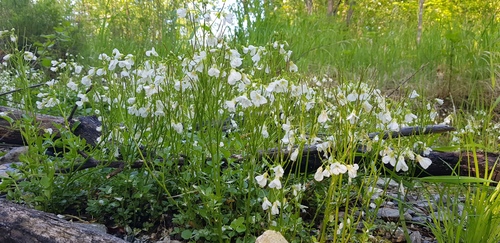
iNaturalist· cc-by-nc
(c) Ryan Andrews, some rights reserved (CC BY-NC), uploaded by Ryan Andrews
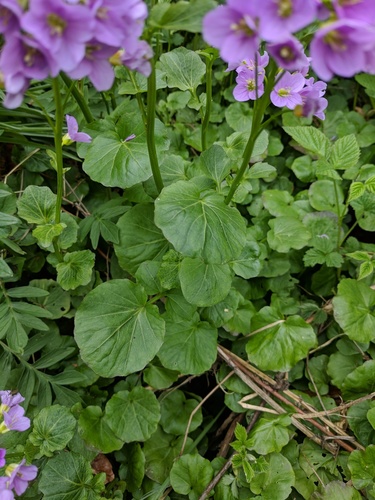
iNaturalist· cc-by-nc
(c) Peter Zika, some rights reserved (CC BY-NC), uploaded by Peter Zika
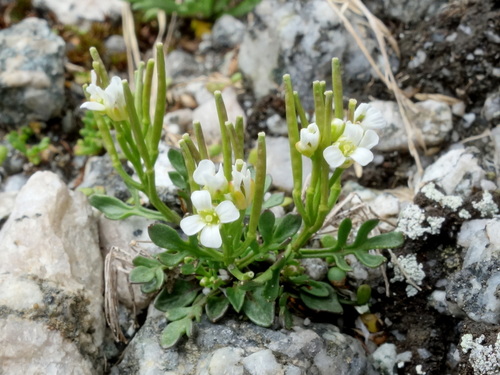
iNaturalist· cc-by
(c) Andrey Zharkikh, some rights reserved (CC BY)
Summary
Source: WikipediaBarbarea orthoceras is a species of flowering plant in the family Brassicaceae known by the common name American yellowrocket. It is native to North America, including much of Canada and the western United States, as well as parts of Asia. It grows in moist areas such as meadows and riverbanks. This is a perennial herb producing a stiff, branching stem to heights between 10 and 60 centimeters. The leaves are a few centimeters long and generally oval in shape with several rounded lobes toward the end. The inflorescence is a spike or cluster of bright yellow flowers at the tip of each stem branch. The fruit is a straight, narrow silique up to 5 centimeters long. The leaves can be eaten raw or cooked, and the roots can have a horseradish-like flavor.
Description
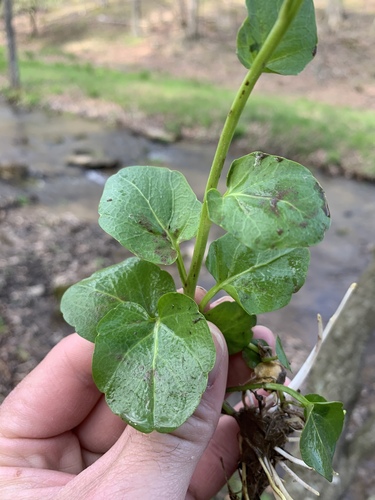
A cabbage family herb. It grows up to 60 cm tall. It takes 2 years to complete its life cycle. The stems are simple and unbranched. The leaves near the base have 2-4 small lobes and one large lobe. The leaves on the stem are alternate. The flowers are small and have 4 yellow petals. The flowers are in clusters in the axils of the upper leaves. The fruit is a narrow pod p to 5 cm long.
Edible Uses
Edible Parts: Leaves Edible Uses: A reliable native spring green for cool mountains and meadows—best before flower. Ecologically useful and culinarily decent with simple blanch-and-sauté prep. Best parts: young rosette leaves and tight buds (cooked). Quality window: pre-bolt. Rating: 3/5.Young leaves - raw or cooked. The rosettes of the dark green, shiny leaves are eaten raw or cooked . A hot, cress-like flavour. Young leaves and pre-bloom shoots/bud clusters are edible (fresh in small amounts; best cooked). Roots and mature stems are fibrous/pungent and not valued. Edibility rating: 3/5 (good spring green when treated like raab; quality drops fast after bolting) [2-3]. aste, Processing & Kitchen Notes: Flavor is mustardy-peppery with less pungency than many wild mustards when harvested young. Blanch 30–60 s then sauté, or boil 2–3 min and dress with fat/acid. Broth becomes yellow-green and pleasantly savory. Older leaves get sharp/alkaline; avoid. Tight buds can be stir-fried like broccoli raab [2-3]. Harvest & Processing Workflow: 1. Identify clean rosettes; harvest young leaves & tight buds 2. Rinse, then blanch or quick-boil; save the savory broth for soup. 3. Use as raab/greens; avoid older, tough, bitter foliage.Cultivar/Selection Notes: None widely offered; use local/native seed if gardening for habitat. Look-Alikes & Confusion Risks: Other yellow mustards (e.g., Rorippa, Descurainia, Sinapis) and watercress/bittercress (Nasturtium, Cardamine). Confirm smooth stems, clasping lobed upper leaves, and appressed angular siliques with very short beak. Traditional/Indigenous Use Summary: Specific recorded food uses are sparse; as a native “mustard,” young leaves likely served as spring potherbs where available.
Traditional Uses
The young leaves in early spring are picked and eaten as a mixed salad. They can also be cooked and eaten as a green vegetable.
This uses section is brief — help expand it
Medicinal Uses
None known
Known Hazards
As with brassicas generally, contains glucosinolates/goitrogens—moderation advised for those with thyroid concerns; cooking reduces sharpness. Avoid roadside/ag-edge contamination.
Distribution
It is a cold temperate plant. It grows in open grasslands, scree, temperate mixed forests, river and stream-sides, moist grassy slopes between 400–2100 m altitude in China.
Where It Grows
Alaska, Asia, China, Europe, Germany, Italy, Japan, Korea, Mediterranean, Mongolia, Netherlands, North America, Russia, Slovenia, Taiwan, USA,
Cultivation
Cool-season plant preferring full sun to bright partial, moist, well-drained loams with consistent spring moisture; tolerates neutral to slightly alkaline soils. Size & Landscape Performance: Clumps 30–90 cm tall in bloom; neat rosettes beforehand. In native plantings it provides early pollinator nectar and a brief gold bloom period; disappears in summer heat. Cultivation (Horticulture): Treat like a cool-season brassica. Identification & Habit: Biennial (occasionally short-lived perennial) with a first-year basal rosette; second year sends up smooth, leafy, unhairy flowering stems. Lower leaves pinnate or deeply lobed (typically <4 lateral pairs) with a larger terminal lobe; upper leaves clasp the stem and are strongly lobed. Four-petaled yellow flowers in elongating racemes. Siliques 2–5 cm, appressed to ascending, 4-angled; beak absent or <2 mm. Seasonality (Phenology): Rosettes: very early spring (often as snow retreats). Bolting/flower: May–August (site elevation dependent). Seed: summer into early autumn. Quality for greens is pre-bolt to early bud. Pests & Problems: Typical brassica issues: flea beetles, aphids, occasional downy mildew/white rust (Albugo) in cool, wet spells. Heat triggers rapid bolting and bitterness.
Propagation
Seed: easiest; germinates cool (5–15 °C). Self-seeds modestly if allowed to ripen.
Other Uses
Ecology & Wildlife: Early nectar for syrphid flies, native bees; host for brassica-feeding insects. Post-disturbance colonizer that binds surface soils. Special Uses
Notes
There are 12 Barbarea species.
Synonyms
Also Known As
Barbica, roža sv. Barbare, Land Cress, Shan jie, Small-flowered Winter-cress, Wintercress, Winter-cress, Winter Kresse
References (6)
- Flora of China @ efloras.org Volume 8
- Heller, C. A., 1962, Wild Edible and Poisonous Plants of Alaska. Univ. of Alaska Extension Service. p 8
- Plants for a Future database, The Field, Penpol, Lostwithiel, Cornwall, PL22 0NG, UK. http://www.scs.leeds.ac.uk/pfaf/
- Tozer, F., 2007, The Uses of Wild Plants. Green Man Publishing. p 45
- Urgamal, M., Oyuntsetseg, B., Nyambayar, D. & Dulamsuren, Ch. 2014. Conspectus of the vascular plants of Mongolia. (Editors: Sanchir, Ch. & Jamsran, Ts.). Ulaanbaatar, Mongolia. “Admon“ Press. 334pp. (p. 79-90).
Show all 6 references Hide references
- Zhou Taiyan, Lu Lianli, Yang Guang; Ihsan A. Al-Shehbaz, BRASSICACEAE (CRUCIFERAE), Flora of China.