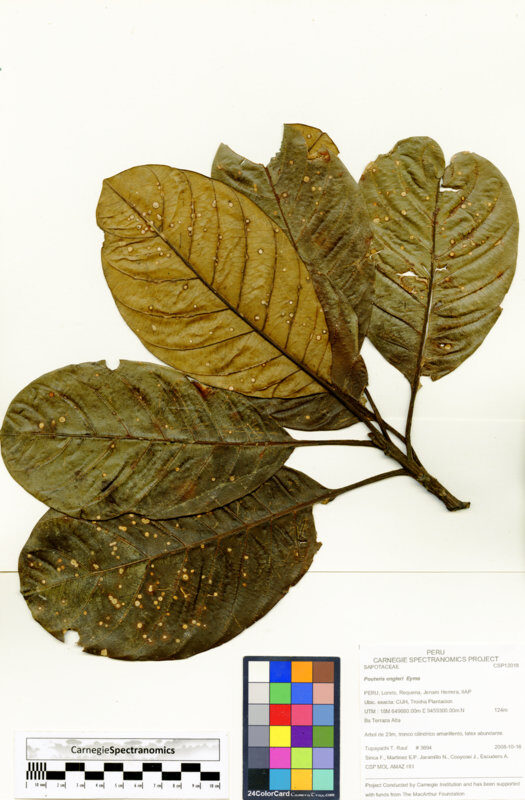
Pouteria torta
(Martius) Radlkofer
Curiola, Twisted pouteria
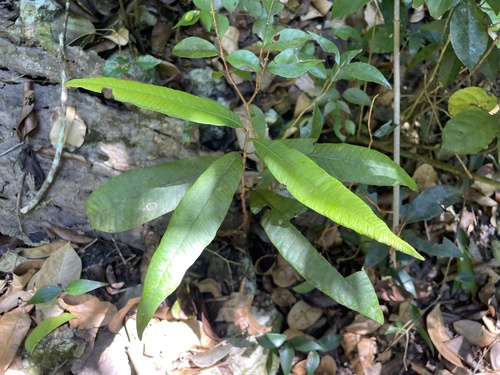
iNaturalist· cc-by-nc
(c) Bayardo Alberto González Ñamendy, some rights reserved (CC BY-NC)
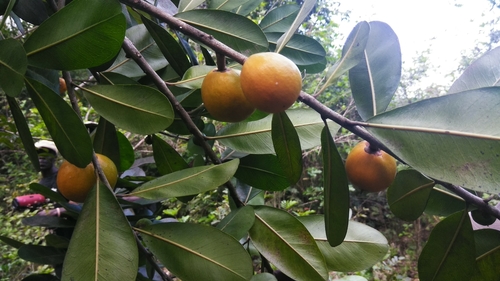
iNaturalist· cc-by-nc
(c) Bayardo Alberto González Ñamendy, some rights reserved (CC BY-NC)
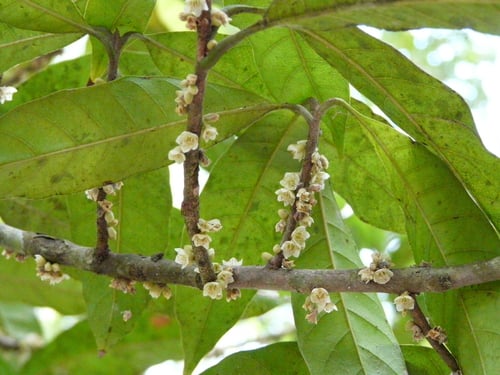
iNaturalist· cc-by-nc
(c) Bayardo Alberto González Ñamendy, some rights reserved (CC BY-NC)
Summary
Source: WikipediaPouteria torta is a species of tree native to Central and South America. It is found largely in the Brazilian cerrado and is commonly called guapeva and grão-de-galo.
Description
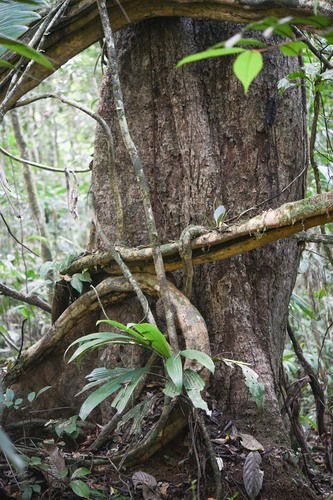
A small to medium sized tree. It grows up to 10 m high. It can be 40 m tall. The crown is round and the trunk is grooved. The trunk is short and 30-40 cm across. The leaves are leathery. They are in groups at the tips of the stems. The leaves are 20-25 cm long. The flowers are small and red. The fruit are small and egg shaped. They are 3-7 cm across. The skin is green to brown and the flesh is soft and white.
Edible Uses
Fruit - raw or used in beverages and preserves. A thick, gelatinous pulp with a slightly sweet flavour. Very tasty.The ovoid fruits are about 5cm long and 4cm in diameter.
Traditional Uses
Fruit are eaten fresh and used in drinks and preserves.
This uses section is brief — help expand it
Distribution
A tropical plant. It grows naturally in wet tropical rainforests in Brazil. It is often near swamps and river banks. It grows in lowlands and uplands.
Where It Grows
Amazon, Belize, Bolivia, Brazil*, Central America, Colombia*, Costa Rica, Ecuador*, El Salvador, Guatemala, Honduras, Mexico, Nicaragua, Panama, Paraguay, Peru, South America*,
Cultivation
Plants are grown from seed. The ripe fruit are harvested and put in a heap to allow the flesh to rot. The seeds are washed out with running water. The seeds are only viable for a very short time. Fresh seed should be planted. They germinate in 25-50 days.
Propagation
Seed - it has a very short viability in storage and so is best sown as soon as it is ripe in individual pots. Germination usually occurs in 3 - 7 weeks, the germination rate is above 80% if the seed is sown fresh.
Other Uses
The wood is moderately heavy, hard, difficult to saw. It has a long durability if it is protected from humidity. It is used for construction, cabinet making and internal carpentry. A fast-growing tree that is tolerant of full sun and supplies a food appreciated by humans and many other species, this tree could be very useful in a mixed planting for restoring native woodland and also for establishing woodland gardens.
Production
Plants grow quickly in the field. The fruit are picked off the ground during the rainy season.
Other Information
It is a cultivated fruit tree.
Notes
There are about 150-320 Pouteria species. They grow in the tropics.
Synonyms
Also Known As
Abiu pilosa, Avio de monte, Grao-de-galo, Jaija'onasotoa, Laranjinha, Ontogamo, Pe'su toa, Piaste, Quinilla negra
References (18)
- Barfod, A. S. & Kvist, L. P., 1996, Comparative Ethnobotanical Studies of the Amerindian Groups in Coastal Ecuador. The Danish Academy of Sciences and Letters. p 79
- Bortolotto, I. M., et al, 2018, Lista preliminar das plantas alimenticias nativas de Mato Grosso do Sul, Brasil. Iheringia, Serie Botanica, Porto Alegre, 73 (supl.):101-116
- Condit, R., et al, 2011, Trees of Panama and Costa Rica. Princeton Field Guides. p 440
- Grandtner, M. M., 2008, World Dictionary of Trees. Wood and Forest Science Department. Laval University, Quebec, Qc Canada. (Internet database http://www.wdt.qc.ca)
- Grandtner, M. M. & Chevrette, J., 2013, Dictionary of Trees, Volume 2: South America: Nomenclature, Taxonomy and Ecology. Academic Press p 530
Show all 18 references Hide references
- Kermath, B. M., et al, 2014, Food Plants in the Americas: A survey of the domesticated, cultivated and wild plants used for Human food in North, Central and South America and the Caribbean. On line draft. p 699
- Lopez-Diago, D. & Garcia, N., 2021, Wild edible fruits of Colombia. Biota ColomBiana 22 (2) p 51
- Lorenzi, H., 2002, Brazilian Trees. A Guide to the Identification and Cultivation of Brazilian Native Trees. Vol. 01 Nova Odessa, SP, Instituto Plantarum p 341
- Lorenzi, H., Bacher, L., Lacerda, M. & Sartori, S., 2006, Brazilian Fruits & Cultivated Exotics. Sao Paulo, Instituto Plantarum de Estuados da Flora Ltda. p 307
- Paz, F. S., et al, 2021, Edible Fruit Plant Species in the Amazon Forest Rely Mostly on Bees and Beetles as Pollinators. Journal of Economic Entomology, XX(XX), 2021, 1–13
- Pennington, T.D., 1990, Sapotaceae in Flora Neotropica Monograph 52. New York Botanical Gardens. p 481
- Peres, M. K., 2011, Diasporos do Cerrado Atrativos para Fauna: Chave Interativa Caracterizacao Visual e Relacoes Ecologicas. Masters thesis. Universidade de Brasilia.
- Philips, O., 1992, The potential for harvesting fruits in tropical rainforests: new data from Amazonian Peru. Biodiversity and Conservation 2, 18-38
- Roa, J. A. G. & Boada, D. S. G., 2018, Fundación para el Fortalecimiento de la Fruticultura y Plantas Alimenticias no Convencionales en Colombia.
- Smith, N., et al, 2007, Amazon River Fruits. Flavors for Conservation. Missouri Botanical Gardens Press. p 235
- Torre, de la, L., et al, 2008, Enciclopedia de las Plantas Útiles del Ecuador. Herbario QCA. Pontificia Universidad Católica del Ecuador. p 573
- Van Roosmalen, M.G.M., & Garcia, O. M., 2000, Fruits of the Amazonian Forest. Part 2: Sapotaceae. Acta Amazonica 30(2): 187-290
- www.colecionandofrutas.org