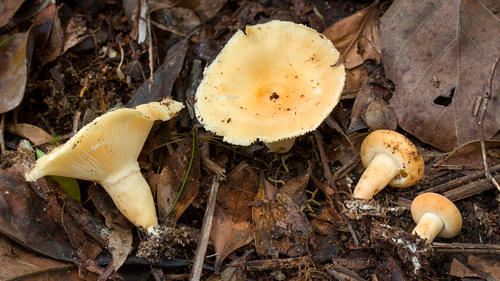
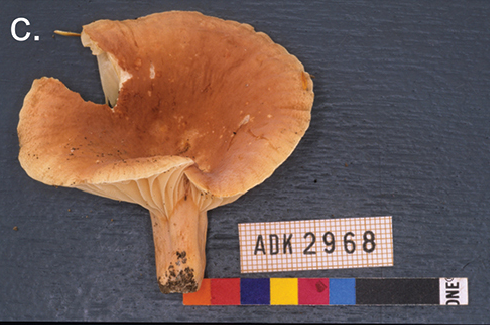
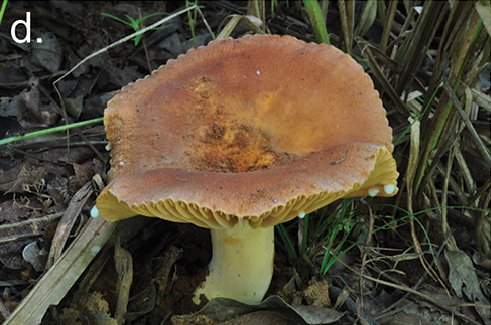
Russula cyanoxantha
(Schff. ex Secr.) Fr.
Charcoal Burner, Blue russula
iNaturalist· cc-by-nc
(c) Trevor Davis, some rights reserved (CC BY-NC)
iNaturalist· cc-by-nc
(c) Federico Calledda, some rights reserved (CC BY-NC), uploaded by Federico Calledda
Summary
Source: WikipediaRussula cyanoxantha, commonly known as the charcoal burner or variegated russula, is a basidiomycete mushroom. It can be confused for a number of other members of its genus. Found mostly in Europe (with North American counterparts), it is an edible mushroom.
Description
A mushroom.
This description is brief — help expand it
Edible Uses
The edible mushroom is suitable for many kinds of preparation; the flesh is not as hard as that of many other edible Russulas. It has a mild, nutty taste, but is also appreciated by maggots.
Traditional Uses
The caps are used in stews and sauces.
This uses section is brief — help expand it
Distribution
It is a temperate plant.
Where It Grows
Africa, Asia, Balkans, Britain, Bulgaria, Central America, China, Costa Rica, Czech Republic, East Africa, Europe, Himalayas, Indochina, Italy, Japan, Malawi, Mediterranean, Mexico, Nepal, North America, Poland, Portugal, Romania, Russia, SE Asia, Slovenia, Spain, Thailand, Turkey, Türkiye,
Other Information
It is sold in local markets.
Notes
CAUTION It looks like Death Cap, Amanita phalloides.
Synonyms
Also Known As
Hed narea, Lanhuang honggu, Rossella
References (21)
- Amai, 1938,
- Boa, E. R., 2004, Wild edible fungi and their importance to people. FAO Non Wood Forest Products Booklet 17
- Cocchi, L. et al, 2006, Heavy metals in edible mushrooms in Italy. Food Chemistry 98: 277-284
- Dongol, et al, 1995, Edible Mushrooms in Nepal
- Guedes de Piniho, P., et al, 2008, Correlation between the Pattern Volatiles and the Overall Aroma of Wild Edible Mushrooms. Journal of Agricultural and Food Chemistry. 56: 1704-1712
Show all 21 references Hide references
- Hall, I. R., et al, 2003, Edible and Poisonous Mushrooms of the World. Timber Press. p 310
- Jordan, P., 2000, The Mushroom Guide and Identifier, Hermes House, p 86
- Kalac, P. and Svoboda, L., 1999, A review of trace element concentrations in edible mushrooms. Food Chemistry 69: 273-281
- Kalac,P., 2009, Chemical composition and nutritional value of European species of wild growing mushrooms: A review. Food Chemistry 113 (2009) 9–16
- Kaufmann, B. et al, 1999, The Great Encyclopedia of Mushrooms. Konemann. p 44
- Kiple, K.F. & Ornelas, K.C., (eds), 2000, The Cambridge World History of Food. CUP p 320
- Luczaj, L., et al, 2015, Wild food plants and fungi used by Ukrainians in the western part of the Maramureş region in Romania. Acta Soc Bot Pol 84(3):339–346
- Pace, G., 1998, Mushrooms of the world. Firefly books. p 148 (Also as Russula cutefracta)
- Perez-Moreno, J. et al, 2008, Wild Mushroom Markets in Central Mexico and a Case Study at Ozumba. Economic Botany, 62(3), 2008, pp. 425–436
- Pieroni, A., 1999, Gathered wild food plants in the Upper Valley of the Serchio River (Garfagnana), Central Italy. Economic Botany 53(3) pp 327-341
- Rila Monastery Nature Park Management Plan 2004 - 2013 (Bulgaria) p 380
- Sanmee, R. et al, 2003, Nutritive value of popular wild edible mushrooms from northern Thailand. Food Chemistry 82: 527-532
- Srichaiwong, P., et al, 2014, A Study of the Biodiversity of Natural Food Production to Support Community Upstream of Chi Basin, Thailand. Asian Social Science 10 (2):
- Stoyneva-Gartner, M.P. & Uzunov, B.A., 2015, An Ethnobiological Glance on Globalization Impact on the Traditional Use of Algae and Fungi as Food in Bulgaria. J Nutr Food Sci 2015, 5:5
- www.plantnames.unimelb.edu.au
- Yildiz, A et al, 2005, Organic elements and protein in some macrofungi of south east Anatolia in Turkey. Food Chemistry 89: 605-609