Laccaria amethystina
(Boel. ex Hooker) Murr.
Amethyst deceiver, Amethystina laccaria
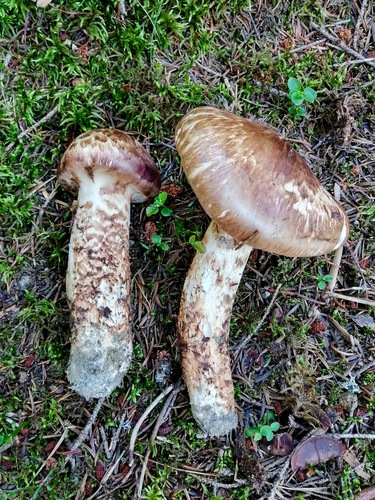
iNaturalist· cc-by
(c) Christian Berg, some rights reserved (CC BY), uploaded by Christian Berg
iNaturalist· cc-by
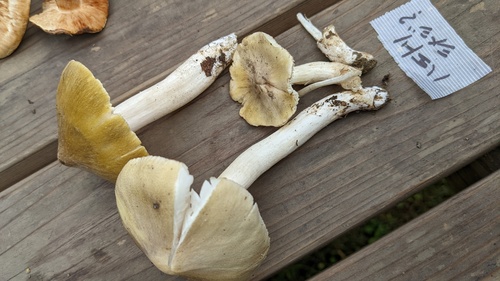
(c) Wolfgang Wollschweber, some rights reserved (CC BY)
iNaturalist· cc-by-nc-sa
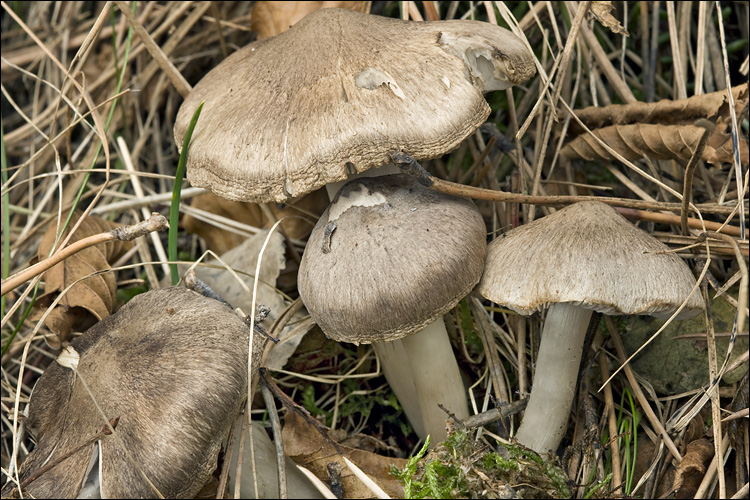
(c) Paul, some rights reserved (CC BY-NC-SA)
Summary
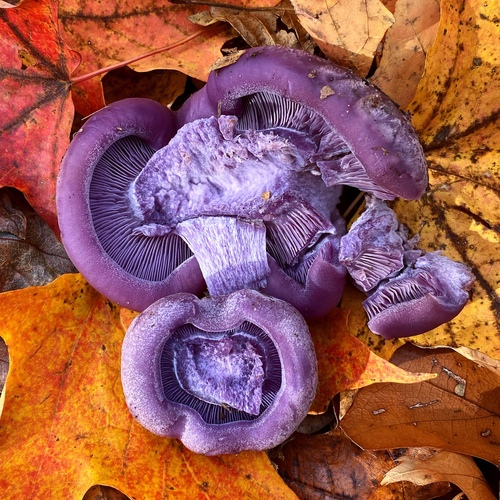
Source: WikipediaLaccaria amethystina, commonly known as the amethyst deceiver, or amethyst laccaria, is a small brightly colored mushroom. Because its bright amethyst coloration fades with age and weathering, it becomes difficult to identify, hence the common name "deceiver". This common name is shared with its close relation L. laccata, which also fades and weathers. Recently, some of the other species in the genus have been given the common name of "deceiver". It is found mainly in Northern temperate zones, in deciduous and coniferous forests, though it is reported to occur in tropical Central and South America as well. The mushroom is edible, but can absorb arsenic from the soil.
Description
A mushroom which grows in large groups. The cap is 1-5 cm across. It is curved over when young but becomes flattened with age and can develop a low spot in the centre. It is deep purple lilac in colour. The stem is 4-10 cm long. It is hollow and has slightly white fibres near the cap. The gills are the same colour as the cap. The spore print is white.
Edible Uses
The mushroom can be eaten fresh, dried and stored, or preserved in spiced alcohol.
Traditional Uses
They can be eaten fresh. It can be dried and stored. It can also be stored in spiced alcohol.
This uses section is brief — help expand it
Distribution
It is a temperate plant. It grows in pine and deciduous forest. They are often under beech and chestnut trees.
Where It Grows
Asia, Balkans, Britain, Bulgaria, Central America, Costa Rica, Europe, Himalayas, Hungary, Mexico, Nepal, North America, Russia,
Other Information
It is sold in local markets.
Synonyms
Also Known As
Xocoyol
References (13)
- Adhikari, M. K., 2014, Addition and correction to the knowledge on edibility of wild mushrooms in Nepal: a discussion. Bul. Dept. Pl. Res. N. 36, Nepal p 5
- Boa, E. R., 2004, Wild edible fungi and their importance to people. FAO Non Wood Forest Products Booklet 17
- Dongol, et al, 1995, Edible Mushrooms in Nepal
- Estrada-Martinez, E., et al, 2009, Contribucion al conocimiento etnomicologico de los Hongos Comestibles Silvestres de Mercados Regionales y Comunidades de la Sierra Nevada (Mexico). Intercienca Jan 2009 Vol. 34 No. 1
- Farfan B., et al, 2007, Mazahua Ethnobotany and Subsistence in the Monarch Butterfly Biosphere Reserve, Mexico. Economic Botany 61(2) pp 173-191
Show all 13 references Hide references
- Jordan, P., 2000, The Mushroom Guide and Identifier, Hermes House, p 62
- Kaufmann, B. et al, 1999, The Great Encyclopedia of Mushrooms. Konemann. p 82
- Pace, G., 1998, Mushrooms of the world. Firefly books. p 119
- Perez-Moreno, J. et al, 2008, Wild Mushroom Markets in Central Mexico and a Case Study at Ozumba. Economic Botany, 62(3), 2008, pp. 425–436
- Perez-Moreno, J., et al, 2009, Social and Biotechnological Studies of Wild Edible Mushrooms in Mexico. Acta Botanica Yunnanica Suppl. XV1: 55-61
- Vetner, J., 2004, Arsenic content of some edible mushroom species. Eur. Food Res. Technol. 219: 71-74
- www.plantnames.unimelb.edu.au
- Zamora-Martinez, M. et al, 1995, Natural production of wild edible mushrooms in the southwestern rural territory of Mexico City, Mexico. Forest Ecology and Management 72:13-20