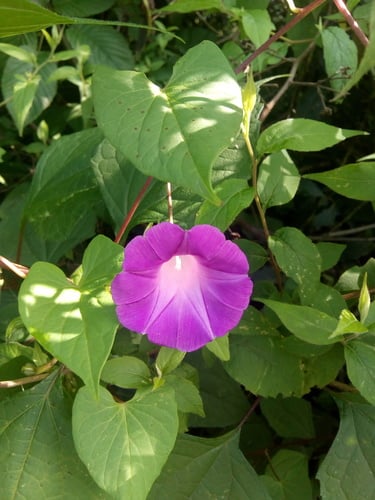
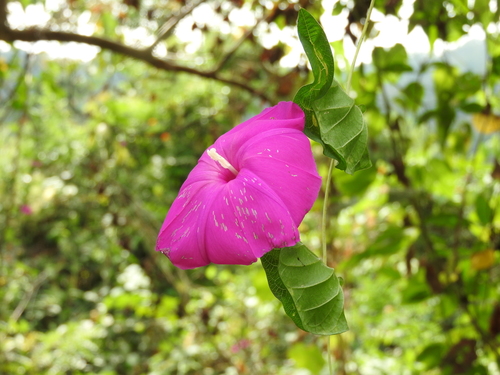
Convolvulus arvensis
L.
Field bindweed, Australian bindweed
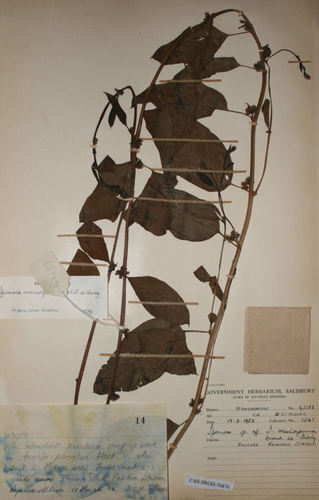
iNaturalist· cc-by-nc
(c) natomapaul, some rights reserved (CC BY-NC)
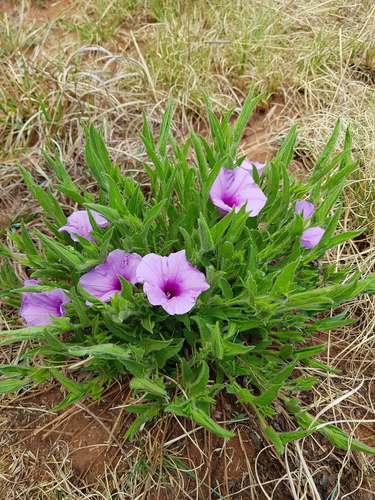
iNaturalist· cc-by-nc
(c) ru_osmanov, some rights reserved (CC BY-NC)
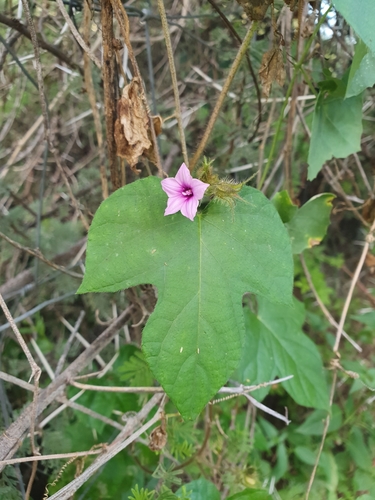
iNaturalist· cc-by-nc
(c) vivienratcliffe, some rights reserved (CC BY-NC)
Summary
Source: WikipediaConvolvulus arvensis, or field bindweed, is a species of bindweed in the Convolvulaceae native to Europe and Asia. It is a rhizomatous and climbing or creeping herbaceous perennial plant with stems growing to 0.5–2 metres (1.6–6.6 ft) in length. It is usually found at ground level with small white and pink flowers. Other common names, mostly obsolete, include lesser bindweed, European bindweed, withy wind (in basket willow crops), perennial morning glory, small-flowered morning glory, creeping Jenny, and possession vine.
Description
A vigorous slender climber. It has a woody base and keeps growing from year to year. It has long branched underground stems or rhizomes. These can be 9 m deep. The stems are fine and twining. They have fine hairs when young. The leaves are alternate and broadly oval. They are 3-5 cm long by 1-4 cm wide. The leaves have stalks. They have lobes at the base. The flowers are small and white or pink. They occur singly. They are 2.5 cm across. The flowering stems are in the axils of leaves and are larger than the leaves. Plants sucker freely. The fruit capsules are cone shaped.
Edible Uses
The plant has been used as a flavouring in a liqueur called 'Noyeau'. No details are recorded as to which part of the plant is used.
Traditional Uses
The leaves are used to give flavour to a liquor called "noyeau". They have also been scalded then fried. They are cooked as a vegetable. They are cooked with yoghurt. The seeds are also boiled with other vegetables or fried and eaten. The flowers are sucked for their nectar. The young shoots with a few leaves are gathered in early spring and used in limited amounts with cracked wheat and ground beans to make a gruel. Caution: Eating too much will cause diarrhoea. The roots are boiled, kneaded into dough and then cooked to make a damper.
Medicinal Uses
The root, and a resin derived from the root, are cholagogue, diuretic, laxative, and strongly purgative. The dried root contains 4.9% resin. The juice of the root is used in the treatment of fevers. A tea made from the flowers is laxative and is used to treat fevers and wounds. A cold tea made from the leaves is laxative, can be applied as a wash for spider bites, or taken internally to reduce excessive menstrual flow.
Distribution
A temperate plant. It grows in cultivated areas, wasteland, roadsides, grassy slopes between 600–4500 m altitude in China. It grows in lowland fields in northern China. It does best in a light, well-drained soil. It needs a sunny position. It is resistant to frost and drought. In Argentina it grows between sea level and 3,200 m above sea level. Tasmania Herbarium.
Where It Grows
Africa, Andorra, Argentina, Armenia, Asia*, Australia, Bahrain, Balkans, Caucasus, Central America, Central Asia, Chile, China, Croatia, East Africa, Europe*, France, Georgia, Greece, Hawaii, Himalayas, Hungary, India, Italy, Korea, Luxembourg, Martinique, Mediterranean, Middle East, Mongolia, Morocco, Mozambique, Myanmar, North Africa, North America, Pacific, Pakistan, Poland, Portugal, SE Asia, Slovenia, South Africa, Southern Africa, South America, Spain, Tajikistan, Tasmania, Turkey, Türkiye, Uruguay,
Cultivation
Prefers a lighter basic soil of low to medium fertility. Bindweed is a very deep-rooting plant with a vigorous root system that extends to a considerable distance and is very hard to eradicate from the soil. Even a small piece of the root will grow into a new plant if it is left in the ground. Once established this plant soon becomes a pernicious weed. It is a climbing plant that supports itself by twining around any support it can find and can soon swamp and strangle other plants. The flowers close at night and also during rainy weather. Although visited by numerous insects, the flowers seldom set fertile seed. On sunny days the flowers diffuse a scent of heliotrope. The plant harbours tobacco mosaic virus of the Solanaceae and so should not be grown near potatoes, tomatoes and other members of that family.
Propagation
Sow seed in situ as soon as it is ripe; it germinates in autumn. This species can become a serious garden weed, so encouraging it is inadvisable.
Other Uses
The stems can be used as twine for tying up plants; they are fairly flexible and strong but not long-lasting. A green dye is obtained from the whole plant.
Other Information
A very minor food. The seeds are eaten by children. It is a famine food.
Notes
It can become a serious weed in temperate places. There are about 100-250 Convolvulus species.
Synonyms
Also Known As
Babootu, Beri, Bhadrabala, Chandvel, Chinese bindweed, Correhuela, Dangirek, Dolasgan, Ero, Filiz, Gandhbhadali, Gondal, Gyoteny, Haranpadi, Haranpag, Hiran kahri, Hirapadi, Kheroon, Khewari, Khvartkla, Lavlavk, Lehi, Lehli, Leksiotu, Liblebe, Luwaya, Naaro, Nari, Parvaty, Parwatiay, Prasarna, Rajbala, Ratcho, Sarmaşık, Slacak, Speaker booti, Szulak, Tanesfalt, Tian xuan hua, Tosbagaotu, Vanvaihre, Veladi
References (39)
- Ajain, M., Ali, T., & Siddiqui, M.F., 2015, A Survey of Ethnobotanically Important Herbaceous Plants of Tehsil Jatoi,District Muzaffar Garh, Punjab, Pakistan. Int. J. Biol. Res., 3(2): 87-92, 2015.
- Ambasta, S.P. (Ed.), 2000, The Useful Plants of India. CSIR India. p 139
- Amin, M., et al, 2023, Edible wild plant species used by different linguistic groups of Kohistan Upper Khyber Pakhtunkhwa (KP), Pakistan. Journal of Ethnobiology and Ethnomedicine 19:6 p 9
- Blamey, M and Grey-Wilson, C., 2005, Wild flowers of the Mediterranean. A & C Black London. p 185
- Bodkin, F., 1991, Encyclopedia Botanica. Cornstalk publishing, p 278
Show all 39 references Hide references
- Bussman, R. W., et al, 2021, Unity in diversity—food plants and fungi of Sakartvelo (Republic of Georgia), Caucasus. Journal of Ethnobiology and Ethnomedicine (2021) 17:72 p 8
- Cakir, E. A., 2017, Traditional knowledge of wild edible plants of Iğdır Province (East Anatolia, Turkey). Acta Soc Bot Pol. 2017;86(4):3568.
- Cerne, M., 1992, Wild Plants from Slovenia used as Vegetables. Acta Horticulturae 318
- Curtis, W.M., 1993, The Student's Flora of Tasmania. Part 3 St David's Park Publishing, Tasmania, p 497
- Dashorst, G.R.M., and Jessop, J.P., 1998, Plants of the Adelaide Plains & Hills. Botanic Gardens of Adelaide and State Herbarium. p 122
- Demir, I. & Ayaz, N., 2022, Wild edible plants contributing to the traditional foods of Mardin (Turkey) Province. Indian Journal of Traditional Knowledge Vol 21(3), July 2022, pp 569-582
- Denes, A., et al, 2012, Wild plants used for food by Hungarian ethnic groups living in the Carpathian Basin. Acta Societatis Botanicorum Poloniae 81 (4): 381-396
- Ertug, F, Yenen Bitkiler. Resimli Türkiye Florası -I- Flora of Turkey - Ethnobotany supplement
- Fang Rhui-cheng; George Staples, CONVOLVULACEAE Flora of China
- Hastings Advance Community College, 2017, Uses for Native Plants of the Mornington Peninsula. 86pp. p 34
- Hovsepyan, R., et al, 2016, Food as a marker for economy and part of identity: traditional vegetal food of Yezidis and Kurds in Armenia. Journal of Ethnic Foods. 3:32-41
- Hu, Shiu-ying, 2005, Food Plants of China. The Chinese University Press. p 636 (As Convolvulus chinensis)
- Hussey, B.M.J., Keighery, G.J., Cousens, R.D., Dodd, J., Lloyd, S.G., 1997, Western Weeds. A guide to the weeds of Western Australia. Plant Protection Society of Western Australia. p 136
- Hyde-Wyatt, B.H. & Morris D.I., 1975, Tasmanian Weed Handbook. Dept of Ag Tasmania. p 89
- Jabeen, A., et al, 2009, Indigenous uses of economically important flora of Margallah Hills National Park, Islamabad, Pakistan. African Journal of Biotechnology Vol. 8 (5), pp. 763-784
- Jones, D.L. & Gray, B., 1977, Australian Climbing Plants. Reed. p 153
- Khalid, N., et al, 2023, Wild food plants gathered by four cultural groups in North Waziristan, Pakistan. Genet Resour Crop Evol. 70:1243–1276
- Kizilarslan, C. & Ozhatay, N., 2012, An ethnobotanical study of the useful and edible plants of İzmit. Marmara Pharmaceutical Journal 16: 134-140, 2012.
- Lim, T. K., 2015, Edible Medicinal and Non Medicinal Plants. Volume 9, Modified Stems, Roots, Bulbs. Springer p 28
- Łukasz Łuczaj and Wojciech M Szymański, 2007, Wild vascular plants gathered for consumption in the Polish countryside: a review. J Ethnobiol Ethnomedicine. 3: 17
- Majeed, M., et al, 2021, Gathered Wild Food Plants among Diverse Religious Groups in Jhelum District, Punjab, Pakistan. Foods 2021, 10, 594.
- Murugan, Pal M., et al, 2010, Phytofoods of Nubra valley, Ladakh - The cold desert. Indian Journal of Traditional Knowledge. Vol. 9(2): 303-308
- (As Beta patellaris)
- Özdemir, E. and Kültür, S., 2017, Wild Edible Plants of Savaştepe District (Balıkesir, Turkey), Marmara Pharm J 21/3: 578-589
- Paczkowska, G. & Chapman, A.R., 2000, The Western Australian Flora. A Descriptive Catalogue. Western Australian Herbarium. p 216
- Phillips, D.C., 1988, Wild Flowers of Bahrain. A Field Guide to Herbs, Shrubs, and Trees. Privately published. p 139
- Rigat, M et al, 2009, Ethnobotany of Food Plants in the High River Ter Valley (Pyrenees, catalonia, Iberian Peninsula): Non-Crop Food Vascular Plants and Crop Food Plants with medicinal Properties. Ecology of Food and Nutrition, 48:303-327
- Sharma, L. et al, 2018, Diversity, distribution pattern, endemism and indigenous uses of wild edible plants in Cold Desert Biosphere Reserve of Indian Trans Himalaya. Indian Journal of Traditional Knowledge. Vol 17(1) January 2018 pp 122-131
- Sp. pl. 1:153. 1753 (type species)
- Tardio, J., et al, 2006, Ethnobotanical review of wild edible plants in Spain. Botanical J. Linnean Soc. 152, 27-71
- Tasmanian Herbarium Vascular Plants list p 22
- Welcome, A. K. & Van Wyk, B.-E., 2019, An inventory and analysis of the food plants of southern Africa. South African Journal of Botany 122 (2019) 136–179
- Williams, K.A.W., 1999, Native Plants of Queensland Volume 4. Keith A.W. Williams North Ipswich, Australia. p 122
- Yesil, Y., et al, 2019, Wild edible plants in Yeşilli (Mardin-Turkey), a multicultural area. Journal of Ethnobiology and Ethnomedicine (2019) 15:52