Sterculia lanceifolia
Roxb.
Chiwaripat
Wikipedia· cc-by-sa
Wikimedia Commons - Sterculia_lanceifolia,_Koh_Lipe_Thailand.jpg
Summary
Source: WikipediaSterculia lanceifolia is a bush/tree species belonging to the genus Sterculia in the family Malvaceae. This species is found in Bangladesh, NE India, China and Indo-China and there are no subspecies listed in the Catalogue of Life.
Description
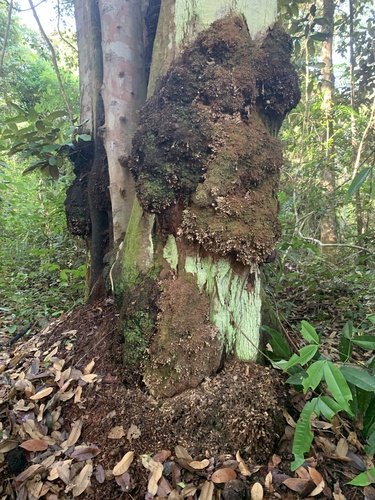
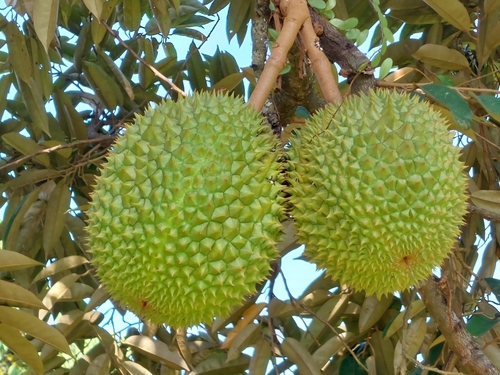
A small or medium sized tree. The bark is dark brown and rough. The flowers are red. The fruit follicles or pods are pink and thinly rough. The seeds are black and have beaks. The seed are oval.
Edible Uses
The seeds are roasted and eaten.
Traditional Uses
The seeds are roasted and eaten.
This uses section is brief — help expand it
Distribution
It is a subtropical plant. It grows in deciduous forests. In Sikkim it grows up to 1,800 m above sea level.
Where It Grows
Asia, China, Himalayas, India, Myanmar, Northeastern India, SE Asia, Sikkim, Tibet,
Cultivation
Plants are grown from seeds.
Propagation
A physical dormancy caused by the hard seed coat of the mature seeds of many species in this genus can be overcome by scarifying the seed. This is carried out by cutting away or abrading some of the seed coat to allow the ingress of water, though great care must be taken not to damage the embryo. The aril surrounding the seed should also be removed - this is easiest when it has been softened through soaking in water. The seeds germinate optimally at temperatures between 20 - 30°c. They can be sown in a nursery seedbed or in containers. A germination rate of about 95%, occurring within about 2 weeks can be expected if the seed has been properly treated.
Other Uses
The fibrous bark is sometimes used to make cordage.
Notes
Also put in the family Sterculiaceae.
Synonyms
Also Known As
Bha-ba-ba-gu, Chiuripat, Kanthior, Makai, Mimong omak, Nag-phona, Nakphona
References (9)
- Ambasta, S.P. (Ed.), 2000, The Useful Plants of India. CSIR India. p 601 (As Sterculia roxburghii)
- Li, S., et al, 2020, Monpa, memory, and change: an ethnobotanical study of plant use in Mêdog County, South-east Tibet, China. Journal of Ethnobiology and Ethnomedicine. (2020) 16:5 p 19
- Patiri, B. & Borah, A., 2007, Wild Edible Plants of Assam. Geethaki Publishers. p 16 (As Sterculia roxburghii)
- Pegu, R., et al, 2013, Ethnobotanical study of Wild Edible Plants in Poba Reserved Forest, Assam, India. Research Journal of Agriculture and Forestry Sciences 1(3):1-10 (As Sterculia roxburghii)
- Pl. asiat. rar. 3:39. 1832 (As Sterculia roxburghii)
Show all 9 references Hide references
- Sawian, J. T., et al, 2007, Wild edible plants of Meghalaya, North-east India. Natural Product Radiance Vol. 6(5): p 422 (As Sterculia roxburghii)
- Singh, H.B., Arora R.K.,1978, Wild edible Plants of India. Indian Council of Agricultural Research, New Delhi. p 83 (As Sterculia roxburghii)
- Sundriyal, M., et al, 1998, Wild edibles and other useful plants from the Sikkim Himalaya, India. Oecologia Montana 7:43-54 (As Sterculia roxburghii)
- Sundriyal, M., et al, 2004, Dietary Use of Wild Plant Resources in the Sikkim Himalaya, India. Economic Botany 58(4) pp 626-638 (As Sterculia roxburghii)