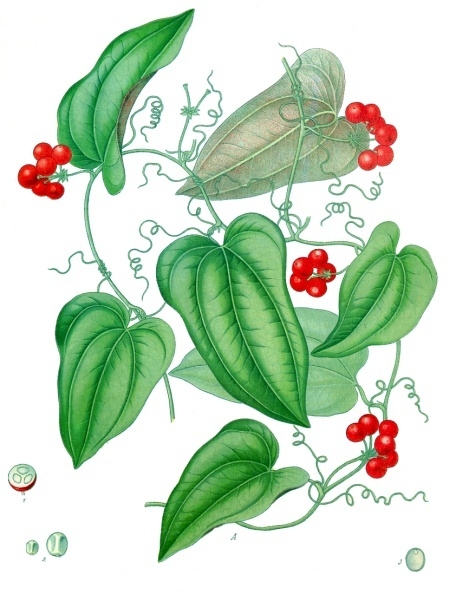
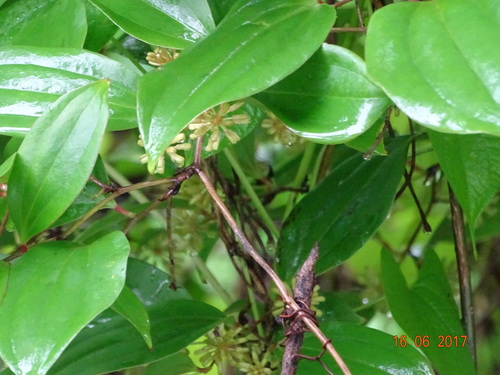
Smilax zeylanica
Linn.
Indian smilax
iNaturalist· cc-by-nc-nd
(c) Subhajit Roy, some rights reserved (CC BY-NC-ND), uploaded by Subhajit Roy
iNaturalist· cc-by
(c) Sindhu Haridas, some rights reserved (CC BY)
Summary
Source: WikipediaSmilax zeylanica is a plant species in the genus Smilax. Its leaves and roots are used for medicinal purposes. The plant is widespread in India, and native in other parts of the Indian subcontinent as well as in Myanmar, Malaysia, Java and Solomon Islands. It is traditionally used for the treatment of ulcers. It is one of the larval host plants of the butterfly Zesius chrysomallus.
Description
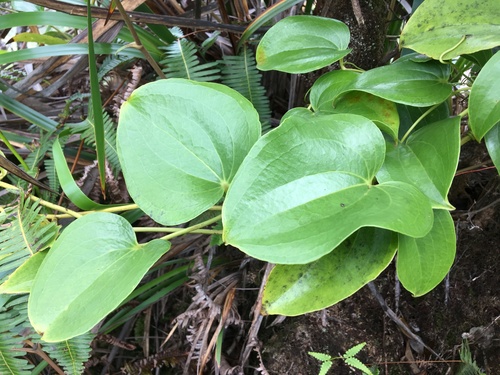
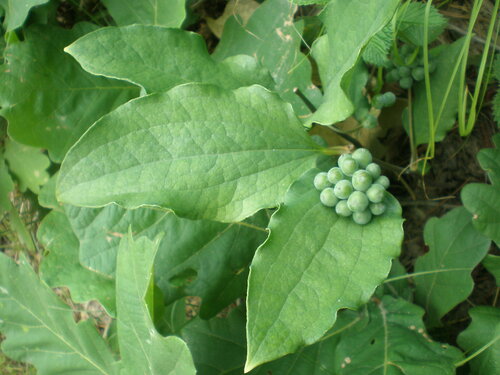
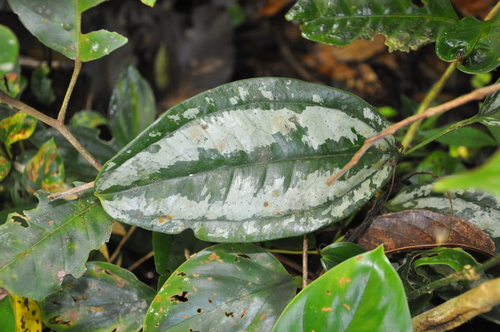
A robust woody climber. It is up to 6 m long. It varies a lot. The branches are angular. They can zigzag. There can be some prickles. The leaves are alternate and oblong to oval. They are 5-24 cm long by 1-13 cm wide. The fruit is a round berry. It is 6-9 mm across. It is a dull yellow. There are 2-3 seeds per berry.
Edible Uses
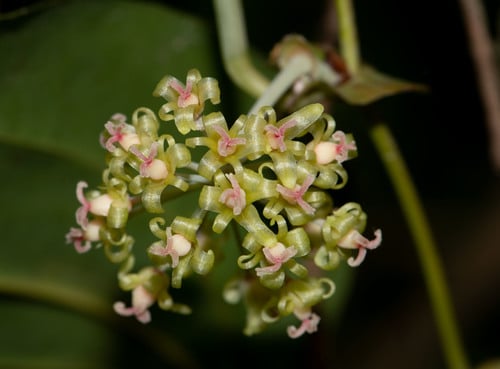
The boiled young roots are edible and used for flavouring. Young stem tips are boiled and used in curries and pickles. The ripe fruit are eaten raw and the seeds are roasted and eaten. Harvested leaves can be stored 5-6 days and are sold in local markets along with flowers.
Traditional Uses
The boiled young roots are edible. They are sued to add flavour. The young stem tips are used as a vegetable. They are boiled and then used in curry. They are used in pickles. The harvested leaves can be stored for 5-6 days. The ripe fruit are eaten raw. The seeds are roasted and eaten.
Distribution
A tropical plant. It grows in jungle or secondary forest. It grows up to 1000 m altitude. In Yunnan.
Where It Grows
Asia, China, Himalayas, India, Indochina, Indonesia, Myanmar, Nepal, New Guinea, Northeastern India, SE Asia, Sikkim, Sri Lanka, Thailand, Vietnam,
Cultivation
Plants can be grown from seeds.
Other Information
Leaves and flowers are sold in local markets.
Notes
There are about 300 Smilax species. It is used in medicine.
Synonyms
Also Known As
Asaihe tuni, Atkir, Aushbash, Chobohini, Chopchini, Gadung india, Gotvel, Jangli, Josti-karna lota, Kareenlanchi, Kayu cina hutan, Kolarbhaji, Kukurdainy, Kumarika, Mutri, Paepayai, Qiemao-qiegala, Rajdanti, Ramdatum, Ramdatun, Ramdatwan, Saihe maruani, Sherdera, Sherdire, Soima jaseb, Tikoni borual, Yorit
References (23)
- Ambasta, S.P. (Ed.), 2000, The Useful Plants of India. CSIR India. p 578
- Chandrakumar, P., et al, 2015, Ethnobotanical studies of wild edible plants of Gond, Halba and Kawar tribes of Salekasa Taluka, Gondia District, Maharashtra State, India. International Research Journal of Pharmacy 6(8)
- Dangol, D. R. et al, 2017, Wild Edible Plants in Nepal. Proceedings of 2nd National Workshop on CUAOGR, 2017.
- Dutta, U., 2012, Wild Vegetables collected by the local communities from the Churang reserve of BTD, Assam. International Journal of Science and Advanced Technology. Vol. 2(4) p 123
- Ghimeray, A. K., Lamsal, K., et al, 2010, Wild edible angiospermic plants of the Illam Hills (Eastern Nepal) and their mode of use by local community. Korean J. Pl. Taxon. 40(1)
Show all 23 references Hide references
- Jadhav, R., et al, 2015, Forest Foods of Northern Western Ghats: Mode of Consumption, Nutrition and Availability. Asian Agri-History Vol. 19, No. 4: 293-317
- Kumar, R. & Saikia, P., 2020, Wild edible plants of Jharkhand and their utilitarian perspectives. Indian Journal of Traditional Knowledge Vol 19 (2), April 2020, pp 237-250
- Lim, T. K., 2015, Edible Medicinal and Non Medicinal Plants. Volume 9, Modified Stems, Roots, Bulbs. Springer p 77
- Liu, Yi-tao, & Long, Chun-Lin, 2002, Studies on Edible Flowers Consumed by Ethnic Groups in Yunnan. Acta Botanica Yunnanica. 24(1):41-56 (As Smilax indica)
- Mahadkar, S., Valvi, S. & Rathod, V., 2012, Nutritional assessment of some selected wild edible plants as a good source of mineral. Asian Journal of Plant Science and Research 2(4):468-472
- Misra, R. C., et al, 2013, Genetic resources of wild tuberous food plants traditionally used in Similipal Biosphere Reserve, Odisha, India. Genetic Resources and Crop Evolution. Vol. 60 No. 2. Springer
- Misra S. & Misra M., 2016, Ethnobotanical and Nutritional Evaluation of Some Edible Fruit Plants of Southern Odisha, India. International Journal of Advances in Agricultural Science and Technology, Vol.3 Issue.1, March- 2016, pg. 1-30
- Pandy, R. K. & Saini, S. K., 2007, Edible plants of tropical forests among tribal communities of Madhya Pradesh. Indian Journal of Traditional Knowledge. 6(1), pp 185-190
- Patiri, B. & Borah, A., 2007, Wild Edible Plants of Assam. Geethaki Publishers. p 148
- Prafulla, S., 2017, Wild Food Diversity of Nawegaon-Nagzira Tiger Reserve in Gondia-Bhandara district of Maharashtra, India. Int. J. of Life Sciences, 2017, Vol. 5 (4): 620-626
- PROSEA handbook Volume 9 Plants yielding non-seed carbohydrates. p 180
- Setiya, A. V., et al, 2016, Exploration and documentation of some wild edible plants used by the aboriginals from Gadchiroli District (M.S.) India. International Advanced Research Journal in Science, Engineering and Technology. 3(7)
- Singh, H.B., Arora R.K.,1978, Wild edible Plants of India. Indian Council of Agricultural Research, New Delhi. p 40, 79
- Sukarya, D. G., (Ed.) 2013, 3,500 Plant Species of the Botanic Gardens of Indonesia. LIPI p 972
- Thoa P. T. K., et al, 2013, Biodiversity indices and utilization of edible wild plants: a case study of the Cham Island in Quang Nam Province, Vietnam. Journal of Research in Environmental Science and Toxicology 2(9) :167-174
- Wild edible plants of Himachal Pradesh
- Xu, You-Kai, et al, 2004, Wild Vegetable Resources and Market Survey in Xishuangbanna, Southwest China. Economic Botany. 58(4): 647-667. (As Smilax indica)
- Yesodharan, K. & Sujana, K. A., 2007, Wild edible plants traditionally used by the tribes in the Parambokulam Wildlife Sanctuary, Kerala, India. Natural Product Radiance 6(1) pp 74-80