Parajubaea torallyi
(Mart.) Burret
Zunkha palm, Mountain coconut
iNaturalist· cc-by-nc
(c) nathalynicolecamargo, some rights reserved (CC BY-NC)
iNaturalist· cc0
no rights reserved, uploaded by Naturalist Tours
iNaturalist· cc-by-nc
(c) nathalynicolecamargo, some rights reserved (CC BY-NC)
Summary
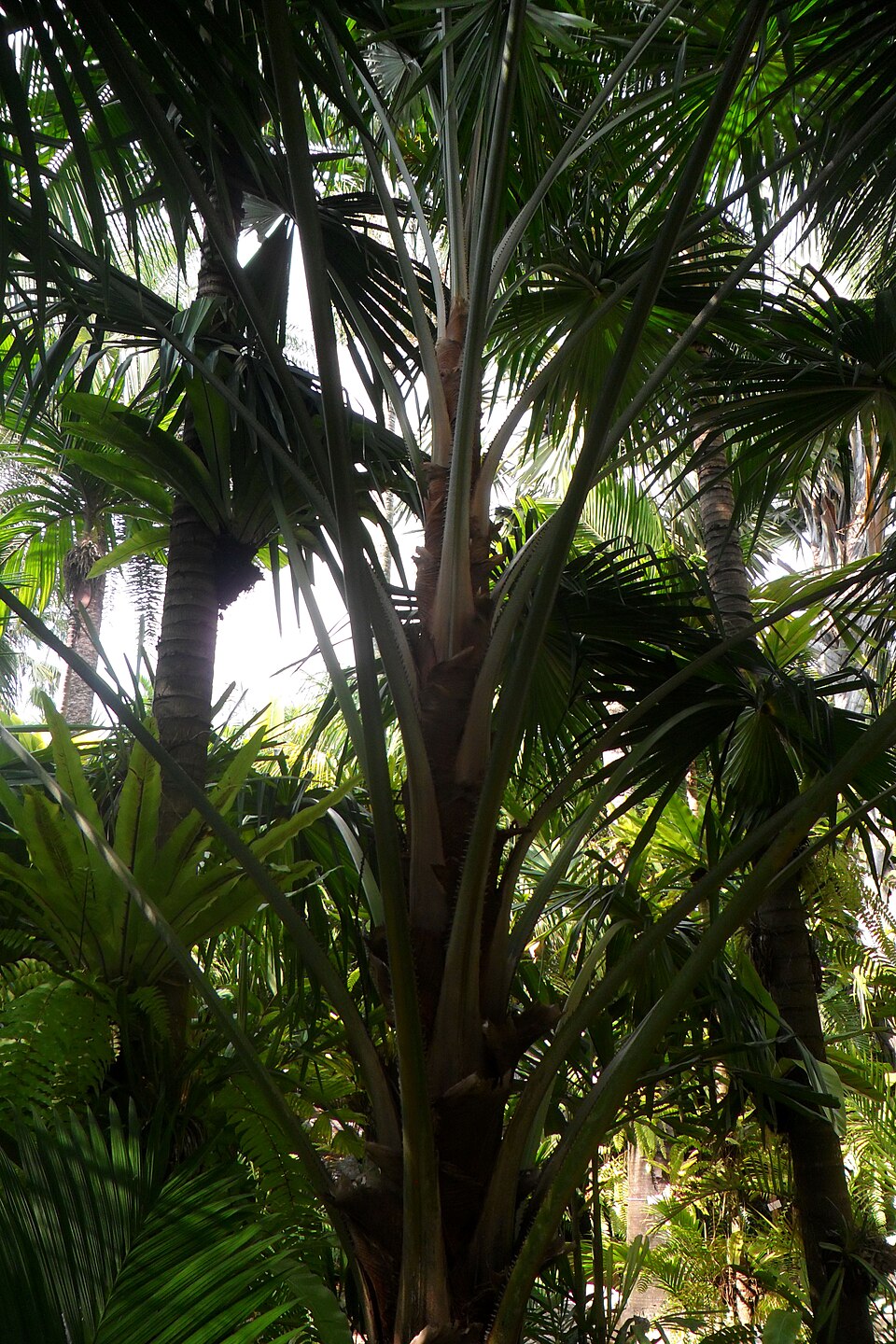
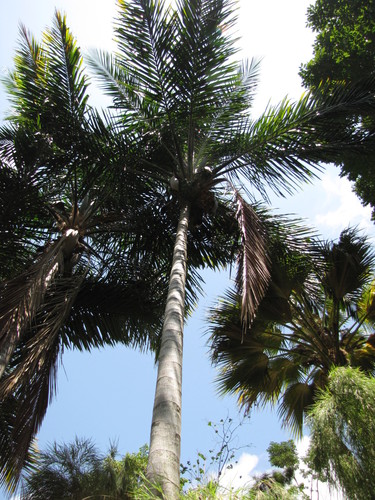
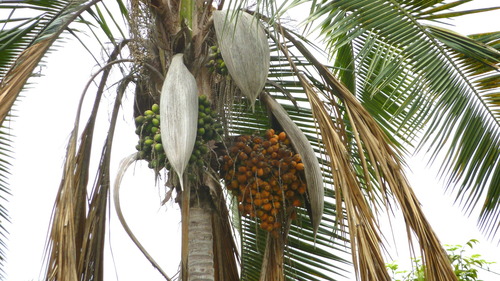
Source: WikipediaParajubaea torallyi, commonly known as the palma de Pasobaya or Bolivian mountain coconut, is a species of evergreen flowering plant of genus Parajubaea, in the family Arecaceae, closely related to the coconut palm in the tribe Cocoseae. It is endemic to Bolivia, where it grows in dry forests on steep rocky slopes at 2,400–3,400 metres (7,900–11,200 ft) in altitude. In its native habitat, due to high altitude, low night temperatures often drop to a range of -3C to -9C during local winter time (July, August), with considerable temperature spans between day and night and practically no precipitation during that time. Annual rainfall is around 500-600mm only, with majority during 2-3 months of the year. The palm therefore naturally occurs only in some valleys that have waterlines available within stony and sandy mountain ground for deep root access. Humidity in these micro climate valleys is quite high despite low precipitation, which might contribute to relief from heat stress by acquiring water over the leaves. It is cultivated in parks and alleys for its stunning ornamental properties united to its cold hardiness. Plants reach 10-15 meters in height and a trunk diameter of 25-50 cm. Leaves length will reach up to 4-5 meters within a crown of 10-15 pinnate leaves. Overall appearance stunningly resembles the tropical coconut palm in many features, i.e leaves, trunk, fruit structure including milk, hence its nickname "Bolivian Mountain Coconut". In cultivation it prefers a mild or cool climate and a neutral to acidic soil, and it tolerates droughts but not excess of water. Specifically it needs soil kept dry in order to withstand very low temperatures unharmed (up to -9C, below this point the palm might survive, but lose all its leaves before recovering for months), whereas it will thrive in hot summer weather only when watered regularly or equivalent ground water access. Normal garden soil is usually sufficient, but light and sandy soils are preferred over lime and cloggy substrates. Specimens have been successfully planted out in subtropical and warm temperature regions, such as (North and South) California, Spain, Portugal, Italy and even southern Switzerland (Tessin). It has shown not to grow well or even survive in climates too cold or too hot and humid (i.e. South Florida, Hawaii). Night frost is tolerated if daytime temperatures are above frost high enough to recover. The palm is used to 15-25C temperature changes between day and night from its natural habitat, but steady frost for day and night requires heating and other protection methods like thermal covers at least as long as severe frost prevails. Once a sufficient root network is established-which may take 1-2 years in a good spot-, it is pretty much self sufficient and can show very strong growth with up to 10-12 leaves a year (report from Portugal) and up to 1.5 meters of trunk and 5 meters in height in 6 years even when completely neglected in a dry spot in the wild (documented case in Southern California). Proven cases from Portugal indicate that extreme summer temperatures (up to 40C) are well tolerated with no growth slowdown, provided water access is sufficient. In winter, growth will stop at temperatures below 5-10C and space around palm should be mulched or covered to keep soil dry during low temperatures. Plants require a sunny position and some shelter from strong winds when young. It is now an endangered species, threatened by habitat loss.
Description
A palm. It grows about 14 m high. The crown is graceful with arching fronds. The fronds are 4.5-5 m long. The fruit is greyish-green and broadly oval. It is smooth and about 5 cm long. It has a sweet yellow kernel. The kernel is edible. This kernel has 3 prominent ridges.
Edible Uses
The sweet kernel is eaten fresh or chewed for its oil, with the remainder typically spat out. The nuts can also be pressed for edible oil, and the palm heart is edible.
Traditional Uses
The kernel is eaten. The nuts are chewed for the sweet oil and the remainder spat out. They can also be pressed for edible oil. The palm heart can be eaten.
Distribution
A tropical plant. It grows naturally in dry temperate forest from 1800 to 2700 m altitude. The climate is cool with some frosts. It grows naturally in Bolivia at high altitudes in arid areas and sandstone valleys. In Hobart Botanical Gardens.
Where It Grows
Andes, Australia, Bolivia*, Brazil, South America, Tasmania,
Cultivation
Plants are grown from seed. Seed are slow to germinate. Planting them shallowly then covering with sphagnum moss probably helps. To get seeds to germinate people have tried filing, cracking etc.
Propagation
Seed - best sown as soon as it is ripe. It usually germinates freely. Stored seed is more difficult to germinate, it should be pre-soaked for 24 hours in warm water before sowing. The seedlings quickly send down a large taproot and so need to be in deep pots. When they are large enough to handle, prick the seedlings out into deep, individual pots and grow them on until large enough to plant out. Traditionally, the seeds are allowed to dry completely for a couple of months in a cool, dry place. They are then planted on top of a loose, moist soil mix, under a 5 - 8cm blanket of moist sphagnum in a place which is cool at night and warm in the day. This helps with oxygen exchange in and out of the seed coat, which breaks down natural growth inhibitors in the seed. Germination can begin within a few weeks. If the seeds do not germinate within a few months, store them dry again for a few months in a cool, dry place. Then soak them for 7 days in warm water and resow.
Other Uses
The leaves are woven to make baskets and fans. Fibres obtained from the leaf sheaths and petioles are used to make ropes, twine, mattresses and donkey panniers. A fibre can be obtained from the trunk. Formerly, the stems were split in two and then cut into pieces 1 metre long, in order to extract and grind the internal fibres with an axe, and finally to weave ropes from the fibres.
Notes
There are 2 Parajubaea species. It is an endangered species.
Synonyms
Also Known As
Bolivian coconut, Janchicoco, Palmera zunca
References (12)
- Balick, M.J. and Beck, H.T., (Ed.), 1990, Useful palms of the World. A Synoptic Bibliography. Colombia p 159
- Facciola, S., 1998, Cornucopia 2: a Source Book of Edible Plants. Kampong Publications, p 30
- Gibbons, M., 2003, A pocket guide to Palms. Chartwell Books. p 154
- Grandtner, M. M. & Chevrette, J., 2013, Dictionary of Trees, Volume 2: South America: Nomenclature, Taxonomy and Ecology. Academic Press p 480
- Haynes, J., & McLaughlin, J., 2000, Edible palms and Their Uses. University of Florida Fact sheet MCDE-00-50-1 p 11
Show all 12 references Hide references
- Henderson, A., Galeano, G and Bernal, R., 1995, Field Guide to the Palms of the Americas. Princeton. p 151
- Jones, D.L., 1994, Palms throughout the World. Smithtonian Institution, Washington. p 56, 283
- Jones, D.L., 2000, Palms of Australia 3rd edition. Reed/New Holland. p 191
- Marcia, M. J., et al, 2011, Palm Uses in Northwestern South America: A Quantitative Review. Bot. Rev. (2011) 77:462-570
- Riffle, R.L. & Craft, P., 2003, An Encyclopedia of Cultivated Palms. Timber Press. p 399
- Wickens, G.E., 1995, Edible Nuts. FAO Non-wood forest products. FAO, Rome. p 169
- World Checklist of Useful Plant Species 2020. Royal Botanic Gardens, Kew