Phoenix loureiroi
Kunth
Khajoor
iNaturalist· cc-by
(c) chiuluan, some rights reserved (CC BY), uploaded by chiuluan
iNaturalist· cc-by-nc
(c) Liu JimFood, some rights reserved (CC BY-NC), uploaded by Liu JimFood
iNaturalist· cc-by-nc
(c) allen83059, some rights reserved (CC BY-NC), uploaded by allen83059
Summary
Source: WikipediaPhoenix loureiroi (commonly known as the mountain date palm, vuyavuy palm, or voyavoy palm,) is a species of flowering plant in the palm family, indigenous to southern Asia, from the Philippines, Taiwan, India, southern Bhutan, Burma, Thailand, Cambodia, Vietnam, Pakistan, and China. It occurs in deciduous and evergreen forests and in clear terrain from sea level to 1,500 m (4,900 ft) altitude. Phoenix loureiroi is named after João de Loureiro; it was originally written by Kunth as "loureirii", but this is an error to be corrected to loureiroi under the provisions of the ICBN.
Description
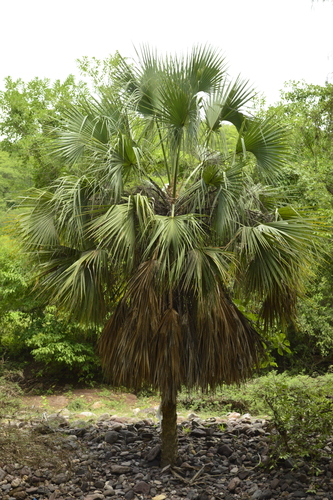
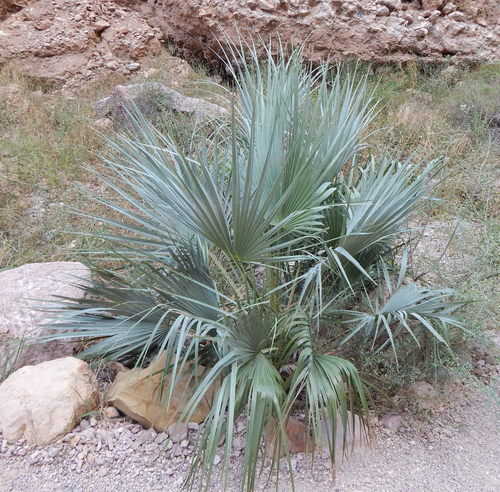
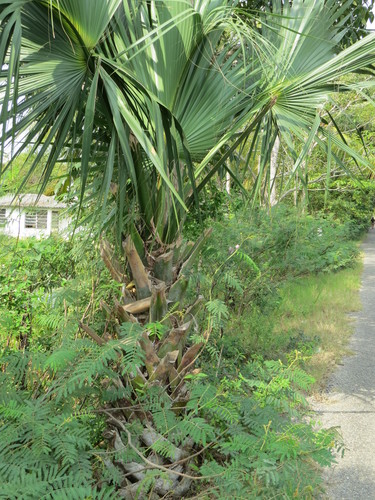
A clumping palm. It can grow up to 4 m high. The trunk can be 20-30 cm across. The old leaf bases are attached to the stems. The fronds are numerous and spreading. They are 2 m long and the leaflets 30 cm long. The leaf stalk is 60 cm long and compressed but not grooved and with long scattered spines. The leaflets are carried in several planes. They are twisted and curved back. The leaflets are bright green and narrow. They are stiff and well spaced. The flower stalk is in the axils of leaves and bears small pale yellow flowers. The flowering stalks are short. Male and female flowers are on separate plants. The fruiting branch has alternating clusters near the ends. The fruit are oblong. They are 12 mm long and dark purple when ripe. There is a sweet edible pulp around a hard seed. The stone of the seed has a groove along its length.
Edible Uses
The ripe fruit are eaten raw, with the sweet fleshy layer chewed and seeds spat out. An edible starch can also be extracted from the stem.
Traditional Uses
The ripe fruit are eaten raw. It is the fleshy layer of the ripe fruit that is chewed and the seeds are spat out. An edible starch can be extracted from the stem.
Medicinal Uses
The leaves are astringent. They are used in the treatment of intestinal troubles. A study has shown that the fruit is an effective treatment for inflammatory bowel diseases. A decoction of the leaves, with salt added, is used as a gargle to treat toothaches.
Distribution
A tropical plant. In the Philippines it grows from sea level to 1425 m altitude. It grows in low mountain forest as well as in cleared forest. It grows along mountain streams. It suits hardiness zones 10-12. In Yunnan. In Townsville palmetum.
Where It Grows
Asia, Australia, Bangladesh, Bhutan, Cambodia, China, Himalayas, Hong Kong, India, Indochina, Indonesia, Laos, Myanmar, Nepal, Northeastern India, Pacific, Pakistan, Philippines, SE Asia, Singapore, Taiwan, Thailand, Vietnam,
Cultivation
Plants can be grown from seeds.
Propagation
Seed - pre-soak for 24 hours in warm water and sow in containers. Germination usually takes place in 2 - 3 months. Seed viability can be maintained for 8 - 15 years at room temperature. Division of suckers. Pot up immediately into large containers and plant into permanent positions once the plant is established.
Other Uses
The leaves are woven into mats, baskets, hand-fans etc, The shredded, sun-dried, juvenile leaves are woven as raincoats. The leaves are used as thatch when making huts etc . The base of the leaves is used as a brush as a substitute for brooms and also as a brush for cleaning walls, windows, floors etc. This brush can also be used for the rough painting of walls and ceilings. The leaf stalks are used as fuel.
Production
The fruit weigh 0.5 g.
Other Information
The mature fruit are eaten by children.
Notes
There are 17 Phoenix species.
Synonyms
Also Known As
Bon khejur, Bukhajuro, Chitteetha, Eechipulla, Kattuthengu, Khajur, Kojiri, Palem korma, Mak bpeng, Thakal, Thangtup, Voyayoi
References (28)
- Acharya K. P. and Acharya, R., 2010, Eating from the Wild: Indigenous knowledge on wild edible plants in Parroha VDC of Rupandehi District, Central Nepal. International Journal of Social Forestry. 3(1):28-48
- Amoros, A., et al, 2014, Physico-chemical and functional characteristics of date fruits from different Phoenix species (Arecaceae). Fruits, Vol. 69, p. 315-323
- Binu, S., 2010, Wild edible plants by the tribals in Pathanamthitta district, Kerala. Indian Journal of Traditional Knowledge. 9(2): 309-312
- Blomberry, A. & Rodd, T., 1982, Palms. An informative practical guide. Angus & Robertson. p 141
- Cundall, P., (ed.), 2004, Gardening Australia: flora: the gardener's bible. ABC Books. p 1030
Show all 28 references Hide references
- Enum. pl. 3:257. 1841 "loureirii" - epithet correctable to "loureiroi" in accordance with ICBN Art. 60.7, Ex. 11
- Flora of Pakistan. www.eFloras.org
- Gautam, R. S., et al, 2020, Wild Edible Fruits of Nepal. Int. J. Appl. Sci. Biotechnol. Vol 8(3): 289-304
- Gautam, R. S., et al, 2022, Ethnobotanical Review of Wild Edible Plants of Nepal. Journal of Natural History Museum Volume 32, 2021-22 p 105
- Haynes, J., & McLaughlin, J., 2000, Edible palms and Their Uses. University of Florida Fact sheet MCDE-00-50-1 p 11
- Hu, Shiu-ying, 2005, Food Plants of China. The Chinese University Press. p 303
- Johnson, D.V., 1998, Tropical palms. Non-wood Forest products 10. FAO Rome. p 48
- Jones, D.L., 1994, Palms throughout the World. Smithtonian Institution, Washington. p 54, 287
- Jones, D.L., 2000, Palms of Australia 3rd edition. Reed/New Holland. p 195
- Kuo, W. H. J., (Ed.) Taiwan's Ethnobotanical Database (1900-2000), http://tk.agron.ntu.edu.tw/ethnobot/DB1.htm (As Phoenix hanceana var. philippinensis)
- Lord, E.E., & Willis, J.H., 1999, Shrubs and Trees for Australian gardens. Lothian. p 98
- Majumdar, K and Datta, N., 2009, Traditional wild edible fruits for the forest dwellers of Tripura, India. Pleione 3(2) 167-178 (As Phoenix humilis)
- Meitei, L. R., et al, 2022, An ethnobotanical study on the wild edible plants used by forest dwellers in Yangoupokpi Lokchao Wildlife Sanctuary, Manipur, India. Ethnobotany Research and Application 23:15
- Misra S. & Misra M., 2016, Ethnobotanical and Nutritional Evaluation of Some Edible Fruit Plants of Southern Odisha, India. International Journal of Advances in Agricultural Science and Technology, Vol.3 Issue.1, March- 2016, pg. 1-30
- Monsalud, M.R., Tongacan, A.L., Lopez, F.R., & Lagrimas, M.Q., 1966, Edible Wild Plants in Philippine Forests. Philippine Journal of Science. p 529 (As Phoenix hanceana var. philippinensis)
- Rasingam, L., 2012, Ethnobotanical studies on the wild edible plants of Irula tribes of Pillur Valley, Coimbatore district, Tamil Nadu, India. Asian Pacific Journal of Tropical Biomedicine. (2012) S1493-S1497
- Reddy, K. N. et al, 2007, Traditional knowledge on wild food plants in Andhra Pradesh. Indian Journal of Traditional Knowledge. Vol. 6(1): 223-229
- Riffle, R.L. & Craft, P., 2003, An Encyclopedia of Cultivated Palms. Timber Press. p 403
- Sasi, R. et al, 2011, Wild edible plant Diversity of Kotagiri Hills - a Part of Nilgiri Biosphere Reserve, Southern India. Journal of Research in Biology. Vol. 1 No. 2, pp 80-87
- Sasi, R. & Rajendran, A., 2012, Diversity of Wild Fruits in Nilgiri Hills of the Southern Western Ghats - Ethnobotanical Aspects. IJABPT, 3(1) p 82-87
- Sukarya, D. G., (Ed.) 2013, 3,500 Plant Species of the Botanic Gardens of Indonesia. LIPI p 800
- Tamil herbs, 2007, Edible Plants of the Tropical Dry Evergreen Forest.
- www.mekonginfo.org/assets/midocs/0001714-environment-forests-and-trees-of-the-central-highlands-of-xieng-khouang-lao