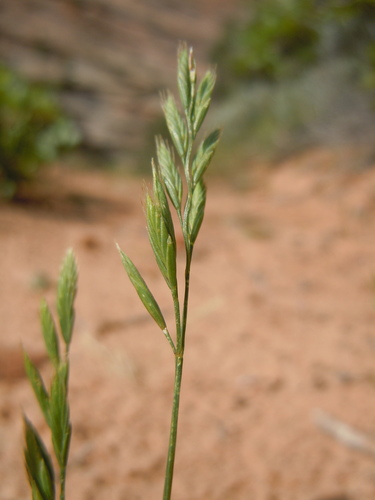
Zizania palustris
L.
Northern wild rice
iNaturalist· cc-by-nc
(c) Daniel Stewart, some rights reserved (CC BY-NC), uploaded by Daniel Stewart
iNaturalist· cc-by-nc
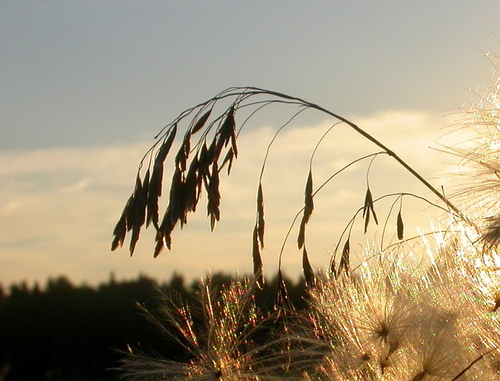
(c) Jean-Marc Vallières, some rights reserved (CC BY-NC), uploaded by Jean-Marc Vallières
iNaturalist· cc-by
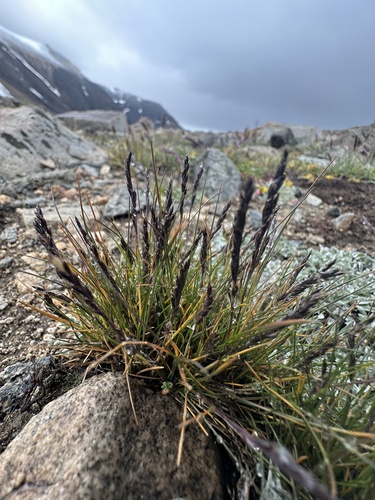
(c) Mary Krieger, some rights reserved (CC BY), uploaded by Mary Krieger
Description
A grass which grows in water. It grows each year from seed. It grows 60-70 cm tall. It can be 160 cm tall. It has a shallow rooting system. The stems tiller or form shoots from the base. There can be 50 tillers per plant. The leaf blade is narrow. It is 6-32 mm wide. There are often 5-6 leaves above the water. The flowers are on a slender, much branched panicle. The lower male spikelets hang down while the upper female spikelets are erect. The seed is like a cylinder and 8-16 mm long by 1.5-4.5 mm wide. They are dark brown to purple-black. The grain is tightly enclosed.
Edible Uses
The species most commonly harvested as grain are the annual species: Zizania palustris and Zizania aquatica. The former, though now domesticated and grown commercially, is still often gathered from lakes in the traditional manner, especially by indigenous peoples in North America; the latter was also used extensively in the past. The stems and root shoots also contain an edible portion on the interior.
Traditional Uses
The grains are cooked and eaten like rice.
This uses section is brief — help expand it
Known Hazards
Wild rice seeds can be infected by the highly toxic fungus ergot, which is dangerous if eaten. Infected grains have pink or purplish blotches or growths of the fungus, from the size of a seed to several times larger.
Distribution
It is a temperate plant. It can be grown like water grown rice. It grows in deeper and cooler water.
Where It Grows
Canada, North America*, USA,
Cultivation
The plants are grown from seed. The seed are dormant for 3 months before they will grow. Seed should be stored in water below 3°C to keep them viable.
Production
Yields or 480-1250 kg/ha are average. The open grains are allowed to ferment in the open air for 4-7 days after harvest. The fermented grain is then dried in an oven for 2 hours at a temperature over 125°C.
Nutrition
| Part | Moisture | kJ | kcal | Protein | Vit A | Vit C | Iron | Zinc |
|---|---|---|---|---|---|---|---|---|
| Shoots | 91.4 | 121 | 29 | 1.6 | — | — | 1 | — |
Synonyms
Also Known As
American wild rice, Indian rice, Mamomin, Wild rice
References (12)
- Beckstrom-Sternberg, Stephen M., and James A. Duke. "The Foodplant Database." http://probe.nalusda.gov:8300/cgi-bin/browse/foodplantdb.(ACEDB version 4.0 - data version July 1994)
- Food Composition Tables for use in East Asia FAO http://www.fao.org/infoods/directory No. 789
- MacKinnon, A., et al, 2009, Edible & Medicinal Plants of Canada. Lone Pine. p 374
- Mant. pl. 2:295. 1771
- Marinelli, J. (Ed), 2004, Plant. DK. p 278
Show all 12 references Hide references
- Moerman, D. F., 2010, Native American Ethnobotany. Timber Press. p 614
- PROSEA (Plant Resources of South East Asia) handbook Volume 10 Cereals. p 154
- Romanowski, N., 2007, Edible Water Gardens. Hyland House. p 73
- USDA, ARS, National Genetic Resources Program. Germplasm Resources Information Network - (GRIN). [Online Database] National Germplasm Resources Laboratory, Beltsville, Maryland. Available: www.ars-grin.gov/cgi-bin/npgs/html/econ.pl (10 April 2000)
- Vaughan, J. C. & Geissler, C. A., 2009, The new Oxford Book of Food Plants. Oxford University Press. p 8
- Wiersema, J. H. & Leon, B., 2013, World Economic Plants. A Standard Reference CRC Press. 2nd Ed. p 736
- World Checklist of Useful Plant Species 2020. Royal Botanic Gardens, Kew