Vitis labrusca
L.
Fox grape
wikimedia· cc-by
midiman (via Wikimedia Commons)
wikimedia· cc-by
Lucy Keith-Diagne (via Wikimedia Commons)
wikimedia· cc0
Britton, Nathaniel Lord, and A. Brown (via Wikimedia Commons)
iNaturalist· cc-by-nc
(c) Sara Rall, some rights reserved (CC BY-NC), uploaded by Sara Rall
iNaturalist· cc-by-nc
(c) Theo Witsell, some rights reserved (CC BY-NC), uploaded by Theo Witsell
iNaturalist· cc-by-nc
(c) Gwyneth Govers, some rights reserved (CC BY-NC), uploaded by Gwyneth Govers
Summary
Source: WikipediaVitis labrusca, the fox grape, is a species of grapevines belonging to the Vitis genus in the flowering plant family Vitaceae. The vines are native to eastern North America and are the source of many grape cultivars, including Catawba, Concord, Delaware, Isabella, Niagara, and many hybrid grape varieties such as Agawam, Alexander and Onaka. Among the characteristics of this vine species in contrast to the European wine grape Vitis vinifera are its "slip-skin" that allows the skin of the grape berries to easily slip off when squeezed, instead of crushing the pulp, and the presence of tendrils on every node of the cane. Vitis labrusca also tends to have strong resistance to mildews and phylloxera. Another contrast with European V. vinifera are unique flavors, best known to most people through the Concord grape. The term "foxy" became a sort of catchall for the wine tasting descriptors used for these American wines that were distinct from the familiar flavors of the European viniferous wines. These flavors have been described as strawberry, raspberry, cotton candy, and "grapey" (because Americans associate these flavors with popular grape juices, candies, jellies and jams, sodas, and more made with Concord grapes). Occasionally, depending on the winemaking, V. labrusca grapes can impart a musky flavor to wine, which some find intriguing while others dislike, but this can be mitigated or increased by winegrowing and winemaking practices. Vitis labrusca is in the parentage of the world's most planted grape variety, Kyoho.
Description
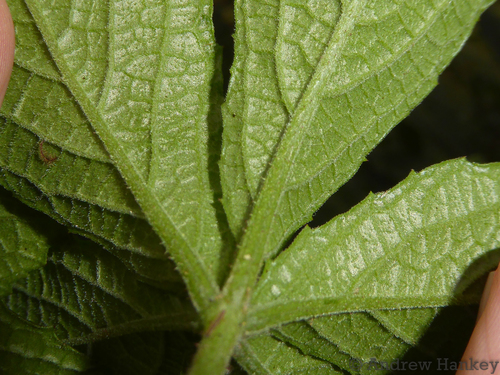
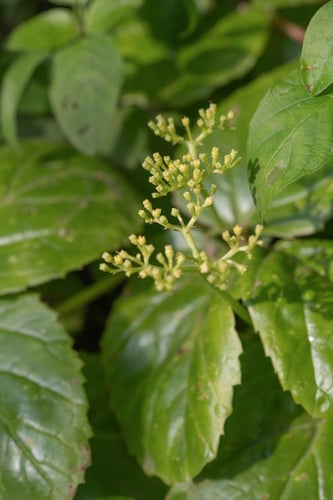
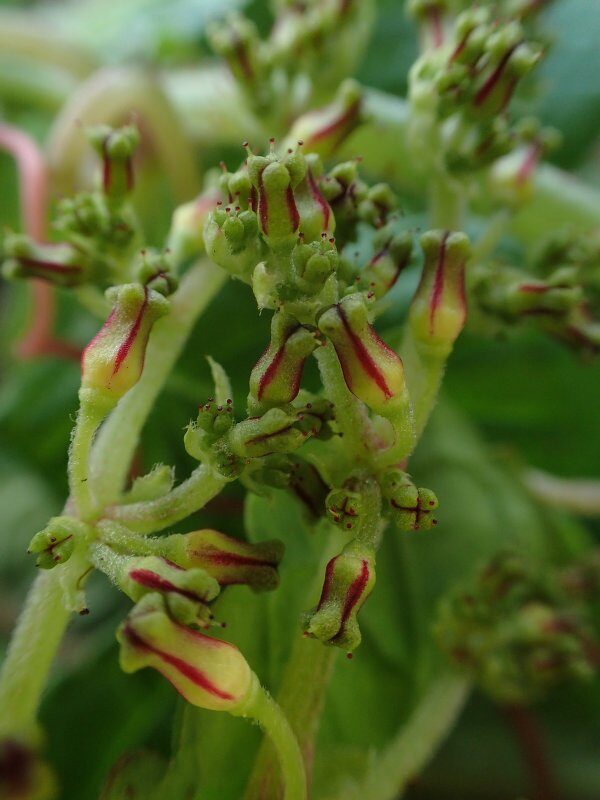
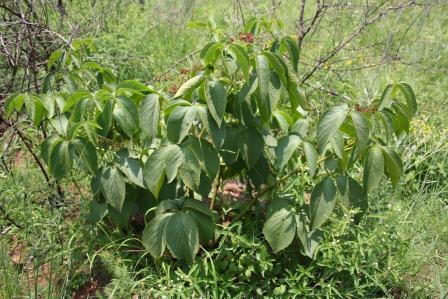
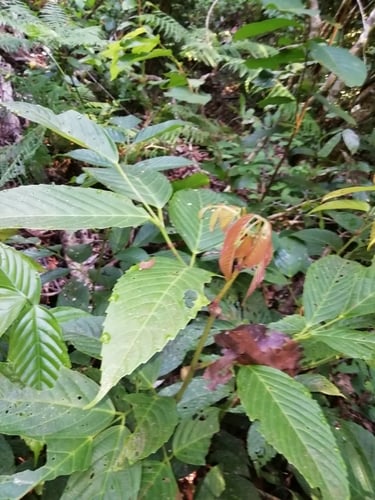
A woody vine. It keeps growing from year to year. The young shoots are long and like felt. The leaves are large and 3 lobed. They are deep green above and like felt and white underneath. The leaves are leathery and 15-30 cm long. The flowers are in closely branched groups with male and female flowers in the same group. The fruit are large and purple-black. They are 2-3 cm across. They have a musky flavour.
Edible Uses
The fruit can be eaten raw or dried for winter use, and also made into pies and preserves. It has a distinctive musky aroma and flavour that many people find unappealing, though it becomes sweeter after a frost, containing 6.6–16.6% sugars. Berries grow up to 2cm in diameter and are produced in fairly large bunches. Young leaves have a pleasant acidic flavour and can be cooked as greens or wrapped around other foods and baked. Young tendrils are edible raw or cooked. The sap is best harvested in spring or early summer when it has a sweet flavour and makes a pleasant drink, though it should not be taken in large quantities as this will weaken the plant. An oil can be extracted from the seeds, though this is only practical when large quantities of grapes are being grown for wine.
Traditional Uses
The fruit are eaten raw. They are also dried or preserved. They are used for juice, jellies, jams, pies, conserves and syrups. They are used for drinks or fermented into wine or vinegar. The leaves are eaten cooked and used to wrap other foods. They are also preserved in salt. The leaves are used for sarma in Turkey. They are rolled around a filling of rice or minced meat.
Medicinal Uses
The leaves are hepatic. An infusion has been used to treat diarrhoea, hepatitis, stomach aches, fevers, headaches, and thrush. Externally, leaves are applied as a poultice to sore breasts, rheumatic joints, and headaches. Wilted leaves have been poulticed onto the breasts to relieve soreness after childbirth. An infusion of the bark has been used to treat urinary complaints.
Distribution
It is a temperate plant. It needs full sun and a well-drained fertile soil. It is more resistant to insect, pest and diseases than Vitis vinifera. It suits plant hardiness zones 4-9.
Where It Grows
Africa, Albania, Asia, Australia, Balkans, Brazil, Caucasus, Central Asia, China, East Africa, Europe, Georgia, Madagascar, Marquesas, Mediterranean, North America, South America, Tajikistan, Tasmania, Ukraine, USA,
Cultivation
Prefers a deep rich moist well-drained moderately fertile loam. Grows best in a calcareous soil. Succeeds in sun or partial shade though a warm sunny position is required for the fruit to ripen. The young growth in spring can be damaged by late frosts. Plants climb by means of tendrils, they grow particularly well into elm trees. The flowers have the sweet scent of mignonette. Any pruning should be carried out in winter when the plants are dormant otherwise they bleed profusely. Cultivated for its edible fruit in N. America, where it can produce yields of up to 17 tonnes per hectare. It is the parent of several named varieties. However, it is of no value as a fruit bearer in Britain, requiring hotter summers than are usually experienced in this country in order to ripen its fruit. Another report says that this species is of interest for its hardiness and its ability to produce crops in cooler climates. Resistant to Phylloxera disease, a disease that almost destroyed the European grape crops. This species can be used as a rootstock in areas where the disease is prevalent and can also be used in breeding programmes with V. vinifera in order to impart resistance to that species. Plants in this genus are notably susceptible to honey fungus. Woody. Growth habit is a single or multiple shooting vine from a crown. Grapes are usually harvested in late summer to early autumn, specifically from late summer through fall, depending on the variety and climate. Grapes typically flower in late spring to early summer. Grapes are considered fast-growing vines, often reaching maturity within 3 to 4 years, depending on the variety and growing conditions. Many Vitis vinifera varieties are self-fertile, meaning they can produce fruit without cross-pollination.
Propagation
Seed is best sown in a cold frame as soon as it ripens. Six weeks of cold stratification improves germination rates, so stored seed should be sown in a cold frame as soon as it is obtained. Germination usually occurs in the first spring but may take another 12 months. Prick seedlings into individual pots when large enough to handle, overwinter in a cold frame, and plant out in early summer. Hardwood cuttings of the current season's growth can be taken in December or January and rooted in a frame. These may be 15–30cm long, or short single-bud sections about 5cm long. For the shorter sections, remove a thin strip of bark roughly 3cm long from the lower side to encourage callusing and rooting; these smaller cuttings need more protection than longer ones. Layering is also an option.
Other Uses
Grapes can be used as ground cover to help prevent soil erosion and support biodiversity, providing habitat for beneficial insects and wildlife. A yellow dye is obtained from fresh or dried leaves. The plant is used as a rootstock for the common grape, Vitis vinifera, particularly in areas where phylloxera disease is prevalent. The flowers are rich in nectar and pollen and are attractive to bees and other beneficial insects. The fruit is consumed by birds, mammals, and insects. Foliage and associated leaf litter can provide shelter for various invertebrates. The leaves and fruits have aromatic properties that may help confuse certain pests.
Other Information
It is cultivated.
Notes
There are 60 to 70 species of Vitis.
Dangerous Lookalikes
This plant can be confused with the following toxic species. Always verify identification carefully before consuming any wild plant.
Canadian Moonseed
Menispermum canadense
Cbaile19
Fox grape
Vitis labrusca
midiman (via Wikimedia Commons)
Canadian Moonseed: No tendrils, single crescent/moon-shaped seed, leaf stem attaches to underside of leaf.
Fox grape: Vine with tendrils, round seeds, leaf stem at edge of leaf, bark that peels.
Also Known As
Adessa, American wine grape, Catawba, Concord grape, Izabela, Northern fox grape, Skunk grape, Slip skin grape, Uva-americana
References (30)
- Beckstrom-Sternberg, Stephen M., and James A. Duke. "The Foodplant Database." http://probe.nalusda.gov:8300/cgi-bin/browse/foodplantdb.(ACEDB version 4.0 - data version July 1994)
- Bussman, R. W., et al, 2021, Unity in diversity—food plants and fungi of Sakartvelo (Republic of Georgia), Caucasus. Journal of Ethnobiology and Ethnomedicine (2021) 17:72 p 15
- Cheifetz, A., (ed), 1999, 500 popular vegetables, herbs, fruits and nuts for Australian Gardeners. Random House p 254
- Crandall, C & Crandall, B., 1996, Flowering Fruiting and Foliage vines. Sterling. p 94
- Dogan, Y., et al, 2015, Of the importance of a leaf: the ethnobotany of sarma in Turkey and the Balkans. Journal of Ethnobiology and Ethnomedicine, 11:56
Show all 30 references Hide references
- Duke, J.A., 1992, Handbook of Edible Weeds. CRC Press. p 212
- Facciola, S., 1998, Cornucopia 2: a Source Book of Edible Plants. Kampong Publications, p 246
- Flowerdew, B., 2000, Complete Fruit Book. Kyle Cathie Ltd., London. p 92
- Hedrick, U.P., 1919, (Ed.), Sturtevant's edible plants of the world. p 684
- Heywood, V.H., Brummitt, R.K., Culham, A., and Seberg, O. 2007, Flowering Plant Families of the World. Royal Botanical Gardens, Kew. p 335
- Hibbert, M., 2002, The Aussie Plant Finder 2002, Florilegium. p 308
- Hu, Shiu-ying, 2005, Food Plants of China. The Chinese University Press. p 535
- Jardin, C., 1970, List of Foods Used In Africa, FAO Nutrition Information Document Series No 2.p 168
- John, L., & Stevenson, V., 1979, The Complete Book of Fruit. Angus & Robertson p 142
- Kermath, B. M., et al, 2014, Food Plants in the Americas: A survey of the domesticated, cultivated and wild plants used for Human food in North, Central and South America and the Caribbean. On line draft. p 921
- Kiple, K.F. & Ornelas, K.C., (eds), 2000, The Cambridge World History of Food. CUP p 1747
- Lorenzi, H., Bacher, L., Lacerda, M. & Sartori, S., 2006, Brazilian Fruits & Cultivated Exotics. Sao Paulo, Instituto Plantarum de Estuados da Flora Ltda. p 626
- Moerman, D. F., 2010, Native American Ethnobotany. Timber Press. p 599
- Pieroni, A. et al, 2014, Resilience at the border: traditional botanical knowledge among Macedonians and Albanian living in Gollobordo, Eastern Albania. Journal of Ethnobiology and Ethnomedicine. 10:31
- Pieroni, A. & Soukand, R., 2017, Are Borders more Important than Geographical Distance? The Wild Food Ethnobotany of the Boykos and its Overlap with that of the Bukovinian Hutsuls in Western Ukraine. Journal of Ethnobiology 37(2): 326–345
- Plants for a Future database, The Field, Penpol, Lostwithiel, Cornwall, PL22 0NG, UK. http://www.scs.leeds.ac.uk/pfaf/
- Small, E., 2009, Top 100 Food Plants. The world's most important culinary crops. NRC Research Press. p 279
- Sp. pl. 1:202. 1753
- Toupal, R. S. & Hollenback, K., 2009, An Ethnobotany of Indiana Dunes National Lakeshore: Plant Uses of the Ojibwa People. Bureau of Applied Research in Anthropology. University of Arizona
- Uphof,
- USDA, ARS, National Genetic Resources Program. Germplasm Resources Information Network - (GRIN). [Online Database] National Germplasm Resources Laboratory, Beltsville, Maryland. Available: www.ars-grin.gov/cgi-bin/npgs/html/econ.pl (10 April 2000)
- van Wyk, B., 2005, Food Plants of the World. An illustrated guide. Timber press. p 384
- Wiersema, J. H. & Leon, B., 2013, World Economic Plants. A Standard Reference CRC Press. 2nd Ed. p 725
- World Checklist of Useful Plant Species 2020. Royal Botanic Gardens, Kew
- Zeven, A. C. & de West, J. M. J., 1982, Dictionary of cultivated plants and their regions of diversity. Wageningen. p 102