Vangueria apiculata
K. Schum.
Tangle-flowered wild medlar
iNaturalist· cc-by-nc
(c) Bart Wursten, some rights reserved (CC BY-NC), uploaded by Bart Wursten
iNaturalist· cc-by-nc
(c) Bart Wursten, some rights reserved (CC BY-NC)
Summary
Source: WikipediaVangueria apiculata is a species of flowering plant in the family Rubiaceae. It is found from Ethiopia to South Tropical Africa.
Description
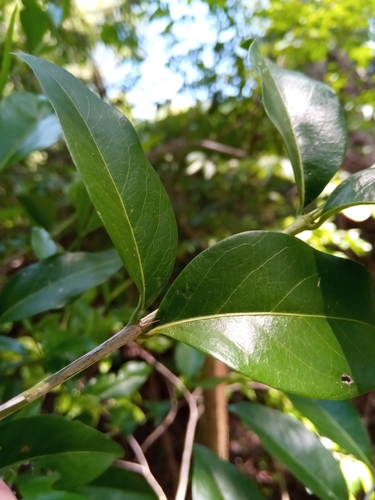
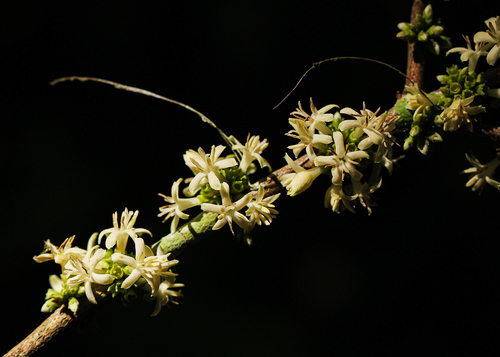
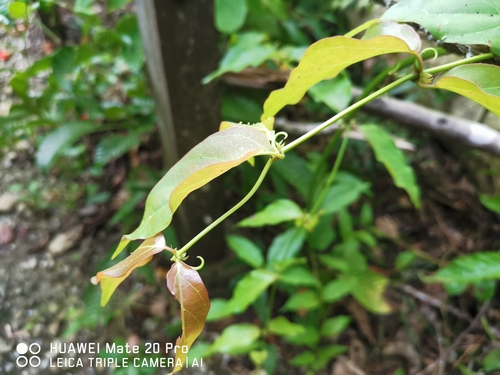
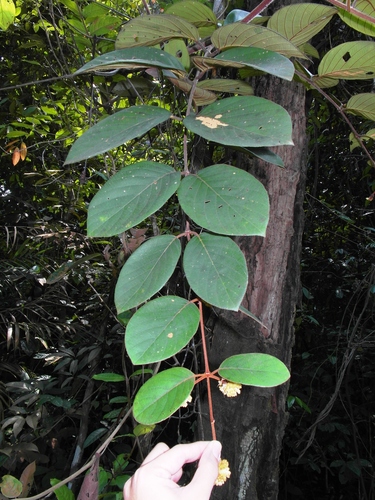
A shrub which loses its leaves during the year. It grows 1.5 to 10 m tall. The bark is smooth and grey-brown. The leaves are thin and papery without hairs. The are oval with a pointed tip. They are about 13 cm long by 6 cm wide. There are 7-11 main veins on each side of the midrib. The network of veins can be seen underneath the leaf. The leaf stalk is 7 mm long. The flowers grow beside the leaves. They are greenish-white and in much branched bunches. The flowers are like tiny tubes. The fruit is green but becomes yellow brown when ripe. The fruit is round and 17-20 mm long. The fruit is edible.
Edible Uses
The ripe fruit are eaten raw as a snack, with the seeds discarded.
Traditional Uses
The ripe fruit are eaten raw as a snack. The seeds are discarded.
This uses section is brief — help expand it
Medicinal Uses
The leaves are used to cure stomach-ache. The roots are boiled and the decoction is used three times a day to rid the body of intestinal worms.
Distribution
A tropical species. It grows in evergreen forest. It often occurs on termite mounds and on rocky ground. It grows in open forest, secondary scrub and cultivated land. In Kenya it grows between 900-2,500 m altitude.
Where It Grows
Africa, Central Africa, Congo, East Africa, Ethiopia, Kenya, Malawi, Mozambique, Rwanda, Somalia, Southern Africa, South Sudan, Sudan, Tanzania, Uganda, Zambia, Zimbabwe,
Cultivation
Plants are grown from seed. Seed is sown directly where the plants are to grow. Plants can be grown in pots then transplanted. It may be useful to soak seeds overnight in cold water. Seed should be sown as soon as they are separated from the fruit. Plants can be topped or cut back and allowed to regrow.
Other Uses
The wood is hard, tough and heavy. It is used for poles, pegs and tool handles. The wood is used for fuel and to make charcoal. The tree is important in agroforestry. (No more information is given)
Production
Fruit are collected in the dry season. They are harvested by climbing the tree.
Other Information
It is a useful backyard fruit tree.
Synonyms
Also Known As
Adenogonye, Amatungunga, Amalera, Aruwano, Elepulepu, Emaler, Emalere, Engumi, Engumieker, Esilepulepu, Garo, Ghallat al merissa, Gurmase, Hawa, Ilgum, Jooc, Kalepulepu, Kaworo, Kikomoa, Kimolwet, Kivireo, Kiviroe, Kukukomosi, Lkoromosei, Magugunwa, Matungunda, Mdawa, Mdowo, Mgugunwa, Mkondikondo, Msambalawe, Mseka, Mukomoa, Muvuma, Mviru, Ndawiro, Ol-gumi, Omorokodo, Polere, Shikhomoli, Taparper, Tapirpirwa, Timpliqisha, Umukoondokoondo
References (41)
- Acipa, A. et al, 2013, Nutritional Profile of some Selected Food Plants of Otwal and Ngai Counties, Oyam District, Northern Uganda. African Journal or Food, Agriculture, Nutrition and Development. 13(2)
- Agea, J. G., et al 2011, Wild and Semi-wild Food Plants of Bunyoro-Kitara Kingdom of Uganda: etc. Environmental Research Journal 5(2) 74-86
- Awas, T., 1997, A Study on the Ecology and Ethnobotany of Non-cultivated Food Plants and Wild Relatives of Cultivated crops in Gambella Region, Southwestern Ethiopia. Addis Ababa University. p 64
- Awodoyin, R.O., Olubode, O.S., Ogbu, J.U., Balogun, R.B., Nwawuisi, J.U. and Orji, K.O., 2015, Indigenous Fruit Trees of Tropical Africa: Status, Opportunity for Development and Biodiversity Management. Agricultural Sciences, 6, 31-41
- Balemie, K., & Kebebew, F., 2006, Ethnobotanical study of wild edible plants in Derashe and Kucha Districts, South Ethiopia. Journal of Ethnobiology and Ethnomedicine. 2:53
Show all 41 references Hide references
- Berihun, T. & Molla, E., 2017, Study on the Diversity and Use of Wild Edible Plants in Bullen District Northwest Ethiopia. Hindawi Journal of Botany. Article ID 8383468
- Bussman, R. W., 2006, Ethnobotany of the Samburu of Mt Nyiru, South Turkana, Kenya. Journal of Ethnobiology and Ethnomedicine. 2:35
- Dale, I. R. and Greenway, P. J., 1961, Kenya Trees and Shrubs. Nairobi. p 478
- East African Herbarium records, 1981,
- Fowler, D. G., 2007, Zambian Plants: Their Vernacular Names and Uses. Kew. p 84
- Glover et al, 1966b,
- Godfrey, J. et al, 2013, Harvesting, preparation and preservation of commonly consumed wild and semi-wild food plants in Bunyoro-Kitara Kingdom, Uganda. Int. J. Med. Arom. Plants. Vol.3 No.2 pp 262-282
- Goode, P., 1989, Edible Plants of Uganda. FAO p 27
- Goode, P., 1989, Edible Plants of Uganda. FAO p 37
- Grivetti, L. E., 1980, Agricultural development: present and potential role of edible wild plants. Part 2: Sub-Saharan Africa, Report to the Department of State Agency for International Development. p 45
- Jardin, C., 1970, List of Foods Used In Africa, FAO Nutrition Information Document Series No 2.p 167
- Johns, T., Mhoro, E. B. and Sanaya, P., 1996, Food Plants and Masticants of the Batemi of Ngorongoro District, Tanzania. Economic Botany, Vol. 50, No. 1, pp. 115-121
- Katende, A.B., Birnie, A & Tengnas B., 1995, Useful Trees and Shrubs for Uganda. Identification, Propagation and Management for Agricultural and Pastoral Communities. Technical handbook No 10. Regional Soil Conservation Unit, Nairobi, Kenya. p 650
- Kenya Trees, Shrubs, Lianas, 1994, nzdl.org
- Kidane, B., et al, 2014, Ethnobotany of Wild and Semi-wild Edible Fruit Species used by Maale and Ari Ethnic Communities in South Ethiopia. Ethnobotany Research and Applications. Vol. 12, 1546-3465-12-455
- Kokwaro, J. O. and Johns. T., Luo Biological Dictionary. p 22
- Lovett, J. C. et al, Field Guide to the Moist Forest Trees of Tanzania. p 144
- Lulekal, E., et al, 2011, Wild edible plants in Ethiopia: a review on their potential to combat food insecurity. Afrika Focus - Vol. 24, No 2. pp 71-121
- Makonda, F. B. S., & Ruffo, C. K., 2011, Species List. NAFORMA, Tanzania
- Masters, T., 2021, Traditional food plants of the upper Aswa River catchment of northern Uganda—a cultural crossroads. Journal of Ethnobiology and Ethnomedicine (2021) 17:24
- Maundu, P. et al, 1999, Traditional Food Plants of Kenya. National Museum of Kenya. 288p
- Mbuvi, M. T. E., et al, 2019, Annonated checklist of plant species of Loita Forest Narok County, Kenya. Int. J. Adv. Res. Biol. Sci. (2019). 6(3): 54-110
- Mpasiwakomu, R. A., 2017, The Diversity and Utilization of Wild Edible and Medicinal Plant Species found in Uvinza Miombo Woodlands, Tanzania. M. Sc. thesis University of Tanzania.
- Msola, D. K., 2007, The role of Wild Foods in Household Income and Food Security in Mufundi District, Tanzania. Morogoro, Tanzania. p 44
- Mutie, F. G., 2020, Conservation of Wild Food Plants and Their Potential for Combatting Food Insecurity in Kenya as Exemplified by the Drylands of Kitui County. Plants 2020, 9, 1017
- Mutie, F. M., et al, 2023, Important Medicinal and Food Taxa (Orders and Families) in Kenya, Based on Three Quantitative Approaches. Plants 2023, 12, 1145
- Ocho, D. L., et al, 2012, Assessing the levels of food shortage using the traffic light metaphor by analyzing the gathering and consumption of wild food plants, crop parts and crop residues in Konso, Ethiopia. Journal of Ethnobiology and Ethnomedicine 8:30
- Ojelel, S., et al, 2019, Wild edible plants used by communities in and around selected forest reserves of Teso-Karamoja region, Uganda. Journal of Ethnobiology and Ethnomedicine (2019) 15:3
- Oryema, C., et al, 2013, Edible wild fruit species of Gulu District, Uganda. International Journal of Biology and Biological Sciences Vol 2(4) pp 068-082
- Palgrave, K.C., 1996, Trees of Southern Africa. Struik Publishers. p 872
- Peters, C. R., O'Brien, E. M., and Drummond, R.B., 1992, Edible Wild plants of Sub-saharan Africa. Kew. p 176
- Ruffo, C. K., Birnie, A. & Tengnas, B., 2002, Edible Wild Plants of Tanzania. RELMA p 702
- Strangeland, T et al, 2009, Total antioxidant activity in 35 Ugandan fruits and vegetables. Food Chemistry 113: 85-91
- Termote, C., et al, 2014, Assessing the potential of wild foods to reduce the cost of a nutritionally adequate diet: An example from eastern Baringo District, Kenya. Food and Nutrition Bulletin, vol. 35, no. 4
- von Katja Rembold, 2011, Conservation status of the vascular plants in East African rain forests. Dissertation Universitat Koblenz-Landau p 185
- White, F., Dowsett-Lemaire, F. and Chapman, J. D., 2001, Evergreen Forest Flora of Malawi. Kew. p 502