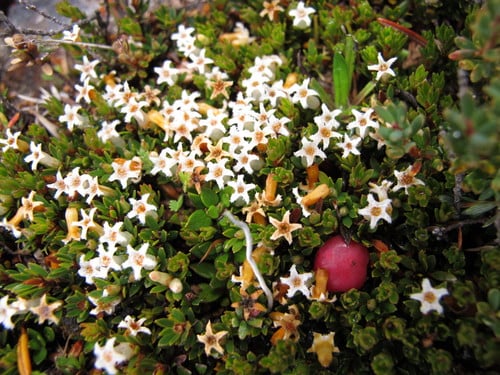
Vaccinium myrtillus
L.
Whortleberry, Bilberry, European blueberry
iNaturalist· cc-by-nc
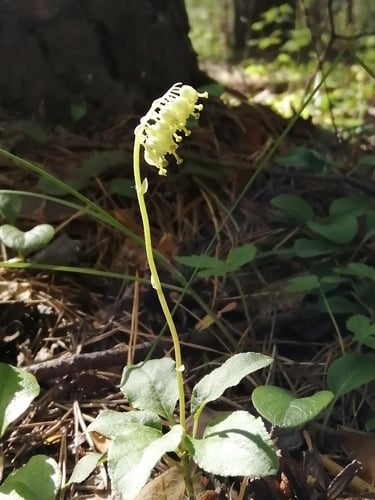
(c) Дмитрий Власов, some rights reserved (CC BY-NC), uploaded by Дмитрий Власов
iNaturalist· cc-by-nc
(c) Lilia Efimtseva, some rights reserved (CC BY-NC), uploaded by Lilia Efimtseva
iNaturalist· cc-by-nc
(c) bellahammy82, some rights reserved (CC BY-NC)
Summary
Source: WikipediaVaccinium myrtillus is a holarctic species of shrub with edible fruit of blue color, known by the common names bilberry, blaeberry, wimberry, and whortleberry. It is more precisely called common bilberry or blue whortleberry to distinguish it from other Vaccinium relatives.
Description
A small shrubby bush. It loses its leaves during the year. It is round and grows to 45 cm high and spreads 90 cm wide. The leaves are 25 mm long and have fine teeth along the edge. There are hairs on the veins underneath. The flowers are in small clusters. They are green when they open but turn red. The fruit are blue-black berries. They are blue inside. They are 6 mm across. They are edible.
Edible Uses
The fruit, up to 10mm in diameter, can be eaten raw or cooked. It has a slightly acid flavour when fresh but is sweet and very tasty, making an excellent preserve; the small seeds make it well suited to jam. The fruit can also be dried and used like currants. A tea can be made from the leaves.
Traditional Uses
The fruit are eaten in jams, pies, and wine. The fruit are also eaten raw with sugar and cream. The leaves are dried and used for herbal tea. The young leaves are also chewed. They are added to soups. The fruit are used in a side dish with game and meat.
Medicinal Uses
Dried bilberry leaves are used to treat a range of complaints. They should be harvested in early autumn — selecting only green leaves — then dried in gentle heat, and should not be used medicinally for more than 3 weeks at a time. A tea made from the dried leaves is strongly astringent, diuretic, tonic, and antiseptic for the urinary tract; taken over a prolonged period it is also used as a remedy for diabetes, though one source notes the leaves may help in pre-diabetic states but are not an alternative to conventional treatment. The leaves contain glucoquinones, which lower blood sugar levels. A decoction of the leaves or bark can be applied locally to ulcers and to ulceration of the mouth and throat. A distilled water made from the leaves makes an excellent eyewash for inflamed or sore eyes. Fresh fruit has a mildly laxative effect, while dried fruit is astringent and commonly used to treat diarrhoea; dried fruit is also antibacterial and a decoction is useful for treating diarrhoea in children. The skin of the fruit contains anthocyanin and is used specifically in the treatment of hemeralopia (day-blindness). The fruit is a rich source of anthocyanosides, which have been shown experimentally to dilate blood vessels, making it a potentially valuable treatment for varicose veins, haemorrhoids, and capillary fragility.
Known Hazards
High tannin content may cause digestive disorders - avoid prolonged use or high doses. Avoid in pregnancy. Avoid if on anticoagulant therapy (e.g. warfarin).
Distribution
It grows in north temperate regions. It can grow on poor stony soils. It can tolerate strong winds and frost. In Kazakhstan it grows in conifer forest with a good humus layer. In China it grows in high mountains in northern China. It grows in acidic and wet soils. It suits hardiness zones 3-9.
Where It Grows
Albania, Andorra, Arctic, Armenia, Asia, Australia, Austria, Azerbaijan, Balkans, Belarus, Bosnia, Britain, Bulgaria, Canada, Caucasus, Central Asia, China, Czech Republic, Dagestan, Denmark, Estonia, Europe, Faroe Islands, Finland, France, Georgia, Germany, Greece, Hungary, Iceland, Ireland, Italy, Kazakhstan, Latvia, Lithuania, Luxembourg, Macedonia, Mediterranean, Moldova, Mongolia, Montenegro, Netherlands, New Zealand, North America, Norway, Poland, Portugal, Romania, Russia, Scandinavia, Siberia, Slovakia, Slovenia, Spain, Sweden, Switzerland, Turkey, Türkiye, Ukraine, USA, Yugoslavia,
Cultivation
Requires a moist but freely-draining lime free soil, preferring one that is rich in peat or a light loamy soil with added leaf-mould. Prefers a very acid soil with a pH in the range of 4.5 to 6, plants soon become chlorotic when lime is present. Succeeds in full sun or light shade though it fruits better in a sunny position. Dislikes root disturbance, plants are best grown in pots until being planted out in their permanent positions.Tolerates some shade, succeeding in light woodland. Very tolerant of wind and exposure. Plants do not always do well in sheltered positions and they fruit better in an exposed position. They can also form the ground layer in acid woods. A freely suckering shrub when growing well. Plants quickly regenerate from below ground level if they are burnt and also tolerate some grazing. One report says the plant is self-sterile, another that it is self-fertile. The fruits are relished by wildlife and the plants provide food for a number of insect species. Plants in this genus are notably resistant to honey fungus. In garden design, as well as the above-ground architecture of a plant, root structure considerations help in choosing plants that work together for their optimal soil requirements including nutrients and water.
Propagation
Sow seed in late winter in a greenhouse using a lime-free potting mix, barely covering the seed. Stored seed may need up to 3 months of cold stratification. Alternatively, sow fresh seed in a greenhouse as soon as it is ripe. Prick seedlings out into individual pots once they reach about 5cm tall and grow on in a lightly shaded position in the greenhouse for at least their first winter. Plant out in late spring or early summer after the last expected frosts. Half-ripe cuttings, 5–8cm with a heel, can be taken in August and rooted in a frame, though this is slow and difficult. Cuttings of mature wood can be taken in late autumn. Layering can be done in late summer or early autumn, or in spring according to some sources, and takes 18 months. Suckers can be divided in spring or early autumn.
Other Uses
A green dye obtained from the leaves and fruit can be used to colour fabrics. A blue or black dye obtained from the fruit can also be used as an ink.
Production
Bushes produce fruit after 3 years. Bushes keep growing for 25 years.
Other Information
The fruit are sold in markets. They are eaten in large quantities.
Dangerous Lookalikes
This plant can be confused with the following toxic species. Always verify identification carefully before consuming any wild plant.
Deadly Nightshade
Atropa belladonna
Joan Simon from Barcelona, España
Whortleberry
Vaccinium myrtillus
(c) Дмитрий Власов, some rights reserved (CC BY-NC), uploaded by Дмитрий Власов
Deadly Nightshade: Tall herbaceous plant (1-2m), single shiny black cherry-sized berries, star-shaped calyx, large oval leaves, sweet but dangerous taste.
Whortleberry: Low woody shrub, berries in clusters with crown/remnant calyx ring, sweet taste.
Nutrition
| Part | Moisture | kJ | kcal | Protein | Vit A | Vit C | Iron | Zinc |
|---|---|---|---|---|---|---|---|---|
| Fruit raw | 84.9 | 240 | 57 | 0.6 | 130 | 22 | 0.7 | 0.1 |
Synonyms
Also Known As
Abie, Arandano commun, Ayıüzümü, Bagole, Biruberi, Blabaer, Blaeberry, Blaubeere, Blueberry, Borovinka, Borovnica, Bosbes, Carnika, Charnitsa, Cherna borovinka, Chernika, Chyernika, Cucoriedky, Czarnem Dwarf bilberry, Eubie, Eumie, Hapalaseni, Hei guo hue jie, Heidelbeer, Jafury, Mellenes, Mirtillo, Murtilo, Mussikka, Mustikas, Must'oi, Myrtille, Navadna borovnica, Nirioun, Outrille, Raspano, Whinberry, Windberry
References (87)
- Abbet, C., et al, 2014, Ethnobotanical survey on wild alpine food plants in Lower and Central Valais (Switzerland). Journal of Ethnopharmacology 151 (2014) 624–634
- Bianchini, F., Corbetta, F., and Pistoia, M., 1975, Fruits of the Earth. Cassell. p 164
- Bodkin, F., 1991, Encyclopedia Botanica. Cornstalk publishing, p 1003
- Bremness, L., 1994, Herbs. Collins Eyewitness Handbooks. Harper Collins. p 134
- Brickell, C. (Ed.), 1999, The Royal Horticultural Society A-Z Encyclopedia of Garden Plants. Convent Garden Books. p 1040
Show all 87 references Hide references
- Bussman, R. W., et al, 2016, A comparative ethnobotany of Khevsureti, Samtskhe-Javakheti, Tusheti, Svaneti, and Racha-Lechkhumi, Republic of Georgia (Sakartvelo), Caucasus. Journal of Ethnobiology and Ethnomedicine (2016) 12:4
- Bussman, R. W. et al, 2017, Ethnobotany of Samtskhe-Javakheti, Sakartvelo (Republic of Georgia), Caucasus. Indian Journal of Traditional Knowledge Vol. 16(1) pp 7-24
- Bussman, R. W., et al, 2021, Unity in diversity—food plants and fungi of Sakartvelo (Republic of Georgia), Caucasus. Journal of Ethnobiology and Ethnomedicine (2021) 17:72 p 9
- Cerne, M., 1992, Wild Plants from Slovenia used as Vegetables. Acta Horticulturae 318
- Christanell, A., et al, 2010, The Cultural Significance of Wild Gathered Plant Species in Kartitsch (Eastern Tyrol, Austria) and the Influence of Socioeconomic Changes on Local Gathering Practices. Chapter 3 in Ethnobotany in the New Europe. Berghahn Books.
- Cundall, P., (ed.), 2004, Gardening Australia: flora: the gardener's bible. ABC Books. p 1453
- Denes, A., et al, 2012, Wild plants used for food by Hungarian ethnic groups living in the Carpathian Basin. Acta Societatis Botanicorum Poloniae 81 (4): 381-396
- Dzhangaliev, A. D., et al, 2003, The Wild Fruit and Nut Plants of Kazakhstan, Horticultural Reviews, Vol. 29. pp 305-371
- Ertug, F, Yenen Bitkiler. Resimli Türkiye Florası -I- Flora of Turkey - Ethnobotany supplement
- Esperanca, M. J., 1988. Surviving in the wild. A glance at the wild plants and their uses. Vol. 1. p 102
- Facciola, S., 1998, Cornucopia 2: a Source Book of Edible Plants. Kampong Publications, p 99
- Flowerdew, B., 2000, Complete Fruit Book. Kyle Cathie Ltd., London. p 66
- Girard, N. J., 2020, Sustainable Foraging of Wild Edible Plants in Norway. A Biocultural Approach. M. Sc. thesis Norwegian University. p 130
- Glowinski, L., 1999, The Complete Book of Fruit Growing in Australia. Lothian. p 163
- Gouldstone, S., 1978, Australian and New Zealand Guide to food bearing plants. Books for Pleasure. p 27
- http://nordicfood lab/org/blog/2102/9/wild-edible-plants-an-overview
- http://www.botanic-gardens-ljubljana.com/en/plants
- Kalle, R. & Soukand, R., 2012, Historical ethnobotanical review of wild edible plants of Estonia (1770s-1960s) Acta Societatis Botanicorum Poloniae 81(4):271-281
- Hakkinen, S. H., et al, 1999, Content of the Flavonols Quercetin, Myricetin, and Kaemferol in 25 Edible Berries. Journal of Agricultural and Food Chemistry. 47: 2274-2279
- Hedrick, U.P., 1919, (Ed.), Sturtevant's edible plants of the world. p 667
- Hu, Shiu-ying, 2005, Food Plants of China. The Chinese University Press. p 612
- Irving, M., 2009, The Forager Handbook, A Guide to the Edible Plants of Britain. Ebury Press p 196
- Johansson, A., Laakso, P. and Kallio, H., 1997, Characterization of seed oils of wild, edible Finnish berries. Food Chemistry 204:300-307
- John, L., & Stevenson, V., 1979, The Complete Book of Fruit. Angus & Robertson p 84
- Kermath, B. M., et al, 2014, Food Plants in the Americas: A survey of the domesticated, cultivated and wild plants used for Human food in North, Central and South America and the Caribbean. On line draft. p 894
- Kiple, K.F. & Ornelas, K.C., (eds), 2000, The Cambridge World History of Food. CUP p 1732
- Kolosova, V., et al, 2020, Foraging in Boreal Forest: Wild Food Plants of the Republic of Karelia, NW Russia. Foods 2020, 9, 1015; p 9
- Kremer, B.P., 1995, Shrubs in the Wild and in Gardens. Barrons. p 115
- Kuhnlein, H. V., et al, 2009, Indigenous Peoples' food systems. FAO Rome
- Luczaj, L., 2012, Ethnobotanical review of wild edible plants of Slovakia. Acta Societatis Botanicorum Poloniae 81(4):245-255
- Łukasz Łuczaj and Wojciech M Szymański, 2007, Wild vascular plants gathered for consumption in the Polish countryside: a review. J Ethnobiol Ethnomedicine. 3: 17
- Luczaj, L. et al, 2013, Wild edible plants of Belarus: from Rostakinski's questionnaire of 1883 to the present. Journal of Ethnobiology and Ethnomedicine 9:21
- Luczaj, L., et al, 2015, Wild food plants and fungi used by Ukrainians in the western part of the Maramureş region in Romania. Acta Soc Bot Pol 84(3):339–346
- Mabey, R., 1973, Food for Free. A Guide to the edible wild plants of Britain, Collins. p 176
- Mattalia, G., et al, 2012, Traditional uses of wild food and medicinal plants among Brigasc, Kye ́, and Provenc ̧al communities on the Western Italian Alps. Genet Resour Crop Evol. Springer
- Menendez-Baceta, G., et al, 2012, Wild edible plants traditionally gathered in Gorbeialdea (Biscay, Basque Country) Genetic Resources and Crop Evolution 59:1329-1347
- Michael, P., 2007, Edible Wild Plants and Herbs. Grub Street. London. p 24
- Miskoska-Milevska, E. et al, 2020, Traditional uses of wild edible plants in the Republic of North Macedonia. PHYTOLOGIA BALCANICA 26(1): 155–162, Sofia, 2020 p 158
- Moerman, D. F., 2010, Native American Ethnobotany. Timber Press. p 584
- Nanagulyan, S., et al, 2020, Wild plants and fungi sold in the markets of Yerevan (Armenia). Journal of Ethnobiology and Ethnomedicine 16:26
- Nedelcheva A., 2013, An ethnobotanical study of wild edible plants in Bulgaria. EurAsian Journal of BioSciences 7, 77-94
- Pardo-de-Santayana, M., et al, 2005, The gathering and consumption of wild edible plants in the Campoo (Cantabria, Spain). International Journal of Food Sciences and Nutrition. 56(7): 529-542
- Pardo-de-Santayana, M., et al, 2007, Traditional knowledge of wild edible plants used in the northwest of the Iberian Peninsula (Spain and Portugal): a comparative study. Journal of Ethnobiology and Ethnomedicine 2007, 3:27
- Pieroni, A., 1999, Gathered wild food plants in the Upper Valley of the Serchio River (Garfagnana), Central Italy. Economic Botany 53(3) pp 327-341
- Pieroni, A., 2008, Local plant resources in the ethnobotany of Theth, a village in the Northern Albanian Alps. Genet Resour Crop Evol (2008) 55:1197–1214
- Pieroni, A.,& Giusti, M. E., 2009, Alpine Ethnobotany in Italy: Journal of Ethnobiology and Ethnomedicine. 5:32
- Pieroni, A. et al, 2014, Resilience at the border: traditional botanical knowledge among Macedonians and Albanian living in Gollobordo, Eastern Albania. Journal of Ethnobiology and Ethnomedicine. 10:31
- Pieroni, A. & Soukand, R., 2017, Are Borders more Important than Geographical Distance? The Wild Food Ethnobotany of the Boykos and its Overlap with that of the Bukovinian Hutsuls in Western Ukraine. Journal of Ethnobiology 37(2): 326–345
- Pieroni, A. & Soukand, R., 2017, The disappearing wild food and medicinal plant knowledge in a few mountain villages of North-Eastern Albania. Journal of Applied Botany and Food Quality 90, 58 - 67
- Pieroni, A. & Soukand, R., 2018, Forest as Stronghold of Local Ecological Practice: Currently Used Wild Food Plants in Polesia, Northern Ukraine. Economic Botany, XX(X) pp. 1-21
- Plants for a Future database, The Field, Penpol, Lostwithiel, Cornwall, PL22 0NG, UK. http://www.scs.leeds.ac.uk/pfaf/
- Prakofjewa, J., et al, 2023, Boundaries Are Blurred: Wild Food Plant Knowledge Circulation across the Polish-Lithuanian-Belarusian Borderland. Biology 2023, 12, 571.
- Pruse, B., et al, 2021, Active Wild Food Practices among Culturally Diverse Groups in the 21st Century across Latgale, Latvia. Biology 2021, 10, 551.
- Redzic, S. J., 2006, Wild Edible Plants and their Traditional Use in the Human Nutrition in Bosnia-Herzegovina. Ecology of Food and Nutrition, 45:189-232
- Rexhepi, B., et al, 2018, Ethnobotanical Study of Wild Edible Plants in Pelagonia Region (Southwestern Macedonia) International Journal of Advances in Science Engineering and Technology, Vol. 6 (1) p 57
- Rigat, M et al, 2009, Ethnobotany of Food Plants in the High River Ter Valley (Pyrenees, catalonia, Iberian Peninsula): Non-Crop Food Vascular Plants and Crop Food Plants with medicinal Properties. Ecology of Food and Nutrition, 48:303-327
- Rivera, C., et al, 2005, The Ethnobotanical Study of Local Mediterranean Food Plants as Medicinal Resources in Southern Spain. Journal of Physiologyand Pharmacology. 56, Suppl. 1, 97-114
- Schunko, C., et al, 2010, Organic farmers use of wild food plants and fungi in a hilly area in Styria (Austria). Journal of Ethnobiology and Ethnomedicine 6:17
- Schunko, C., et al, 2012, Intracultural variation of knowledge about wild plant uses in the Biosphere Reserve Grosses Walsertal (Austria). Journal or Ethnobiology and Ethnomedicine, 8:23
- Self, M., 199, Phoenix Seeds catalogue. p 14
- Sfikas, G., 1984, Trees and shrubs of Greece. Efstathiadis Group. Athens. p 174
- Shikov, A. N. et al, 2017, Traditional and Current Food Use of Wild Plants Listed in the Russian Pharmacopoeia. Frontiers in Pharmacology. Vol. 8 Article 841
- Simkova, K. et al, 2014, Ethnobotanical review of wild edible plants used in the Czech Republic. Journal of Applied Botany and Food Quality 88, 49-67
- Soukand, R., et al, 2017, Multi-functionality of the few: current and past uses of wild plants for food and healing in Liubań region, Belarus. Journal of Ethnobiology and Ethnomedicine (2017) 13:10
- Sp. pl. 1:349. 1753
- Stryamets, N., et al, 2015, From economic survival to recreation: contemporary uses of wild food and medicine in rural Sweden, Ukraine and NW Russia. Journal of Ethnobiology and Ethnomedicine 11:53
- Sulamain, N., et al, 2023, The Importance of Becoming Tamed: Wild Food Plants as Possible Novel Crops in Selected Food-Insecure Regions. Horticulturae 2023, 9, 171.
- Svanberg, I., et al, 2012, Edible wild plant use in the Faroe Islands and Iceland. Acta Societatis Botanicorum Poloniae 81(4): 233-238
- Svanberg, I., 2012, The use of wild plants as food in pre-industrial Sweden. Acta Societatis Botanicorum Poloniae 81(4): 317-327
- Tardio, J., et al, Ethnobotanical review of wild edible plants in Spain. Botanical J. Linnean Soc. 152 (2006), 27-71
- Trehane, J., 2004, Blueberries, Cranberries and Other Vacciniums. Timber Press. p 176, 233
- Turner, N., 1997, Food Plants of Interior First Peoples. Royal BC Museum Handbook p 119
- Turner, N., et al, 2011, "Up on the Mountain": Ethnobotanical Important of Montane Sites in Pacific Coastal North America. Journal of Ethnobiology 31(1): 4-43
- Urgamal, M., Oyuntsetseg, B., Nyambayar, D. & Dulamsuren, Ch. 2014. Conspectus of the vascular plants of Mongolia. (Editors: Sanchir, Ch. & Jamsran, Ts.). Ulaanbaatar, Mongolia. “Admon“ Press. 334pp. (p. 79-90).
- USDA, ARS, National Genetic Resources Program. Germplasm Resources Information Network - (GRIN). [Online Database] National Germplasm Resources Laboratory, Beltsville, Maryland. Available: www.ars-grin.gov/cgi-bin/npgs/html/econ.pl (10 April 2000)
- Vanhanen, S. & Pesonen, P., 2015, Wild plant gathering in Stone Age Finland. Quaternary International xxx (2015) 1-13
- van Wyk, B., 2005, Food Plants of the World. An illustrated guide. Timber press. p 375
- Vorstenbosch, T., et al, 2017, Famine food of vegetal origin consumed in the Netherlands during World War II. Journal of Ethnobiology and Ethnomedicine (2017) 13:63
- Whitney, C. W., et al, 2012, A Survey of Wild Collection and Cultivation of Indigenous Species in Iceland. Human Ecology 40:781-787
- Wiersema, J. H. & Leon, B., 2013, World Economic Plants. A Standard Reference CRC Press. 2nd Ed. p 709
- World Checklist of Useful Plant Species 2020. Royal Botanic Gardens, Kew
- www.ediblewildfood.com