Vaccinium cylindraceum
Sm.
iNaturalist· cc-by-nc
(c) Hugo Afonso, some rights reserved (CC BY-NC), uploaded by Hugo Afonso
iNaturalist· cc-by-nc
(c) Daniel Onea, some rights reserved (CC BY-NC)
iNaturalist· cc-by-nc
(c) Daniel Onea, some rights reserved (CC BY-NC)
Summary
Source: WikipediaVaccinium cylindraceum, known by its common names such as Azores blueberry, (Portuguese: uva-da-serra, uva-do-mato) is a semi-deciduous species of Vaccinium endemic to the Azores. It has gained the Royal Horticultural Society's Award of Garden Merit as an ornamental.
Description
An almost evergreen shrub. It grows 1-4 m tall. It is large and upright. The leaves are bright green and glossy. They are sword shaped and have fine teeth. Some leaves turn yellow and remain on the bush for a longer time while other leaves turn red then fall. The flowers are in long clusters that hang down. They grow on one year old stems. The flowers are 1.25 cm long and narrow. They are yellow-green and tinged with red. The fruit are blue-black berries. They are edible.
Edible Uses
The fruit can be eaten raw or cooked. It is a reasonable size — up to 25mm long, though not particularly fat — with a juicy texture and a mild but pleasant flavour.
Medicinal Uses
None known.
Distribution
It is a temperate plant. It can tolerate drought and grow in neutral soil. The soils need to be well drained. In the Azores it grows between 350-1,550 m above sea level.
Where It Grows
Azores, Europe, Mediterranean, Portugal,
Cultivation
Requires a moist but freely-draining lime free soil, preferring one that is rich in peat or a light loamy soil with added leaf-mould. Prefers a very acid soil with a pH in the range of 4.5 to 6, plants soon become chlorotic when lime is present. Succeeds in full sun or light shade though it fruits better in a sunny position. Requires shelter from strong winds. According to some reports this plant is not frost tolerant, but a specimen is growing well in a woodland garden at Hilliers Arboretum in Hampshire and it was carrying a heavy crop of fruit in September 1994. Dislikes root disturbance, plants are best grown in pots until being planted out in their permanent positions. Plants in this genus are notably resistant to honey fungus.
Propagation
Sow seed in late winter in a greenhouse using a lime-free potting mix, barely covering the seed. Stored seed may need up to 3 months of cold stratification. Alternatively, sow fresh seed in a greenhouse as soon as it is ripe. Prick seedlings out into individual pots once they reach about 5cm tall, and grow them on in a lightly shaded greenhouse position for at least their first winter. Plant out in late spring or early summer after the last expected frosts. Half-ripe cuttings, 5–8cm with a heel, can be taken in August and rooted in a frame, though this is slow and difficult. Layering can be done in late summer or early autumn — or in spring according to some sources — and takes 18 months. Suckers can be divided in spring or early autumn.
Other Uses
None known.
Dangerous Lookalikes
This plant can be confused with the following toxic species. Always verify identification carefully before consuming any wild plant.
Deadly Nightshade
Atropa belladonna
Joan Simon from Barcelona, España
Vaccinium cylindraceum
Vaccinium cylindraceum
(c) Hugo Afonso, some rights reserved (CC BY-NC), uploaded by Hugo Afonso
Deadly Nightshade: Tall herbaceous plant (1-2m), single shiny black cherry-sized berries, star-shaped calyx, large oval leaves, sweet but dangerous taste.
Vaccinium cylindraceum: Low woody shrub, berries in clusters with crown/remnant calyx ring, sweet taste.
References (4)
- Brickell, C. (Ed.), 1999, The Royal Horticultural Society A-Z Encyclopedia of Garden Plants. Convent Garden Books. p 1039
- Plants for a Future database, The Field, Penpol, Lostwithiel, Cornwall, PL22 0NG, UK. http://www.scs.leeds.ac.uk/pfaf/
- A. Rees, Cycl. 36: Vaccinium no. 23. 1817
- Trehane, J., 2004, Blueberries, Cranberries and Other Vacciniums. Timber Press. p 223
More from Ericaceae
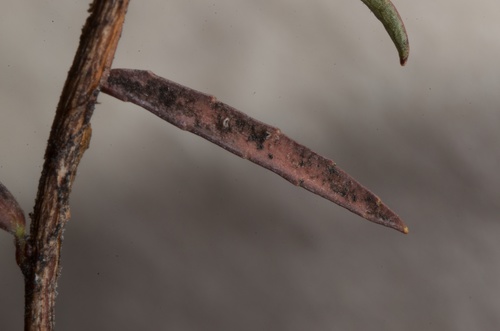
Gaultheria macrostigma
Prostrate snowberry, False snowberry
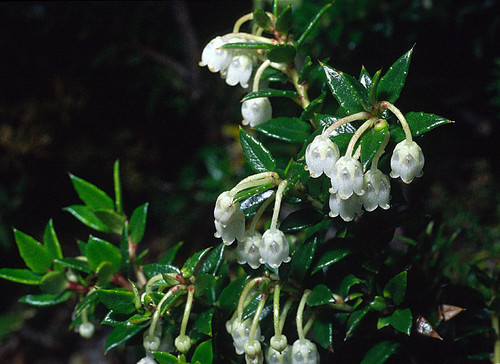
Gaultheria mucronata
Prickly heath
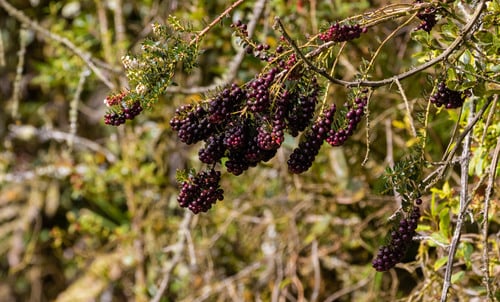
Gaultheria myrsinoides
Manzana
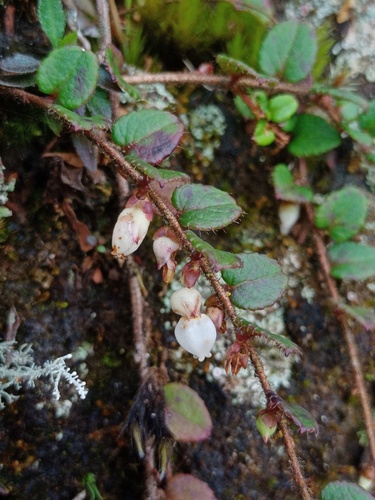
Gaultheria nummularioides
Coinwort snowberry
Gaultheria ovatifolia
Mountain checkerberry, Western Teaberry, Slender false-wintergreen
Gaultheria procumbens
Wintergreen, Checkerberry, Teaberry