Urera trinervis
(Hochst.) Friis & Immelman
Climbing nettle
Wikipedia· cc-by-sa
Wikimedia Commons - Urera_trinervis03.jpg
iNaturalist· cc-by-nc
(c) graham_g, some rights reserved (CC BY-NC)
Summary
Source: WikipediaScepocarpus trinervis (Hochst.) Friis & Immelman is a softly woody dioecious liane, sometimes epiphytic, climbing to 20 m, often to the canopy and hanging in festoons. It is one of some 44 species of Urera belonging to the nettle family Urticaceae. It is known in English as the tree climbing-nettle or climbing nettle.
Description
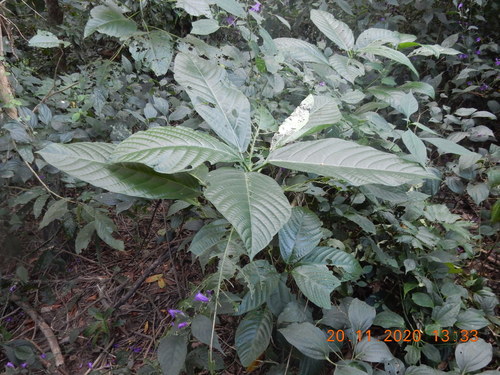
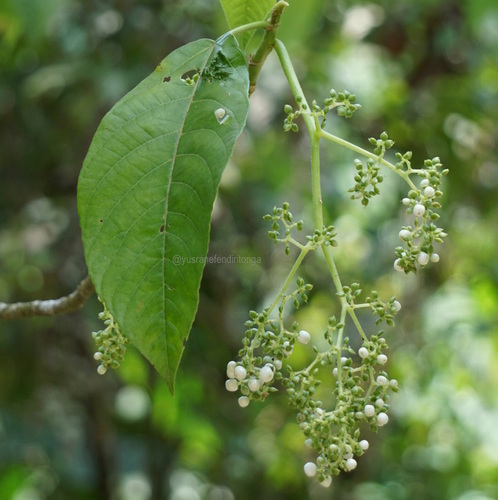
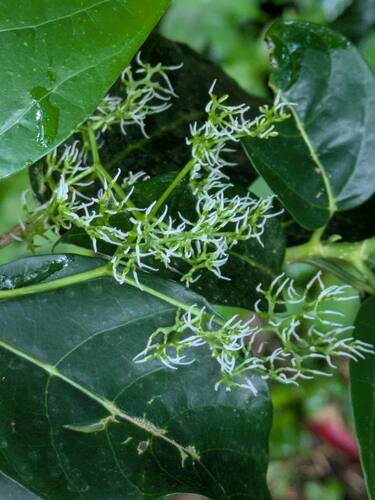
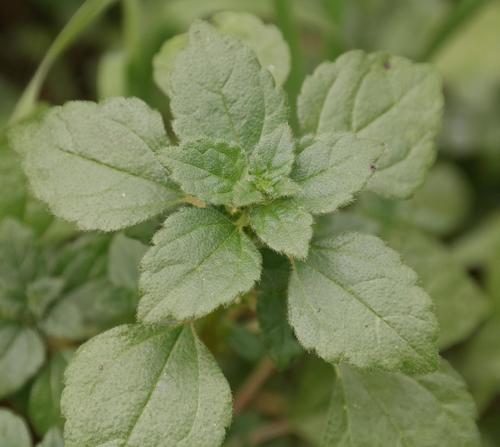
A soft scrambling shrub. It can be 3 m tall. It can occur in the canopy in evergreen forest. The bark is brown or greenish. The leaves are oval or heart shaped. They are 12 cm long by 6 cm wide. The surface of the leaf has a textured feel. There are 3 veins from the base. The edge of the leaf is wavy. The flowers are of separate sexes on separate plants. They are small and greenish-white. They occur in small branched sprays in the axils of leaves. The fruit are small nuts.
Edible Uses
The young stems contain potable water. The leaves are occasionally cooked and eaten as a vegetable, though it is only a minor vegetable of local importance.
Traditional Uses
The young stems contain useful water. The leaves are occasionally cooked and eaten as a vegetable.
This uses section is brief — help expand it
Medicinal Uses
The leaves are chewed and the juice swallowed in order to treat bilious disorders. The leaf-sap is drunk to treat intestinal disorders. The leaves are used externally to treat scabies. The stems, when cut, yield a potable water. This is sometimes drunk to treat tachycardia.
Known Hazards
The plant has stinging hairs, though usually only on the inflorescences.
Distribution
A tropical plant. It grows in the rainforest. It suits humid locations. It grows between 300-1,300 m above sea level.
Where It Grows
Africa, Angola, Central Africa, Congo DR, East Africa, Equatorial Guinea, Eswatini, Ethiopia, Gabon, Ghana, Madagascar, Malawi, Mozambique, Nigeria, Sao Tome and Principe, South Africa, Southern Africa, Swaziland, Tanzania, Uganda, West Africa, Zambia, Zimbabwe,
Cultivation
Presumably a dioecious species, in which case both male and female forms need to be grown if fruit and seed are required.
Other Uses
The bark fibre is used for making ropes. It is highly valued for making fishing lines. The powdered leaves are used in pottery.
Other Information
A minor vegetable only of local importance.
Synonyms
Also Known As
Basoke, Oghai
References (13)
- Abbiw, D.K., 1990, Useful Plants of Ghana. West African uses of wild and cultivated plants. Intermediate Technology Publications and the Royal Botanic Gardens, Kew. p 41 (As Urera cameroonensis)
- Burkill, H. M., 1985, The useful plants of west tropical Africa, Vol. 5. Kew.
- Busson, 1965,
- Grubben, G. J. H. and Denton, O. A. (eds), 2004, Plant Resources of Tropical Africa 2. Vegetables. PROTA, Wageningen, Netherlands. p 539
- Jardin, C., 1970, List of Foods Used In Africa, FAO Nutrition Information Document Series No 2.p 108 (As Urera cameroonensis)
Show all 13 references Hide references
- Liengola, I. B., 2001, A contribution to the study of native edible plants by the Turumbu and Lokele of the Tshopo District, Province Orientale, D. R. Congo. Syst. Geogr. Pl. 71:687-698
- Martin, F.W. & Ruberte, R.M., 1979, Edible Leaves of the Tropics. Antillian College Press, Mayaguez, Puerto Rico. p 223 (As Urera cameroonensis)
- Okigbo, B.N., Vegetables in Tropical Africa, in Opena, R.T. & Kyomo, M.L., 1990, Vegetable Research and development in SADCC countries. Asian Vegetable Research and development Centre. Taiwan. p 45 (As Urera cameroonensis)
- Palgrave, K.C., 1996, Trees of Southern Africa. Struik Publishers. p 120 (As Urera cameroonensis)
- Peters, C. R., O'Brien, E. M., and Drummond, R.B., 1992, Edible Wild plants of Sub-saharan Africa. Kew. p 197
- Swaziland's Flora Database http://www.sntc.org.sz/flora
- White, F., Dowsett-Lemaire, F. and Chapman, J. D., 2001, Evergreen Forest Flora of Malawi. Kew. p 582
- World Checklist of Useful Plant Species 2020. Royal Botanic Gardens, Kew