Ugni molinae
Turcz.
Chilean guava
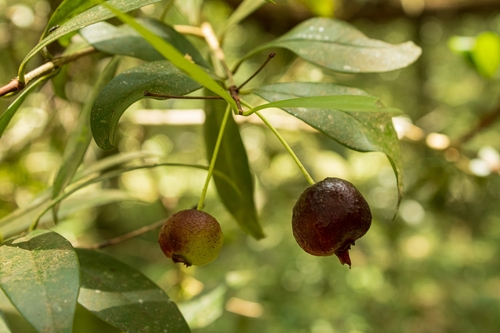
iNaturalist· cc-by-nc-sa
(c) Claudio Maureira, some rights reserved (CC BY-NC-SA), uploaded by Claudio Maureira
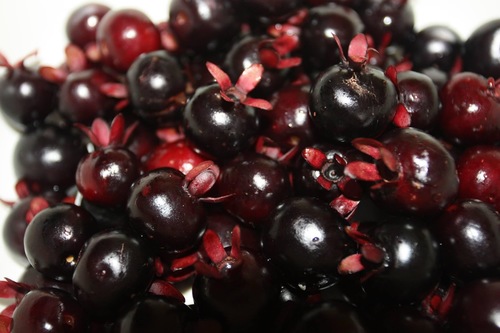
iNaturalist· cc-by-nc
(c) Manuel Palacios, some rights reserved (CC BY-NC)
Summary
Source: WikipediaUgni molinae, commonly known as Chilean guava berry, or strawberry myrtle, is a shrub native to Chile and adjacent regions of southern Argentina. The local Spanish name is murta, and the Mapuche Native American name is "uñi". It is in the same botanical family as the guava, in Myrtaceae. The fruit is sometimes marketed as "Ugniberry", as "New Zealand cranberry" in New Zealand, and the name "Tazziberry" has been trademarked in Australia, but it is not a native plant to these countries.
Description
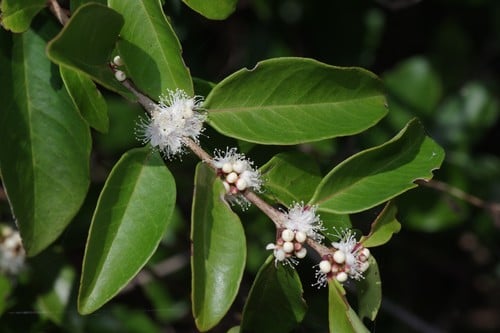
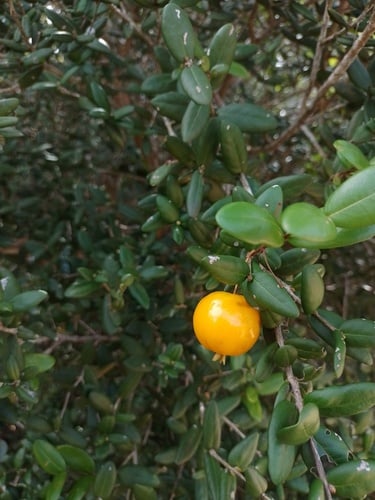
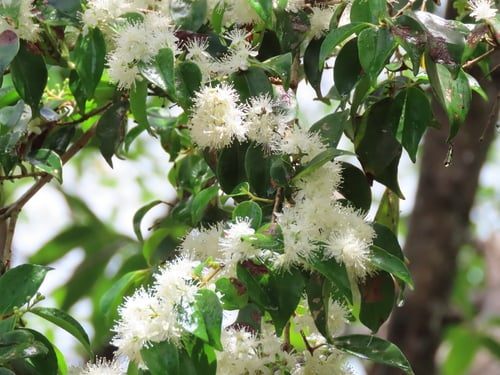
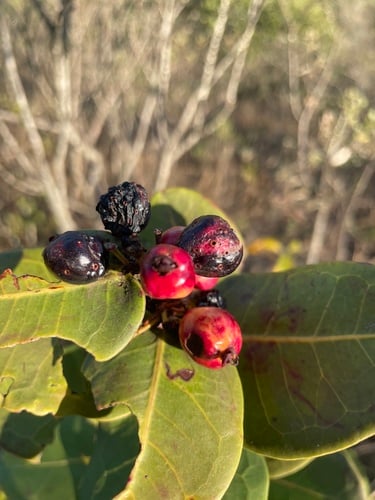
A small evergreen shrub. It grows up to 1-1.8 m tall. It spreads 0.9 m wide. The stems are wiry. They are red. The leaves are deep green and glossy. The flowers are urn shaped. The flowers are cream with pink tints. There are 40-60 tiny stamen at the centre. The fruit is similar to cranberry. The fruit are rich red and round. They are 2-3 cm across.
Edible Uses
The fruit can be eaten raw or cooked. It has an absolutely delicious, very aromatic flavour reminiscent of wild strawberries. Fruits are about 15mm in diameter and are freely produced even on small plants. Leaves can be used as a tea substitute, and the roasted seeds make a coffee substitute.
Traditional Uses
The fruit are used for jellies, jam, sauce, drinks and wine. They can be eaten raw. The leaves are used to flavour water. The seeds are used as a coffee substitute.
Medicinal Uses
No medicinal uses are currently known for this species.
Distribution
It is a temperate plant. It will grow in most soils. It is tolerant of moderate frosts. It needs acid soil. It cannot tolerate lime. They do best in cool, moist, humus-rich soils. The soils need to be well-drained. They can grow in sun or part shade. In Argentina it grows between 700-1,500 m above sea level. It suits hardiness zones 8-10. Hobart Botanical Gardens. Arboretum Tasmania.
Where It Grows
Argentina, Australia, Bolivia*, Chile*, New Zealand, South America, Tasmania,
Cultivation
Succeeds in any reasonably good soil including dry ones. Prefers a moderately fertile well-drained loam in a sunny position. Fairly tolerant of maritime exposure. Established plants are drought resistant. A very ornamental plant, it is only hardy in the milder parts of Britain, tolerating temperatures down to about -10°c when fully dormant. The young growth in spring can be damaged by late frosts. Plants grow and fruit very well in Cornwall, indeed, in the past it has been cultivated commercially for its fruit there (it was one of Queen Victoria's favourite fruits), but is now normally only grown as an ornamental plant. This is a much underused plant that highly merits cultivation on a commercial scale for its fruit. Flowers and fruits well even when the plants are young. Plants in this genus are notably resistant to honey fungus. Chilean guava is self-fertile, meaning it can produce fruit without needing another plant for pollination. The fruit is typically harvested in late summer to early autumn, around late February to April (Southern Hemisphere), depending on the climate and specific variety. Chilean guava usually flowers in late spring to early summer, producing small, white to pink flowers that are quite fragrant. Chilean guava is a relatively slow-growing shrub, reaching maturity in about 3 to 4 years, but it can live for many years, often producing fruit annually.
Propagation
Pre-soak seed for 24 hours in warm water, then sow in late winter in a greenhouse. Prick out seedlings into individual pots as soon as they are large enough to handle and grow on in the greenhouse for at least the first winter. Plant out in late spring or early summer after the last expected frosts. Cuttings of half-ripe wood, 7–10cm with a heel, taken in July/August in a frame; pot up in autumn and overwinter in a cold frame before planting out in late spring — this method gives a high success rate. Cuttings of mature wood from the current season's growth, 7–12cm with a heel, taken in November in a shaded, frost-free frame and planted out in late spring or early autumn, also give a high percentage. Layering is another option.
Other Uses
Chilean guava can be used as a hedge or border plant owing to its dense foliage and attractive flowers, and it tolerates trimming well enough to be grown as a small hedge in the milder parts of Britain. It contributes to biodiversity by providing food and habitat for wildlife. The small, fragrant flowers are rich in nectar and pollen, attracting pollinators such as bees. The edible fruits are consumed by birds and small mammals, and the dense foliage provides shelter that may be used for nesting or roosting. The plant also provides shelter for invertebrates through leaf litter and groundcover, supporting beneficial insects and their habitats.
Production
Bushes bear in 2 years.
Notes
There are 10 Ugni species.
Synonyms
Also Known As
Chilean cranberry, Chilean guava myrtle, Cranberry, Guava myrtle, Guni, Muria, Murta, Murtilla, Murtillo, New Zealand cranberry, Strawberry myrtle, Tazziberry, Temo, Ugni, Unu
References (35)
- Barreau, A., et al, 2016, How Can We Teach Our Children if We Cannot Access the Forest? Generational Change in Mapuche Knowledge of Wild Edible Plants in Andean Temperate Ecosystems of Chile. Journal of Ethnobiology 36(2): 412–432
- Bodkin, F., 1991, Encyclopedia Botanica. Cornstalk publishing, p 999
- Bodkin, F., 1991, Encyclopedia Botanica. Cornstalk publishing, p 716 (As Myrtus ugni)
- Brickell, C. (Ed.), 1999, The Royal Horticultural Society A-Z Encyclopedia of Garden Plants. Convent Garden Books. p 688, 1036
- Brito, A., et al, 2014, Anthocyanin Characterization, Total Phenolic Quantification and Antioxidant Features of Some Chilean Edible Berry Extracts. Molecules 2014, 19, 10936-10955
Show all 35 references Hide references
- Bull. Soc. Imp. Naturalistes Moscou 21(2):579. 1848
- Chamorro, M. F., & Ladio, A., 2020, Native and exotic plants with edible fleshy fruits utilized in Patagonia and their role as sources of local functional foods. BMC Complementary Medicine and Therapies. 20:155
- Cordero, S. E., Abello, L. A., & Galvez, F. L., 2017, Plantas silvestres comestibles y medicinales de Chile y otras partes del mundo. CORMA p 131
- Cundall, P., (ed.), 2004, Gardening Australia: flora: the gardener's bible. ABC Books. p 1448
- Daly, A. B., 20014, Narrating changing foodways: wild edible plant knowledge and traditional food systems in Mapuche lands of the Andean Temperate Forests, Chile. Masters Thesis Vancouver. p 45
- Davis, S.D., Heywood, V.H., & Hamilton, A.C. (eds), 1994, Centres of plant Diversity. WWF. Vol 1 or 2. p 566
- Facciola, S., 1998, Cornucopia 2: a Source Book of Edible Plants. Kampong Publications, p 161
- Fouqué, A., 1972, Espèces fruitières d'Amérique tropicale. Institut français de recherches fruitierès outre-mer
- Fuentes, L., et al, 2019, Patagonian Berries: Healthy Potential and the Path to Becoming Functional Foods. Foods 2019, 8, 289
- Garner, R.J., and Chaudhri, S.A., (Ed.) 1976, The Propagation of Tropical fruit Trees. FAO/CAB. p 354 (As Eugenia ugni)
- Gouldstone, S., 1983, Growing your own Food-bearing Plants in Australia. Macmillan p 88 (As Myrtus ugni)
- Hedrick, U.P., 1919, (Ed.), Sturtevant's edible plants of the world. p 432 (As Myrtus ugni)
- Hermandez Bermejo, J.E., and Leon, J. (Eds.), 1994, Neglected Crops. 1492 from a different perspective. FAO Plant Production and Protection Series No 26. FAO, Rome. p 16 (As Myrtus ugni)
- Hibbert, M., 2002, The Aussie Plant Finder 2002, Florilegium. p 304
- John, L., & Stevenson, V., 1979, The Complete Book of Fruit. Angus & Robertson p 292 (As Myrtus ugni)
- Kermath, B. M., et al, 2014, Food Plants in the Americas: A survey of the domesticated, cultivated and wild plants used for Human food in North, Central and South America and the Caribbean. On line draft. p 885
- Kiple, K.F. & Ornelas, K.C., (eds), 2000, The Cambridge World History of Food. CUP p 1753 (As Myrtus ugni)
- Leon-Lobos, P., et al, 2022, Patterns of Traditional and Modern Uses of Wild Edible Native Plants of Chile: Challenges and Future Perspectives. Plants (Basel) v 11 (6) Table S1
- Lord, E.E., & Willis, J.H., 1999, Shrubs and Trees for Australian gardens. Lothian. p 267
- Lyle, S., 2006, Discovering fruit and nuts. Land Links. p 443
- Martin, J. S. & Villagra M. M., 2013, Productos forestales no madereros de la Region del Maule. p 17
- Plants for a Future database, The Field, Penpol, Lostwithiel, Cornwall, PL22 0NG, UK. http://www.scs.leeds.ac.uk/pfaf/
- Rapoport, E. H. & Ladio, A. H., 1999, Plantas comestibles. Bosque Volume 20 No. 2. ISSN 0314-8799
- Reis, S. V. and Lipp, F. L., 1982, New Plant Sources for Drugs and Foods from the New York Botanical Garden herbarium. Harvard. p 209
- Ryan, S., 2008, Dicksonia. Rare Plants Manual. Hyland House. p 59
- USDA, ARS, National Genetic Resources Program. Germplasm Resources Information Network - (GRIN). [Online Database] National Germplasm Resources Laboratory, Beltsville, Maryland. Available: www.ars-grin.gov/cgi-bin/npgs/html/econ.pl (10 April 2000)
- Velasquez, P. & Montenegro, G., 2017, Chilean Endemic/Native Plant Resources as Functional and Superfoods. Chp. 6 in Superfood and Functional Food - An Overview of Their Processing and Utilization
- Wiersema, J. H. & Leon, B., 2013, World Economic Plants. A Standard Reference CRC Press. 2nd Ed. p 704
- World Checklist of Useful Plant Species 2020. Royal Botanic Gardens, Kew
- www.chileflora.com