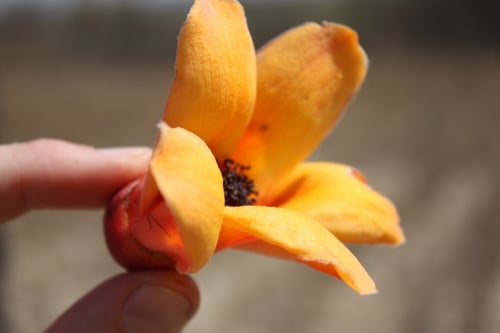
Triplochiton scleroxylon
K. Schum.
African whitewood
iNaturalist· cc-by-nc
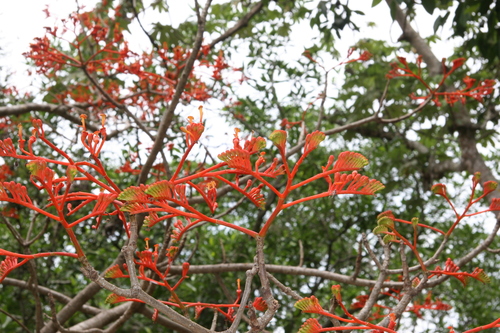
(c) Carel Jongkind, some rights reserved (CC BY-NC), uploaded by Carel Jongkind
iNaturalist· cc-by-nc
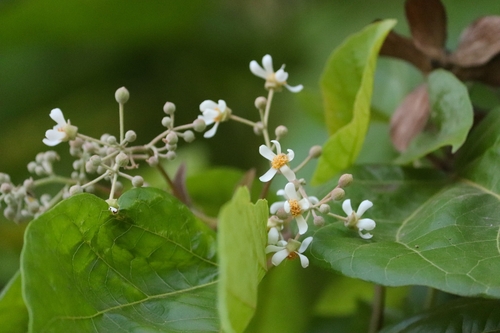
(c) peterneuenschwander, some rights reserved (CC BY-NC)
iNaturalist· cc-by-nc
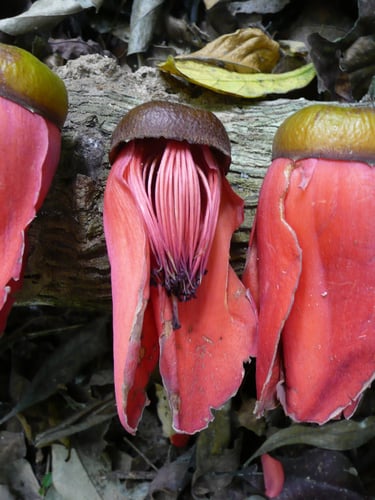
(c) peterneuenschwander, some rights reserved (CC BY-NC)
Summary
Source: WikipediaTriplochiton scleroxylon is a tree of the genus Triplochiton of the family Malvaceae. The timber is known by the common names African whitewood, abachi, obeche (in Nigeria), wawa (in Ghana), ayous (in Cameroon) and sambawawa (in Ivory Coast). The tree is the official state tree of Ekiti State, Nigeria.
Description
A large tree. It grows 35-65 m tall. The trunk is 7 m around. It has large buttresses. It loses its leaves during the year. The bark is grey and fairly smooth. The leaves are 10-20 cm long. The leaves have lobes arranged like fingers on a hand. There are 5-7 lobes. The leaf stalk is 3.5-10 cm long. The flowers are in short panicles. The petals are white but reddish-purple at the base. They are densely hairy. The flowers are saucer shaped. The fruit have wings. The fruit are 6 cm long with 1-5 wings.
Edible Uses
The leaves are cooked and used as a vegetable or sauce in traditional cuisine in west Africa.
Traditional Uses
The leaves are cooked as a vegetable. It is also used in a sauce.
This uses section is brief — help expand it
Medicinal Uses
The plant is used in traditional medicine to treat oedemas and as an anodyne.
Known Hazards
The sawdust has been known to cause occupational allergic contact dermatitis, allergic rhinitis and asthma in workers in sawmills.
Distribution
It is a tropical plant. It grows in the lowland rainforests. It suits humid locations. It is common in drier disturbed forest. It grows in rich soils with high pH.
Where It Grows
Africa, Benin, Cameroon, Central Africa, Central African Republic, CAR, Congo, Congo DR, Côte d'Ivoire, Gabon, Ghana, Guinea, Guinée, Ivory Coast, Liberia, Nigeria, Pacific, Sierra Leone, Solomon Islands, Togo, West Africa,
Cultivation
A plant of the moist, lowland tropics, where it is found at elevations up to 900 metres. It grows best in areas where annual daytime temperatures are within the range 24 - 30°c, but can tolerate 18 - 36°c. It prefers a mean annual rainfall in the range 1,600 - 2,400mm, but tolerates 1,000 - 4,000mm. Requires a sunny position. Succeeds in most well-drained, fertile soils. Prefers a pH in the range 5.5 - 6.5, tolerating 4.5 - 7.5. A very fast-growing tree. Under natural conditions seedlings may reach 15 metres tall and 15cm in stem diameter after 4 years. Mean annual diameter increment in the forest averages 1cm, but in Nigeria mean annual diameter increments of up to 2.5cm have been recorded and in the Central African Republic as low as 0.3cm. In a 19-year-old plantation in Ghana with 600 stems/ha, the trees were on average 21.8 metres tall with a bole diameter of 27cm.
Propagation
Seed begins to germinate 1–2 weeks after sowing, though germination rates are often low. Pre-treating seeds by moistening them between layers of damp cotton wool improves both rate and speed of germination. Fruits with wings removed are shallowly buried in pots placed under shade, and seedlings are pricked out when the first leaves appear — they are fragile and sensitive to damping off. Seedlings develop a taproot that is often forked with few lateral roots in the upper 15cm of soil; the taproot of a 2-metre-tall sapling may reach 1 metre in length. Seedlings of 1–3 years old with tops intact but roots severely cut back can be successfully planted in 40cm × 40cm × 40cm holes, though cutting the primary root has also been observed to cause serious drawbacks as new roots form slowly, making the plant liable to parasitic attack. Fruits can be collected when still green just before maturation. Stored at 18°c, fruits fully retain viability for 18 months; at 25°c, viability drops from about 80% to 15% after 6 months. More than 50% of seeds may still germinate after 7.5 years in sealed containers at 4°c. Single-node cuttings with one leaf can be rooted under mist; rooting is improved by a hormone dip and a high bed temperature of 30°c. Cuttings 10cm long with 2–4 leaves taken from 2-month-old branches can be placed in a nursery under 40–60% shade with mist, producing a rooted and hardened plantlet in about 12 weeks. Marcotting is possible by ringing a branch at an internode; best results occur when foliage is at maximum density between August and October, with up to 50% success in 12-year-old trees.
Other Uses
Agroforestry: Trees are often preserved in cocoa plantations as shade trees, and in Nigeria the species is planted in agroforestry systems with cocoa. It is a natural pioneer species that rapidly colonises open land such as abandoned farmland, making it useful for re-establishing native forest or as a nurse tree in a woodland garden. The bark is used to cover the roofs and walls of huts. The heartwood is whitish to pale yellow, indistinctly demarcated from a sapwood band up to 15cm wide that is somewhat lighter. Grain is usually interlocked, sometimes straight, with a moderately coarse texture. Quarter-sawn faces have a ribbon-like appearance and the wood is lustrous. Fresh wood has an unpleasant smell that disappears on drying. The wood is very light and very soft; it is not durable, being liable to fungal attack including blue stain, and is susceptible to termites, powder-post beetles, and dry-wood borers — it should not be used in contact with the ground or exposed to the weather. It seasons rapidly with little risk of checking or distortion and is moderately stable to stable once dry. It works easily with hand and machine tools using ordinary saw teeth and cutting tools; sharp edges are needed for a smooth finish, and the wood tends to tear during mortising — a cutting angle of 15° is recommended when planing to prevent tearing. Peeling and slicing properties are good. The wood stains and polishes well; filling is recommended for a good finish. Nailing and screwing properties are rather poor and splitting may occur; gluing is possible but must be done carefully as the wood is absorbent. Carving characteristics are good. The wood is widely used for interior joinery, panelling, moulding, furniture, boxes and crates, sculptures, matches, pencils, peeled and sliced veneer for interior and exterior parts of plywood, fibre and particle boards, and block board. It is important in house building for beams, posts, and planks, and is also used for roof shingles. Wood from the buttresses is used to make doors, platters, bowls, and sandals; the bole is used for dugout canoes. The wood pulp can produce paper of moderate quality.
Notes
It has also been put in the families Sterculiaceae and Helicteraceae. It is an important timber species.
Nutrition
| Part | Moisture | kJ | kcal | Protein | Vit A | Vit C | Iron | Zinc |
|---|---|---|---|---|---|---|---|---|
| Leaves | 74.7 | 668 | 160 | 29.2 | — | 78 | 9.2 | — |
Synonyms
Also Known As
Arere, Ayous, Ewowo, Obeche, Samba
References (14)
- Achigan-Dako, E, et al (Eds), 2009, Catalogue of Traditional Vegetables in Benin. International Foundation for Science.
- Bosu, P.P. & Krampah, E., 2005. Triplochiton scleroxylon K.Schum. [Internet] Record from Protabase. Louppe, D., Oteng-Amoako, A.A. & Brink, M. (Editors). PROTA (Plant Resources of Tropical Africa), Wageningen, Netherlands. < http://database.prota.org/search.htm>. Accessed 23 October 2009
- Bot. Jahrb. Syst. 28:331. 1900
- Codjia, J. T. C., et al, 2003, Diversity and local valorisation of vegetal edible products in Benin. Cahiers Agricultures 12:1-12
- Dansi, A., et al, 2008, Traditional leafy vegetables and their use in the Benin Republic. Genet Resour Crop Evol (2008) 55:1239–1256
Show all 14 references Hide references
- Herzog, F., et al, 1993, Nutritive Value of Four Wild Leafy Vegetables in Côte d'Ivoire. Internat. J. Vit. Nutr. Res. 63 (1993) 234-238
- Jardin, C., 1970, List of Foods Used In Africa, FAO Nutrition Information Document Series No 2.p 107
- Keay, R.W.J., 1989, Trees of Nigeria. Clarendon Press, Oxford. p 120
- Martin, F.W. & Ruberte, R.M., 1979, Edible Leaves of the Tropics. Antillian College Press, Mayaguez, Puerto Rico. p 204
- Okigbo, B.N., Vegetables in Tropical Africa, in Opena, R.T. & Kyomo, M.L., 1990, Vegetable Research and development in SADCC countries. Asian Vegetable Research and development Centre. Taiwan. p 44
- Polansky, C., 2018, Annex: Tree Identification and Propagation Images and text for 29 species found in Nimba County, Liberia. ACDI p60
- Oteng-Amoako, A. A. (Ed.), 2006, 100 Tropical African Timber Trees from Ghana. Forestry Research Institute of Ghana. p 248
- Vivien, J. & Faure, J.J., 1985, Abres des forets dense d'Afrique Centrale. Agence de Cooperation Culturelle et Technique. Paris. p 466
- World Checklist of Useful Plant Species 2020. Royal Botanic Gardens, Kew