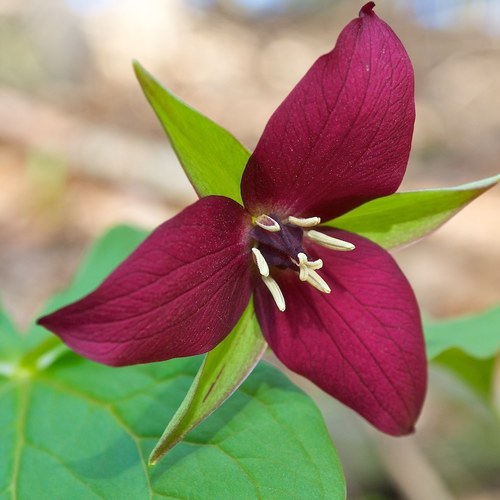
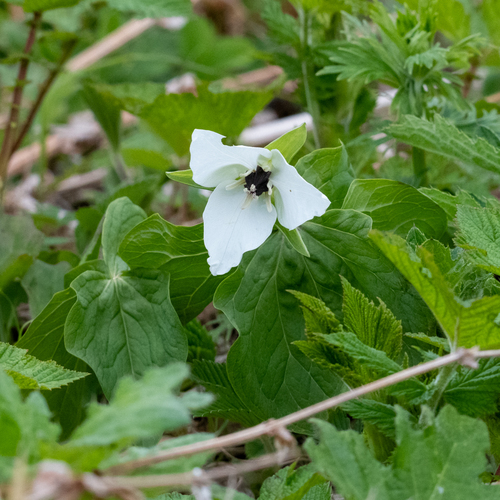
Trillium grandiflorum
(Michx.) Salisb.
White trilium, Wake robin, White wake robin, Grand trillium, Showy trillium, Large-flowered trillium
iNaturalist· cc-by-nc-sa
(c) sandy richard, some rights reserved (CC BY-NC-SA)
iNaturalist· cc-by-nc
(c) erin oneill, some rights reserved (CC BY-NC)
Summary
Source: WikipediaTrillium grandiflorum, the white trillium, large-flowered trillium, great white trillium, white wake-robin or French: trille blanc, is a species of flowering plant in the family Melanthiaceae. A monocotyledonous, herbaceous perennial, the plant is native to eastern North America, from northern Quebec to the southern parts of the United States through the Appalachian Mountains into northernmost Georgia and west to Minnesota. There are also several isolated populations in Nova Scotia, Maine, southern Illinois, and Iowa. Trillium grandiflorum is most common in rich, mixed upland forests. It is easily recognized by its attractive three-petalled white flowers, opening from late spring to early summer, that rise above a whorl of three leaf-like bracts. It is an example of a spring ephemeral, a plant whose life-cycle is synchronized with that of the deciduous woodland which it favours. White trillium often occurs in dense drifts of many individuals. The G. Richard Thompson Wildlife Management Area in the Blue Ridge Mountains is renowned for an extensive stand of white trillium that blooms each spring. Over a two square mile area along the Appalachian Trail near Linden, Virginia there is a spectacular annual display of white trilliums estimated at near ten million individuals.
Description
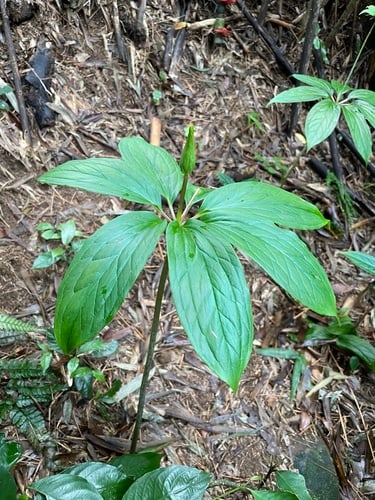
A perennial plant. It grows 30-45 cm high and wide. The leaves are dark green and form a mound. They are in rings of three. The flowers are white, pink, purple or yellow with distinct veins. The sepals are green. The flowers are almost triangular in outline with 3 petals. The petals have wavy edges and are curved backwards. The flowers are 5-8 cm wide.
Edible Uses
Young leaves are cooked and used like spinach. This is considered a famine food, used only when all else fails.
Traditional Uses
The young unfolding leaves can be added fresh to salads. They can be boiled and served with vinegar. (The leaves become bitter once the buds and flowers appear.)
Medicinal Uses
The root is diuretic. The raw root, grated and applied as a poultice to the eye, can help reduce swelling. The raw root is also used as a poultice on aching, rheumatic joints. A decoction of the root bark can be used as ear drops to treat a sore ear. The grated root steeped in water and drunk as a tea treats cramps. The grated root simmered in water and drunk treats irregular menses.
Distribution
It is a temperate plant. It is frost hardy. It grows in rich, moist woodlands. It can grow in shade. It needs moist, rich, well drained soil. It suits hardiness zones 5-9.
Where It Grows
Australia, Britain, Canada, Europe, North America, USA,
Cultivation
It is grown from sections of the rhizome. These are spaced 15-30 cm apart and 10 cm deep. Plants can be propagated by division or from seed.
Propagation
Seed is best sown in a shaded cold frame as soon as it is ripe. Stored seed should be sown in late winter or early spring. Germination usually occurs within 1–3 months at 15°C, though some reports indicate seeds produce a root after the first cold stratification but no shoot until after a second winter; others suggest germination can take up to 3 years. Seedlings are prone to damping off and must be watered carefully with good air circulation. Young plants should be overwintered in a cold frame in their first year, then planted out in late spring. Pots must not become too dry or too wet. Divide with care when plants die down after flowering. Larger divisions can go directly into permanent positions; smaller divisions are best potted up and grown on in light shade in a greenhouse or cold frame until establishing well, then planted out the following spring.
Other Uses
None known. This plant is suited to food forest use.
Production
It has a slow 7 year lifecycle.
Other Information
It is a famine food.
Notes
There are about 46 Trillium species. Also put in the family Trilliaceae.
References (15)
- Burnie, G.(Ed.), 2003, Annuals and Bulbs. The Gardener's Handbooks. Fog City Press. p 303
- Cundall, P., (ed.), 2004, Gardening Australia: flora: the gardener's bible. ABC Books. p 1430
- Facciola, S., 1998, Cornucopia 2: a Source Book of Edible Plants. Kampong Publications, p 242
- Jackes, D. A., 2007, Edible Forest Gardens
- Joyce, D., 1998, The Garden Plant Selector. Ryland, Peters and Small. p 275
Show all 15 references Hide references
- Kermath, B. M., et al, 2014, Food Plants in the Americas: A survey of the domesticated, cultivated and wild plants used for Human food in North, Central and South America and the Caribbean. On line draft. p 878
- Kiple, K.F. & Ornelas, K.C., (eds), 2000, The Cambridge World History of Food. CUP p 1871
- MacKinnon, A., et al, 2009, Edible & Medicinal Plants of Canada. Lone Pine. p 173
- Parad. lond. 1: t. 1. 1806
- Plants for a Future database, The Field, Penpol, Lostwithiel, Cornwall, PL22 0NG, UK. http://www.scs.leeds.ac.uk/pfaf/
- Ryan, S., 2008, Dicksonia. Rare Plants Manual. Hyland House. p 117
- Slocum, P.D. & Robinson, P., 1999, Water Gardening. Water Lilies and Lotuses. Timber Press. p 137
- Toupal, R. S. & Hollenback, K., 2009, An Ethnobotany of Indiana Dunes National Lakeshore: Plant Uses of the Ojibwa People. Bureau of Applied Research in Anthropology. University of Arizona
- Uphof,
- www.wildediblefood.com