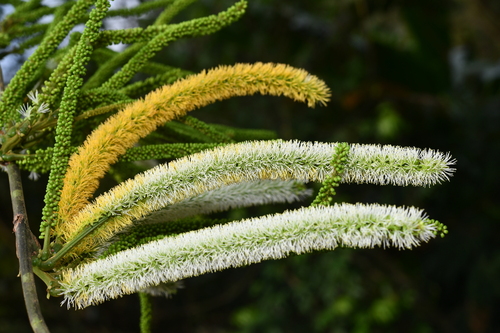
Trifolium bifidum
A. Gray
Piñole clover, Notch-leaf Clover
iNaturalist· cc-by
(c) Ken-ichi Ueda, some rights reserved (CC BY), uploaded by Ken-ichi Ueda
iNaturalist· cc-by-nc
(c) Isaiah Woodard, some rights reserved (CC BY-NC)
Summary
Source: WikipediaTrifolium bifidum is a species of clover known by the common names notchleaf clover and pinole clover. It is native to the western United States from Washington to California, where it grows in many types of habitat. It is an annual herb spreading or growing erect in form. It is lightly hairy to hairless in texture. The leaves are made up of oval leaflets 1 to 2 centimeters long, usually with notches in the tips. The inflorescence is a head of flowers up to 1.5 centimeters wide. Each flower has a calyx of sepals that narrow to bristles covered in long hairs. The flower corolla is yellowish, pinkish, or purple and under a centimeter long. The flowers droop on the head as they age.
Description
An annual plant reaching 0.5 m tall with hermaphroditic insect-pollinated flowers. Fixes atmospheric nitrogen. Grows in light sandy, medium loamy, or heavy clay soils with preference for good drainage; tolerates nutrient-poor conditions across mildly acidic, neutral, and basic soils. Requires full sun and cannot tolerate shade. Prefers moist soil.
Edible Uses
Young leaves can be eaten raw or cooked, though they are best used sparingly. The seed is edible raw or cooked and can be used as a piñole. It can also be sprouted and added to salads, or dried and ground into a powder to thicken soups or mixed with cereals when making bread.
Traditional Uses
North America, USA,
This uses section is brief — help expand it
Medicinal Uses
None known
Distribution
It is a temperate plant.
Where It Grows
NORTHERN AMERICA: United States (Oregon, Washington (s.-c.), California)
Cultivation
We have very little information on this species and do not know if it will be hardy in Britain, though judging by its native range it should succeed outdoors in most parts of the country. The following notes are based on the general needs of the genus. Succeeds in a moist, well-drained circum-neutral soil in full sun. Succeeds in poor soils. It grows well in an apple orchard, the trees will produce tastier fruit that stores better. It should not be grown with camellias or gooseberries because it harbours a mite that can cause fruit drop in the gooseberries and premature budding in the camellias. This species has a symbiotic relationship with certain soil bacteria, these bacteria form nodules on the roots and fix atmospheric nitrogen. Some of this nitrogen is utilized by the growing plant but some can also be used by other plants growing nearby. Buttercups growing nearby depress the growth of the nitrogen bacteria by means of a root exudate. When removing plant remains at the end of the growing season, it is best to only remove the aerial parts of the plant, leaving the roots in the ground to decay and release their nitrogen.
Propagation
Pre-soak seed for 12 hours in warm water, then sow in spring in situ. If seed is scarce, sow into pots in a cold frame instead. Once large enough to handle, prick seedlings into individual pots and plant out after the last expected frosts.
Other Uses
Acts as a dynamic accumulator.
Production
There are about 240 Trifolium species. They are mostly temperate.
References (4)
- Beckstrom-Sternberg, Stephen M., and James A. Duke. "The Foodplant Database." http://probe.nalusda.gov:8300/cgi-bin/browse/foodplantdb.(ACEDB version 4.0 - data version July 1994)
- Moerman, D. F., 2010, Native American Ethnobotany. Timber Press. p 566
- Plants for a Future database, The Field, Penpol, Lostwithiel, Cornwall, PL22 0NG, UK. http://www.scs.leeds.ac.uk/pfaf/
- Proc. Calif. Acad. Sci. 3:102. 1864