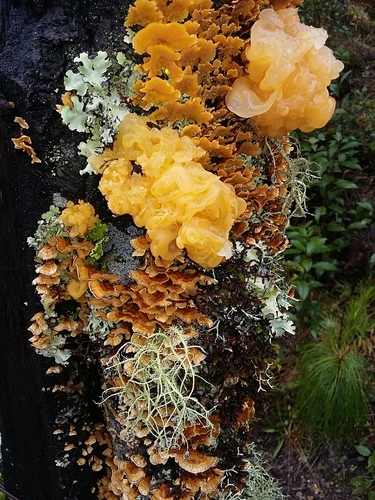
Tremella fuciformis
Berkeley
White jelly fungus, Snow fungus
iNaturalist· cc-by
(c) Alex Abair, some rights reserved (CC BY), uploaded by Alex Abair
iNaturalist· cc-by-sa
(c) Dan Molter, some rights reserved (CC BY-SA)
iNaturalist· cc-by-nc-nd
(c) Pete McGregor, some rights reserved (CC BY-NC-ND), uploaded by Pete McGregor
Summary
Source: WikipediaTremella fuciformis is a species of fungus commonly known as snow fungus, snow ear, silver ear fungus, white jelly mushroom, and white cloud ears. It produces white, frond-like, gelatinous fruit bodies. The species is widespread, especially in the tropics, where it can be found on the dead branches of broadleaf trees. It is a parasitic yeast, and grows as a slimy, mucus-like film until it encounters its preferred hosts, various species of Annulohypoxylon (or possibly Hypoxylon) fungi, whereupon it then invades, triggering the aggressive mycelial growth required to form the fruiting bodies. This fungus is commercially cultivated and is one of the most popular fungi in the cuisine and medicine of China.
Description
A mushroom. A jelly fungus up to 10 cm across. It resembles crinkled pale-gold sea sponges. These are translucent convoluted masses. The spores are about 8 microns and round, smooth and colourless.
Edible Uses
Tremella fuciformis has been cultivated in China since at least the nineteenth century. Initially, suitable wooden poles were prepared and then treated in various ways in the hope that they would be colonized by the fungus. This haphazard method of cultivation was improved when poles were inoculated with spores or mycelium. Modern production only began, however, with the realization that both the Tremella and its host species needed to be inoculated into the substrate to ensure success. The "dual culture" method, now used commercially, employs a sawdust mix inoculated with both fungal species and kept under optimal conditions. The most popular species to pair with T. fuciformis is its preferred host, Annulohypoxylon archeri. Estimated production in China in 1997 was 130,000 tonnes. T. fuciformis is also cultivated in other East Asian countries, with some limited cultivation elsewhere. In Chinese cuisine, T. fuciformis is traditionally used in sweet dishes. While tasteless, it is valued for its gelatinous texture as well as its supposed medicinal benefits. Most commonly, it is used to make a dessert soup called luk mei (六味) in Cantonese, often in combination with jujubes, dried longans, and other ingredients. It is also used as a component of a drink and as an ice cream. Since cultivation has made it less expensive, it is now additionally used in some savoury dishes. In Vietnamese cuisine, it is often used in Chè (Vietnamese pronunciation: [cɛ̂]), a Vietnamese term that refers to any traditional Vietnamese sweet beverage, dessert soup or pudding.
Distribution
It is a temperate plant. They often occur in groups on dead wood. It is common in eucalypt and mixed forest.
Where It Grows
Africa, Asia, Australia, Cameroon, Central Africa, China, Côte d'Ivoire, East Africa, Europe, Hong Kong, Indochina, Ivory Coast, Japan, Madagascar, Malaysia, New Zealand, Pacific, Papua New Guinea, PNG, Poland, SE Asia, Tanzania, Tasmania, Thailand, West Africa,
Nutrition
| Part | Moisture | kJ | kcal | Protein | Vit A | Vit C | Iron | Zinc |
|---|---|---|---|---|---|---|---|---|
| Fungus dried | 19.7 | 1150 | 275 | 3.7 | — | — | 3.5 | — |
| Fungus boiled | 92.6 | 59 | 14 | 0.4 | — | 0 | 0.2 | 0.3 |
Also Known As
Cendawan jelly putch, Hanukao, Seet gnee, Shirokikurage, Silver ear mushroom, Yiner
References (20)
- Boa, E. R., 2004, Wild edible fungi and their importance to people. FAO Non Wood Forest Products Booklet 17
- Buyck, B., 2008, The Edible Mushrooms of Madagascar: An Evolving Enigma. Economic Botany 62(3) pp. 509-520
- Crowe, A., 1997, A Field Guide to the Native Edible Plants of New Zealand. Penguin. p 163
- Dashorst, G.R.M., and Jessop, J.P., 1998, Plants of the Adelaide Plains & Hills. Botanic Gardens of Adelaide and State Herbarium. p 22
- efta-online.org, Edible Fungi of Tropical Africa, Jardin botanique Meise
Show all 20 references Hide references
- Food Composition Tables for use in East Asia FAO http://www.fao.org/infoods/directory No. 512
- forests-366202-SI
- Fuhrer, B & Robinson, R., 1992, Rainforest Fungi of Tasmania and SE Australia, CSIRO p 81
- Fuhrer, B., 2005, A field guide to Australian Fungi. Bloomings Books. p 295
- Hall, I. R., et al, 2003, Edible and Poisonous Mushrooms of the World. Timber Press. p 316
- Hu, Shiu-ying, 2005, Food Plants of China. The Chinese University Press. p 269
- Kiple, K.F. & Ornelas, K.C., (eds), 2000, The Cambridge World History of Food. CUP p 322
- Low, T., 1992, Bush Tucker. Australia’s Wild Food Harvest. Angus & Robertson. p 169
- See, L. S., et al, 2008, Utilization of Macrofungi by some Indigenous Communities for Food and Medicine in Peninsular Malaysia. Sustainable Forest Management and Poverty Alleviation: Roles of Traditional Forest-related Knowledge IUFRO World Series Volume 21
- Shaw, 1984,
- Solomon, C., 2001, Encyclopedia of Asian Food. New Holland. p 240
- Sunrinrut, P. et al, 1987, Protein, amino acids and some major and trace elements in Thai and Norwegian mushrooms. Plant Foods for Human Nutrition. 37:117-125 (As Tremellaria faciformis)
- Tibuhwa, 2013, Wild Mushroom - an underutilized healthy food resource and income generator: experience from Tanzania rural areas. Journal of Ethnobiology and Ethnomedicine 9:49
- van Dijk, H., et al, 2003, Knowledge and Utilization of Edible Mushrooms by Local Populations of the Rain Forest of South Cameroon. Ambio Vol. 32, No. 1.pp 19-23
- www.plantnames.unimelb.edu.au