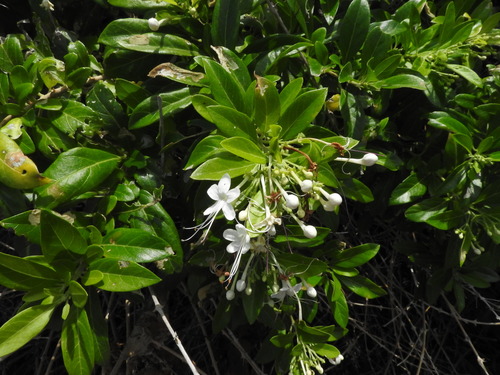
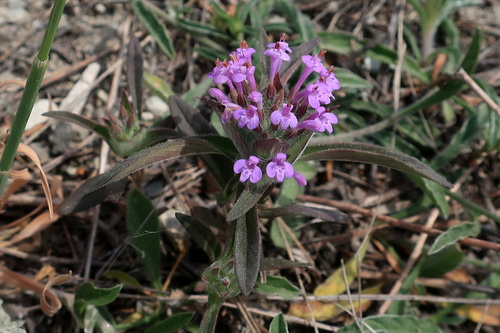
Thymus praecox subsp. arcticus
(E. Durand) Jalas
Wild thyme, Mother-of-thyme, Creeping thyme
iNaturalist· cc-by-nc
(c) Stefan Gey, some rights reserved (CC BY-NC), uploaded by Stefan Gey
iNaturalist· cc-by-sa
(c) Sten Porse, some rights reserved (CC BY-SA)
iNaturalist· cc-by
(c) Karl Gruber, some rights reserved (CC BY)
Summary
Source: WikipediaThymus praecox is a species of thyme. A common name is mother of thyme, but "creeping thyme" and "wild thyme" may be used where Thymus serpyllum, which also shares these names, is not found. It is native to central, southern, and western Europe.
Description
A small herb. It is hairy. It is a creeping plant. It can be woody and grow from year to year. It forms flat mats over the ground. The leaves are dark green. They are small and oval. They are about 10 mm long. They last for 2 to 3 years and are leathery. The flowers are white.
Edible Uses
This thyme has a strong scent similar to Oregano. It can be used in cuisine. Like other species of thyme, Thymus praecox is characterized by substantial differences in essential oil composition from plant to plant. Plants which differ in this way are known as chemotypes and a geographical population will generally contain a mix of chemotypes. For example, studies of chemotypes in Greenland, Iceland, Norway, England, Scotland, and Ireland show that chemotypes span those countries rather than being geographically localized. Some of those areas contain greater chemotype diversity than others.
Traditional Uses
It is used as a seasoning for salads, sauces, stews, seafood dishes, vinegar, stuffings and pickles. It is used to flavour sour milk. It is rubbed over goat's milk cheese to add flavour. It is the source of an essential oil used to flavour Benedictine.
Distribution
An Arctic plant. It grows in dry sunny positions. It suits plant hardiness zone 5.
Where It Grows
Asia, Australia, Britain, Canada, Europe, Greenland, Iceland, North America, Switzerland,
Notes
There are between 300 and 400 Thymus species.
Synonyms
Also Known As
Serpolet
References (8)
- Facciola, S., 1998, Cornucopia 2: a Source Book of Edible Plants. Kampong Publications, p 137
- Hibbert, M., 2002, The Aussie Plant Finder 2002, Florilegium. p 299
- Lawton, B.P., 2002, Mints. A Family of Herbs and Ornamentals. Timber Press, Portland, Oregon. p 212
- Morley, B. & Everard, B., 1970, Wild Flowers of the World. Ebury press. Plate 5
- Plants for a Future database, The Field, Penpol, Lostwithiel, Cornwall, PL22 0NG, UK. http://www.scs.leeds.ac.uk/pfaf/
Show all 8 references Hide references
- Svanberg, I., et al, 2012, Edible wild plant use in the Faroe Islands and Iceland. Acta Societatis Botanicorum Poloniae 81(4): 233-238
- Veroeff. Geobot. Inst. ETH Stiftung Ruubel Zuurich 43:190. 1970
- Whitney, C. W., et al, 2012, A Survey of Wild Collection and Cultivation of Indigenous Species in Iceland. Human Ecology 40:781-787