Thylacium africanum
Lour.
Mutungu
gbif· cc-by-nc-sa
MBG
gbif· cc0
Botanical Research Institute of Texas
gbif· cc-by-nc-sa
MBG
Description
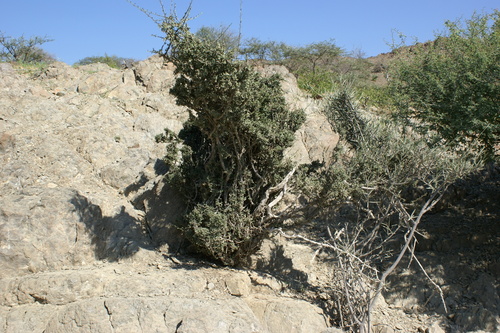
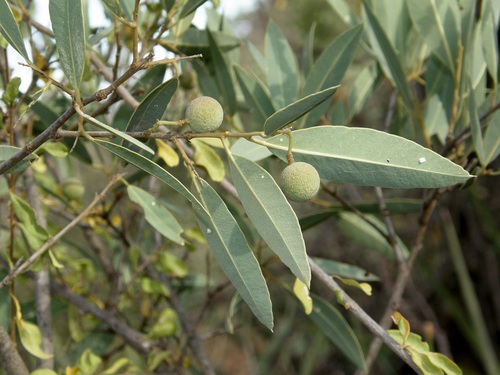
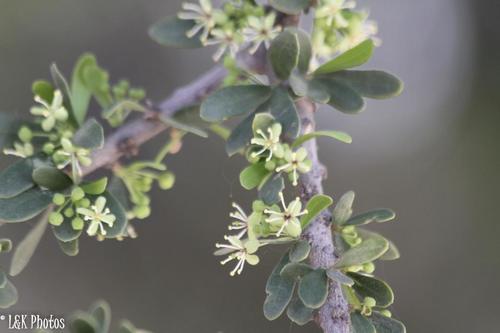
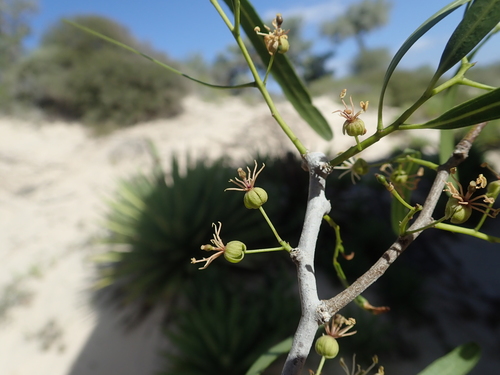
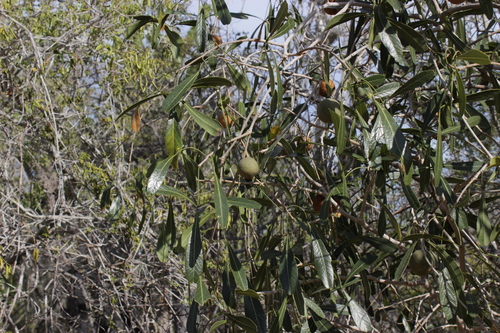
A shrub or small tree. It grows up to 5 m tall. The leaves often have 3 leaflets. The leaflets are 3-10 cm long by 1-6 cm wide. They are narrowly sword shaped. The flowers are 3 cm across and greenish-white. They have a dark purple centre. They are in groups with a few flowers. The fruit have 5-10 ribs.
Edible Uses
The root cortex is prepared by removing the skin, cutting, pounding, soaking, straining, and boiling for many hours into a porridge. The fruit are eaten fresh, especially by children.
Traditional Uses
The skin of the root is removed, the cortex cut up, pounded, and soaked, then strained, and the remaining material boiled for many hours and used as a porridge. Caution: It can be toxic unless well prepared. The fruit are eaten fresh.
Known Hazards
The root can be toxic unless well prepared through the extended cooking process.
Distribution
A tropical plant. It grows in semi arid places. In Tanzania it grows between sea level and 1,600 m above sea level. It is rare in Swaziland. It grows in the lowlands.
Where It Grows
Africa, East Africa, Eswatini, Kenya, Madagascar, Malawi, Mozambique, South Africa, Southern Africa, Swaziland, Tanzania, Zimbabwe,
Cultivation
The plant can be grown by seeds or cuttings.
Production
Tubers are collected during the rainy season. Dried flour can be stored for several months.
Other Information
It is an important famine food. The fruit are eaten especially by children.
Notes
An unresolved name in The Plant List.
Also Known As
Kishangalaji, Lolmugi, Matanuyu, Mdudu, Mtongi, Mtungu, Mtunguru, Mtunguu, Mutungu, Mwimahigulu, Raa-wa-mburi, Sakarantei, Shingaazi, Umududu
References (11)
- Dale, I. R. and Greenway, P. J., 1961, Kenya Trees and Shrubs. Nairobi. p 128
- Grivetti, L. E., 1980, Agricultural development: present and potential role of edible wild plants. Part 2: Sub-Saharan Africa, Report to the Department of State Agency for International Development. p 47
- Ichikawa, M., 1980, The Utilization of Wild Food Plants by the Suiei Dorobo in Northern Kenya. J. Anthrop. Soc. Nippon. 88(1): 25-48
- Jardin, C., 1970, List of Foods Used In Africa, FAO Nutrition Information Document Series No 2.p 106
- BROKENSHA & RILEY,
Show all 11 references Hide references
- KABUYE,
- Msuya, T. S., et al, 2010, Availability, Preference and Consumption of Indigenous Foods in the Eastern Arc Mountains, Tanzania, Ecology of Food and Nutrition, 49:3, 208-227
- NEWMAN,
- RILEY & BROKENSHA,
- Ruffo, C. K., Birnie, A. & Tengnas, B., 2002, Edible Wild Plants of Tanzania. RELMA p 664
- Swaziland's Flora Database http://www.sntc.org.sz/flora (As Thilachium africanum)