Theobroma cacao
L.
Cacao
iNaturalist· cc-by-nc
(c) Mikaeel, some rights reserved (CC BY-NC), uploaded by Mikaeel
iNaturalist· cc-by-nc
(c) grinnin, some rights reserved (CC BY-NC)
iNaturalist· cc-by-nc
(c) grinnin, some rights reserved (CC BY-NC)
Summary
Source: WikipediaTheobroma cacao (cacao tree or cocoa tree) is a small (6–12 m (20–39 ft) tall) evergreen tree in the Malvaceae family. Its seeds—cocoa beans—are used to make chocolate liquor, cocoa solids, cocoa butter and chocolate. Although the tree is native to the tropics of the Americas, the largest producer of cocoa beans in 2022 was Ivory Coast.
Description
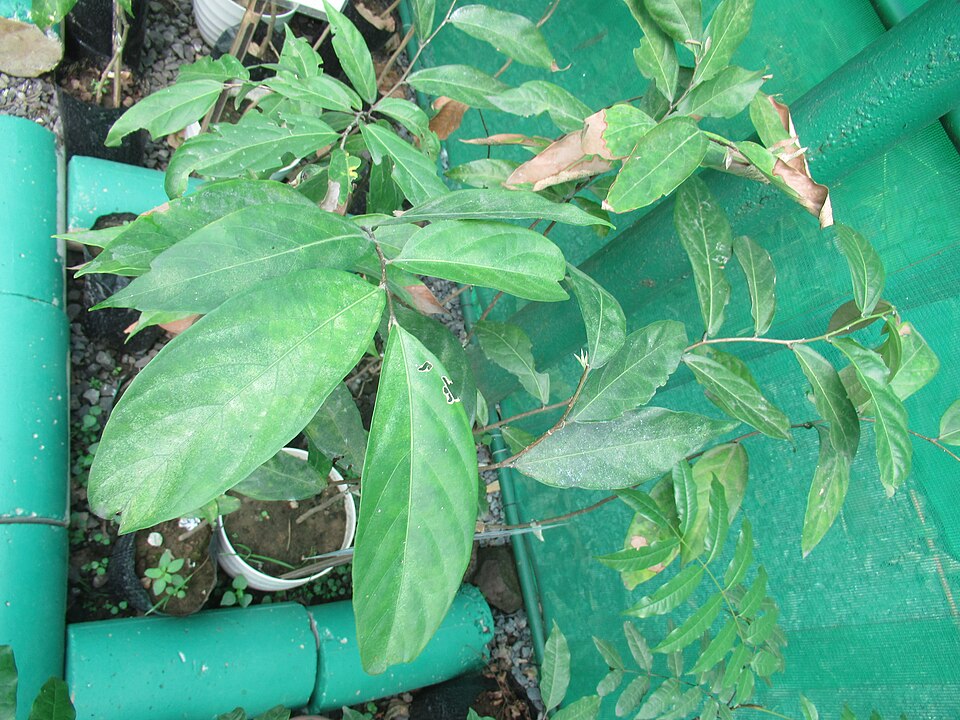
A small evergreen tree. It grows to 15 m tall. Often it is pruned to be only 6 m tall. The trunk is straight for about 90-159 cm above the ground then a fan arrangement of branches develops. The leaves are large and simple. They are in a spiral arrangement around the branch. They are 17-30 cm long and hang down. They are red brown when young. The leaves are wider towards the pointed tip. The leaves are thin but leathery with prominent veins. The flowers are on short shoots like cushions on the trunk and woody branches. The flowers are small, yellow-white and about 1 cm across. A ribbed pod develops. The pods are large about 15-20 cm long by 10 cm across. They are green when young but become yellow or red. The pods have rows of seeds. There are 20-50 oval seeds. These are white at first then become red-brown as they ripen. There is a sweet pulp surrounding the seeds.
Edible Uses
The dried, fermented and roasted seeds — known as cacao beans — are the source of cocoa, chocolate and cocoa butter, all widely used in confectionery, baking, ice cream and drinks. The somewhat bitter flavour is typically balanced with sugar or other sweeteners. Seeds contain up to 50% fat. Curing involves pressing, fermenting and drying the ripe seeds, which are then roasted and ground into cocoa powder. A butter-like fat called cocoa butter is also extracted from the seeds. Each fruit holds around 20–40 seeds surrounded by a thin, succulent pulp with a slightly sweet flavour, which is sucked as a snack or made into juices and jellies. The seed also contains a pigment reported to be useful as a food colouring.
Traditional Uses
The seeds are eaten. The seeds are also processed and used for chocolate. The seeds are fermented for 6 days to remove the flesh then washed and dried. The pulp in the pod is edible when ripe. It is used in jellies and sweets.
Medicinal Uses
Cacao has therapeutic value alongside its culinary uses. The seed contains xanthines, a fixed oil and endorphins. It is a bitter, stimulant, diuretic herb that stimulates the nervous system, lowers blood pressure and dilates the coronary arteries. Cacao powder and butter are nutritive; the butter also soothes and softens damaged skin. In Central America and the Caribbean, the seed is used as a heart and kidney tonic. An infusion of the baked seed membranes is drunk as a remedy for anaemia. Combined with stems of Chromolaena odorata and wood of Cecropia obtusa, the seed is applied externally as an emollient to help extract embedded splinters or prickles. Cacao powder is taken internally for angina and high blood pressure. In Amazonas State, Brazil, cocoa butter is rubbed onto bruises, and it is commonly used to treat chapped skin and burns. Research has shown it can help counter bacteria responsible for boils and septicaemia. The leaf contains genistic acid, shown to be antirheumatic and analgesic. An infusion of the leaf buds, used with incense, treats diarrhoea. An infusion of the dry pods is used to reduce leprosy spots.
Known Hazards
Chocolate can cause allergies and migraine in some people.
Distribution
A tropical plant. It is native from Mexico to Central America. It grows in lowland areas with a rainfall around 2,000 mm annually. It can grow in areas with rainfall between 1,200 and 7,000 mm. Plants do best in acid or neutral soil which is well drained. It has a long tap root which will not develop on rocky or hard soil. Cocoa does not do well on windy sites where there are sudden fluctuations of humidity. Shade trees help provide these conditions. It needs temperatures above 20°C. In PNG it mostly grows below 800 m above sea level. It suits hardiness zones 11-12. In Yunnan.
Where It Grows
Africa, Amazon, American Samoa, Andamans, Asia, Australia, Belize, Bolivia, Bougainville, Brazil*, Cameroon, Central Africa, Central America, China, Colombia*, Congo DR, Congo R, Cook Islands, Costa Rica, Côte d'Ivoire, Cuba, Dominica, Dominican Republic, East Africa, East Timor, Ecuador*, El Salvador, Ethiopia, Europe, Fiji, French Guiana, FSM, Gabon, Ghana, Grenada, Guatemala, Guinea, Guinée, Guianas, Guyana, Haiti, Hawaii, Honduras, India, Indochina, Indonesia, Ivory Coast, Jamaica, Laos, Liberia, Madagascar, Malaysia, Marquesas, Mauritius, Mexico, Myanmar, Nicaragua, Niger, Nigeria, Niue, North America, Pacific, Panama, Papua New Guinea, PNG, Peru*, Philippines, Pohnpei, Puerto Rico, Rotuma, Samoa, Sao Tome and Principe, SE Asia, Sierra Leone, Singapore, Solomon Islands, South America*, Spain, Sri Lanka, St. Kitts and Nevis, St Lucia, Suriname, Tanzania, Timor-Leste, Togo, Trinidad and Tobago, Uganda, USA, Vanuatu, Venezuela, Vietnam, Wallis and Futuna, West Africa, West Indies, West Timor, Zambia,
Cultivation
Plants are grown from seed. Seed can be sown in pots in a nursery then transplanted or can be sown directly. Seedlings need shade. Plants can also be grown from cuttings. Cuttings from side branches are used. Cuttings are normally raised in a nursery. Seeds should be removed from the pod and dried but should not be stored for more than 3 months. Seeds germinate in 1 week. Plants should be spaced 3 m apart. Plants can be pruned. Flowers are pollinated by insects.
Propagation
Seed loses viability within 5–7 days of being separated from the pulp, so sow as soon as ripe in individual containers in a shaded position, covering with about 5mm of potting compost. Fresh seed germinates readily without a dormancy period, usually sprouting within 7–10 days. Seedlings grow slowly. Air layering, leaf-bud cuttings and grafting are also possible.
Other Uses
The cacao tree provides a wide range of locally useful materials, including fibre for cloth, thread and paper, and wood for construction and implements. Ash from pod husks contains potassium oxide, extractable as potassium hydroxide, which is useful in saponification. Burnt husks can be pounded into a paste with soapy properties suitable for washing clothes. Fat from unfermented cocoa beans can be used in soap making. Cacao butter, obtained from the seeds, is used in skin creams, cosmetics and as a suppository base. The wood is light, soft and of low durability; it is occasionally used for fuel or charcoal. The cocoa bean testa is also used as fuel, with a calorific value of 16,000–19,000 BTU/kg, slightly higher than wood. The tree is often interplanted with bananas, coconuts and rubber.
Production
Some seedling varieties produce within 3-5 years. They continue to produce for 50 years. Fruits mature after 6 months. Seeds are fermented for 1 week and the temperature should not go above 50°C but once the temperature has come down to 35°C they can be sun dried. During drying the moisture content reduces from 50-60% to 6% over about one week.
Other Information
An important cultivated food plant.
Notes
Also put in the family Byttneriaceae and the Sterculiaceae.
Nutrition
| Part | Moisture | kJ | kcal | Protein | Vit A | Vit C | Iron | Zinc |
|---|---|---|---|---|---|---|---|---|
| Seed | 3.6 | 1908 | 456 | 12 | 15 | 3 | 3.6 | — |
Synonyms
Also Known As
Cacau-verdaeiro, Cacau, Cacaueiro, Cacautl, Chocolate tree, Cokelat, Ka, Kakao, Kakaw, Kokoe, Koko, Pohon coklat, Pokok choklat, Prorounahi
References (89)
- Ambasta, S.P. (Ed.), 2000, The Useful Plants of India. CSIR India. p 634
- Barwick, M., 2004, Tropical and Subtropical Trees. A Worldwide Encyclopedic Guide. Thames and Hudson p 412
- Bendezu, Y. F., 2018, Arboles nativos de lad Region Ucayali. Instituto Nacional de Innovacion Agraria. p 197
- Bernal,R., et al, (Eds), 2016, Catalogo de Plantas y Liquenes de Colombia, Volumen 11, Magnoliaceae a Zygophyllaceae. Universidad Nacional de Colombia. p 1566
- Bernholt, H. et al, 2009, Plant species richness and diversity in urban and peri-urban gardens of Niamey, Niger. Agroforestry Systems 77:159-179
Show all 89 references Hide references
- Bianchini, F., Corbetta, F., and Pistoia, M., 1975, Fruits of the Earth. Cassell. p 218
- Bodkin, F., 1991, Encyclopedia Botanica. Cornstalk publishing, p 979
- Bodner, C. C. and Gereau, R. E., 1988, A Contribution to Bontoc Ethnobotany. Economic Botany, 43(2): 307-369
- Bremness, L., 1994, Herbs. Collins Eyewitness Handbooks. Harper Collins. p 86
- Burkill, H. M., 1985, The useful plants of west tropical Africa, Vol. 1. Kew.
- Burkill, I.H., 1966, A Dictionary of the Economic Products of the Malay Peninsula. Ministry of Agriculture and Cooperatives, Kuala Lumpur, Malaysia. Vol 2 (I-Z) p 2186
- Burkill, I.H., 1966, A Dictionary of the Economic Products of the Malay Peninsula. Ministry of Agriculture and Cooperatives, Kuala Lumpur, Malaysia. Vol 2 (I-Z) p 2191 (As Theobroma pentagona)
- Cabalion, P. and Morat, P., 1983, Introduction le vegetation, la flore et aux noms vernaculaires de l'ile de Pentcoste (Vanuatu), In: Journal d'agriculture traditionnelle et de botanique appliquee JATBA Vol. 30, 3-4
- Cobley, L.S. (rev. Steele, W.M.) 2nd Ed., 1976, An Introduction to the Botany of Tropical Crops. Longmans. p 207
- Coe, F. G. and Anderson, G. J., 1999, Ethnobotany of the Sumu (Ulwa) of Southeastern Nicaragua and Comparisons with Miskitu Plant Lore. Economic Botany Vol. 53. No. 4. pp. 363-386
- Condit, R., et al, 2011, Trees of Panama and Costa Rica. Princeton Field Guides. p 284
- Cope, F.W., 1979, Cacao, in Simmonds, N.W., (ed), Crop Plant Evolution. Longmans. London. p 285
- Cundall, P., ybal, J., 1980, Herbs and Spices, A Hamlyn Colour Guide, Hamlyn Sydney p 190
- D'Ambrosio, U., & Puri, R. K., 2016, Foodways in transition: food plants, diet and local perceptions of change in a Costa Rican Ngäbe community. Journal of Ethnobiology and Ethnomedicine (2016) 12:3 p 27
- Daly, D. C., An Index of Common Names of Plants in Acre, Brazil. New York Botanical Garden Universidade Federal do Acre.
- Grandtner, M. M. & Chevrette, J., 2013, Dictionary of Trees, Volume 2: South America: Nomenclature, Taxonomy and Ecology. Academic Press p 662
- http://www.botanic-gardens-ljubljana.com/en/plants
- Hunter, D., et al, 2019, The potential of neglected and underutilized species for improving diets and nutrition. Planta (2019) 250:709-729
- Kermath, B. M., et al, 2014, Food Plants in the Americas: A survey of the domesticated, cultivated and wild plants used for Human food in North, Central and South America and the Caribbean. On line draft. p 864 (Also as Theobroma pentagonum)
- Latham, P., 2004, Useful Plants of Bas-Congo province. Salvation Army & DFID p 279
- Llamas, K.A., 2003, Tropical Flowering Plants. Timber Press. p 269
- Lorenzi, H., 2002, Brazilian Trees. A Guide to the Identification and Cultivation of Brazilian Native Trees. Vol. 01 Nova Odessa, SP, Instituto Plantarum p 347
- Lorenzi, H., Bacher, L., Lacerda, M. & Sartori, S., 2006, Brazilian Fruits & Cultivated Exotics. Sao Paulo, Instituto Plantarum de Estuados da Flora Ltda. p 166
- Mapes, C. & Basurto, F., 2016, Biodiversity and Edible Plants of Mexico. Chapter 5 in R. Lira, et al. (eds.), Ethnobotany of Mexico, Ethnobiology, Springer. p
- Martin, F. W., et al, 1987, Perennial Edible Fruits of the Tropics. USDA Handbook 642 p 63
- Menninger, E.A., 1977, Edible Nuts of the World. Horticultural Books. Florida p 45
- Miguel, E., et al, 1989, A checklist of the cultivated plants of Cuba. Kulturpflanze 37. 1989, 211-357
- Moerman, D. F., 2010, Native American Ethnobotany. Timber Press. p 556
- Morley, B. & Everard, B., 1970, Wild Flowers of the World. Ebury press. Plate 176
- Mulherin, J., 1994, Spices and natural flavourings. Tiger Books, London. p 38
- NYBG Herbarium "edible"
- Paz, F. S., et al, 2021, Edible Fruit Plant Species in the Amazon Forest Rely Mostly on Bees and Beetles as Pollinators. Journal of Economic Entomology, XX(XX), 2021, 1–13
- Peekel, P.G., 1984, (Translation E.E.Henty), Flora of the Bismarck Archipelago for Naturalists, Division of Botany, Lae, PNG. p 374, 378,
- Penafield Anchundia, D. D., 2017, Traditional food consumption and its nutritional contribution in Guasaganda, Central Ecuador. PhD Ghent University p 72
- Pham-Hoang Ho, 1999, An Illustrated Flora of Vietnam. Nha Xuat Ban Tre. p 495
- Philips, O., 1992, The potential for harvesting fruits in tropical rainforests: new data from Amazonian Peru. Biodiversity and Conservation 2, 18-38
- Plants of Haiti Smithsonian Institute http://botany.si.edu/antilles/West Indies
- Priyadi, H., et al, 2010, Five hundred plant species in Gunung Halimun Salak National Park, West Java. A checklist including Sundanese names, distribution and use. CIFOR, FFPRI, SLU p 27
- Purseglove, J.W., 1968, Tropical Crops Dicotyledons, Longmans. p 571
- Roa, J. A. G. & Boada, D. S. G., 2018, Fundación para el Fortalecimiento de la Fruticultura y Plantas Alimenticias no Convencionales en Colombia.
- Rosero-Toro, et al, 2018, Cultural significance of the flora of a tropical dry forest in the Doche vereda (Villavieja, Huila, Colombia). Journal of Ethnobiology and Ethnomedicine (2018) 14:22 p 12
- Sampek, K. E., 2016, From chocolate to Potatoes. ReVista 16(1) p 14
- Segura, S., et al, 2018, The edible fruit species in Mexico. Genet Resour Crop Evol (2018) 65:1767–1793
- Small, E., 2009, Top 100 Food Plants. The world's most important culinary crops. NRC Research Press. p 187
- Smith, A.C., 1981, Flora Vitiensis Nova, Lawaii, Kuai, Hawaii, Volume 2 p 398
- Smith, N., Mori, S.A., et al, 2004, Flowering Plants of the Neotropics. Princeton. Plate 47 (Photo)
- Smith, N., et al, 2007, Amazon River Fruits. Flavors for Conservation. Missouri Botanical Gardens Press. p 158
- Sp. pl. 2:782. 1753
- Staples, G.W. and Herbst, D.R., 2005, A tropical Garden Flora. Bishop Museum Press, Honolulu, Hawaii. p 544
- Sukarya, D. G., (Ed.) 2013, 3,500 Plant Species of the Botanic Gardens of Indonesia. LIPI p 550, 725
- Sukenti, K., et al, 2016, Ethnobotanical study on local cuisine of the Sasak tribe in Lombok Island, Indonesia. Journal of Ethnic Foods. 3 (2016) 189-200 p 198
- Tabuti, J. R. S., 2012, Important Woody Plant Species, their Management and Conservation Status in Balawoli Sub-country, Uganda. Ethnobotany Research & Applications 10:269-286
- Tardio, J., et al, Ethnobotanical review of wild edible plants in Spain. Botanical J. Linnean Soc. 152 (2006), 27-71
- Terashima, H., et al, 1992, Ethnobotany of the Lega in the Tropical Rainforest of Eastern Zaire (Congo): Part Two, Zone de Walikale, African Study Monographs, Suppl. 19:1-60
- Torre, de la, L., et al, 2008, Enciclopedia de las Plantas Útiles del Ecuador. Herbario QCA. Pontificia Universidad Católica del Ecuador. p 599
- USDA, ARS, National Genetic Resources Program. Germplasm Resources Information Network - (GRIN). [Online Database] National Germplasm Resources Laboratory, Beltsville, Maryland. Available: www.ars-grin.gov/cgi-bin/npgs/html/econ.pl (10 April 2000)
- van Roosmalen, M.G.M., 1985, Fruits of the Guianan Flora. Utrecht Univ. & Wageningen Univ. p 420
- van Wyk, B., 2005, Food Plants of the World. An illustrated guide. Timber press. p 364
- Vasquez, R. and Gentry, A. H., 1989, Use and Misuse of Forest-harvested Fruits in the Iquitos Area. Conservation Biology 3(4): 350f
- Vasquez, Roberto Ch. & Coimbra, German S., 1996, Frutas Silvestres Comestibles de Santa Cruz. p 236
- Vickery, M.L. and Vickery, B., 1979, Plant Products of Tropical Africa, Macmillan. p 62
- Vivien, J., & Faure, J.J., 1996, Fruitiers Sauvages d'Afrique. Especes du Cameroun. CTA p 348
- Walter, A. & Lebot, V., 2007, Gardens of Oceania. ACIAR Monograph No. 122. CD-ROM minor species p 15
- Wickens, G.E., 1995, Edible Nuts. FAO Non-wood forest products. FAO, Rome. p157
- Wiersema, J. H. & Leon, B., 2013, World Economic Plants. A Standard Reference CRC Press. 2nd Ed. p 683
- Williams, C.N., Chew, W.Y., and Rajartnam, J.A., 1989, Tree and Field Crops of the Wetter Regions of the Tropics. Longman, p 51
- Zaldivar, M. E., et al, 2002, Species Diversity of Edible Plants Grown in Homegardens of Chibehan Amerindians from Costa Rica. Human Ecology, Vol. 30, No. 3, pp. 301-316
- Zuchowski W., 2007, Tropical Plants of Costa Rica. A Zona Tropical Publication, Comstock Publishing. p 205ropical Garden Flora. Bishop Museum Press, Honolulu, Hawaii. p 544
- USDA, ARS, National Genetic Resources Program. Germplasm Resources Information Network - (GRIN). [Online Database] National Germplasm Resources Laboratory, Beltsville, Maryland. Available: www.ars-grin.gov/cgi-bin/npgs/html/econ.pl (10 April 2000)
- van Roosmalen, M.G.M., 1985, Fruits of the Guianan Flora. Utrecht Univ. & Wageningen Univ. p 420
- van Wyk, B., 2005, Food Plants of the World. An illustrated guide. Timber press. p 364
- Vasquez, Roberto Ch. & Coimbra, German S., 1996, Frutas Silvestres Comestibles de Santa Cruz. p 236
- Vickery, M.L. and Vickery, B., 1979, Plant Products of Tropical Africa, Macmillan. p 62
- Vivien, J., & Faure, J.J., 1996, Fruitiers Sauvages d'Afrique. Especes du Cameroun. CTA p 348
- Walter, A. & Lebot, V., 2007, Gardens of Oceania. ACIAR Monograph No. 122. CD-ROM minor species p 15
- Wickens, G.E., 1995, Edible Nuts. FAO Non-wood forest products. FAO, Rome. p157
- Wiersema, J. H. & Leon, B., 2013, World Economic Plants. A Standard Reference CRC Press. 2nd Ed. p 683
- Williams, C.N., Chew, W.Y., and Rajartnam, J.A., 1989, Tree and Field Crops of the Wetter Regions of the Tropics. Longman, p 51
- World Checklist of Useful Plant Species 2020. Royal Botanic Gardens, Kew
- www.colecionandofrutas.org
- www.proyanomami.org
- www.worldagroforestrycentre.org/treedb/
- Zaldivar, M. E., et al, 2002, Species Diversity of Edible Plants Grown in Homegardens of Chibehan Amerindians from Costa Rica. Human Ecology, Vol. 30, No. 3, pp. 301-316
- Zuchowski W., 2007, Tropical Plants of Costa Rica. A Zona Tropical Publication, Comstock Publishing. p 205