Sparassis crispa
(Wulf.) Fr.
Sparassis, Eastern cauliflower mushroom, Brain fungus
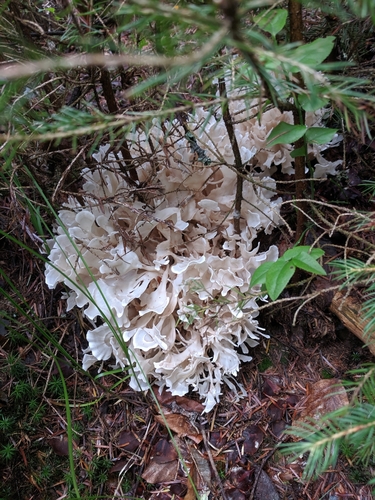
iNaturalist· cc-by-nc
(c) Aurelija, some rights reserved (CC BY-NC), uploaded by Aurelija
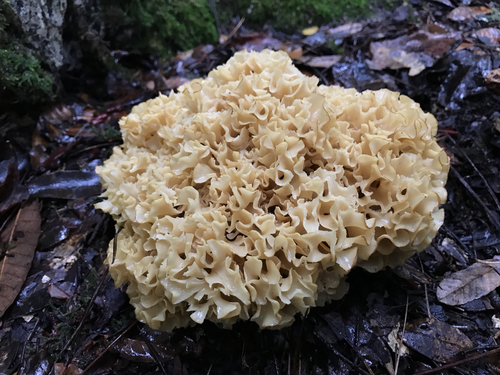
iNaturalist· cc-by-nc
(c) telissaw, some rights reserved (CC BY-NC), uploaded by telissaw
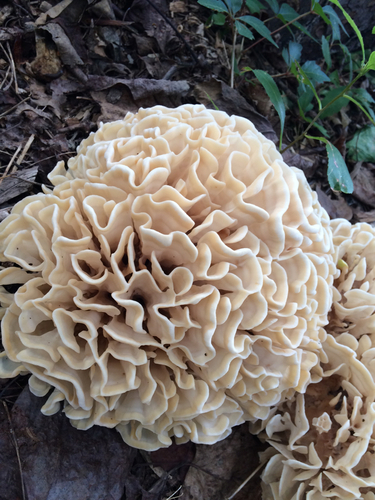
iNaturalist· cc-by
(c) Katja Schulz, some rights reserved (CC BY)
Summary
Source: WikipediaSparassis crispa is a species of fungus in the family Sparassidaceae. It is sometimes called cauliflower fungus, or cauliflower mushroom.
Description
A mushroom. The fruiting body is 13-28 cm across.
This description is brief — help expand it
Edible Uses
It is considered a good edible fungus when young and fresh but is difficult to clean. (A toothbrush and running water are recommended.) One French cookbook, which gives four recipes for this species, says that grubs and pine needles can get caught up in holes in the jumbled mass of flesh. The Sparassis should be blanched in boiling water for 2–3 minutes before being added to the rest of the dish. It should be cooked slowly. It can also be preserved in oil or cold water or by drying. Stored specimens may attract maggots.
Distribution
It is a temperate plant. It grows in mountains. In Yunnan.
Where It Grows
Andorra, Asia, Britain, Caucasus, China, Europe, Georgia, Himalayas, India, Japan, Korea, Mexico, North America, Poland,Russia, Scandinavia, Sweden, Switzerland, Turkey, Türkiye, USA
Other Information
It is cultivated.
Synonyms
Also Known As
Blomkalssvamp, Hua er xiu qiu jun, Kombostosoko, Xiuqiujun
References (20)
- Boa, E. R., 2004, Wild edible fungi and their importance to people. FAO Non Wood Forest Products Booklet 17
- Bussman, R. W., et al, 2016, A comparative ethnobotany of Khevsureti, Samtskhe-Javakheti, Tusheti, Svaneti, and Racha-Lechkhumi, Republic of Georgia (Sakartvelo), Caucasus. Journal of Ethnobiology and Ethnomedicine.
- Bussman, R. W. et al, 2017, Ethnobotany of Samtskhe-Javakheti, Sakartvelo (Republic of Georgia), Caucasus. Indian Journal of Traditional Knowledge Vol. 16(1) pp 7-24
- Bussman, R. W., et al, 2021, Unity in diversity—food plants and fungi of Sakartvelo (Republic of Georgia), Caucasus. Journal of Ethnobiology and Ethnomedicine (2021) 17:72 p 17
- Ciesla, W.M., 1998, Non-wood forest products from conifers. Non-wood forest products 12, FAO, Rome, p 91
Show all 20 references Hide references
- Garibay-Orijel, R., et al, 2007, Understanding cultural significance, the edible mushrooms case. Journal of Ethnobiology and Ethnomedicine. 3:4
- Hall, I. R., et al, 2003, Edible and Poisonous Mushrooms of the World. Timber Press. p 289, 315
- http://www.mykoweb.com/CAF/edible.html
- Jordan, P., 2000, The Mushroom Guide and Identifier, Hermes House, p 88
- Kasper-Pakosz, R., et al, 2016, Wild and native plants and mushrooms sold in the open-air markets of south- eastern Poland. Journal of Ethnobiology and Ethnomedicine 12:45
- Kaufmann, B. et al, 1999, The Great Encyclopedia of Mushrooms. Konemann. p 208
- Kaye, G.C., 1986, Wild and Exotic Mushroom Cultivation in North America
- Liu, D., et al, 2018, An ethnobotanical survey of edible fungi in Chuxiong City, Yunnan, China. Journal of Ethnobiology and Ethnomedicine (2018) 14:42
- Mabey, R., 1973, Food for Free. A Guide to the edible wild plants of Britain, Collins. p 40
- Negi, P. S. & Subramani, S. P., 2015, Wild Edible Plant Genetic Resources for Sustainable Food Security and Livelihood of Kinnaur District, Himachal Pradesh, India, International Journal of Conservation Science. 6 (4): 657-668
- Oh, S.S., et al, Evalution of antioxydant activity of Mycoleptodonoides aitchisonii, Sparassis crispa, Lentinus lepideus and Lentinula edodes. XXIII IUFRO World Congress Forests for the Future: Sustaining Society and the Environment.
- Pace, G., 1998, Mushrooms of the world. Firefly books. p 216
- Schneider, E., 2001, Vegetables from Amaranth to Zucchini: The essential reference. HarperCollins. p 143
- Semwal, K. C., et al, 2014, Edible mushrooms of the Northwestern Himalaya, India: a study of indigenous knowledge, distribution and diversity. Mycosphere 5(3): 440–461
- www.plantnames.unimelb.edu.au