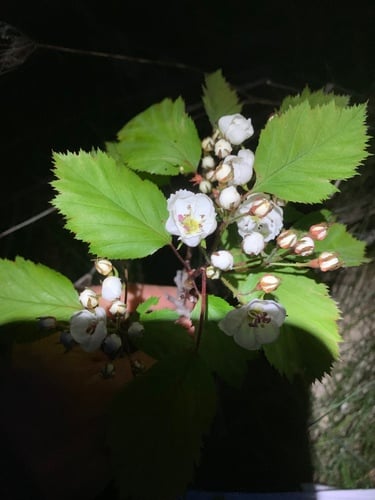
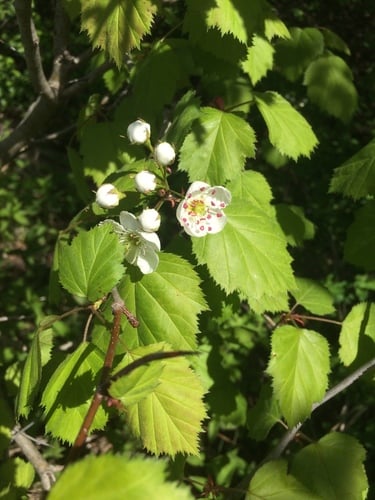
Sorbus commixta
Hedlund
Japanese rowan
iNaturalist· cc-by-sa
(c) harum.koh, some rights reserved (CC BY-SA), uploaded by harum.koh
iNaturalist· cc-by-nc
(c) onidiras-iNaturalist, some rights reserved (CC BY-NC), uploaded by onidiras-iNaturalist
Summary
Source: WikipediaSorbus commixta, the Japanese rowan, is a species of flowering plant in the family Rosaceae, native to central and eastern China, Korea, Japan, and Sakhalin (in the Russian Far East).
Description
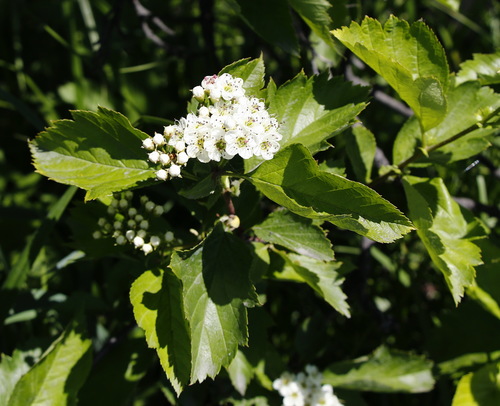
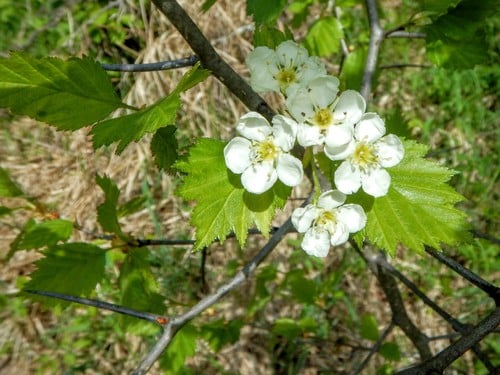
A deciduous tree. It grows 10 m tall. It is a broad cone shape. The bark is grey and smooth. The leaves are divided into leaflets along the stalk. The leaves are 20 cm long and have up to 15 leaflets. These taper to a point. They are 7.5 cm long by 2.5 cm wide. The leaflets have teeth along the edge. They are glossy above and blue-green underneath. They turn yellow to red or purple in autumn. The flowers are 8 mm across and white. They are in large clusters 15 cm across. The fruit are rounded and orange-red. They are 8 mm across.
Edible Uses
The fruit can be eaten raw or cooked, measuring about 7.5mm across and produced in fairly large bunches for easy harvesting. The leaves can be cooked and have been used as a famine food when nothing else is available. The leaves may contain cyanogens, so caution is advised.
Traditional Uses
The leaves are fried and eaten and also cooked with mixed vegetables. The ripe fruit are eaten.
This uses section is brief — help expand it
Medicinal Uses
None known
Known Hazards
The seeds probably contain hydrogen cyanide. This is the ingredient that gives almonds their characteristic flavour. Unless the seed is very bitter it should be perfectly safe in reasonable quantities. In small quantities, hydrogen cyanide has been shown to stimulate respiration and improve digestion, it is also claimed to be of benefit in the treatment of cancer. In excess, however, it can cause respiratory failure and even death.
Distribution
It is a temperate plant. It is native to Japan and Korea. It grows in mountain forests. It suits hardiness zones 6-9.
Where It Grows
Asia, Australia, Canada, Europe, Japan, Korea, Lithuania, North America,
Cultivation
Succeeds in most reasonably good soils in an open sunny position. Dislikes dry soils. Tolerates light shade, though it fruits better in a sunny position. Plants are susceptible to fireblight. This species is suitable for street planting.
Propagation
Seed is best sown as soon as it is ripe in a cold frame. Where seed is plentiful, it can be sown in an outdoor seedbed. Stored seed benefits from 2 weeks of warm stratification followed by 14–16 weeks of cold stratification, so sow as early in the year as possible. Prick out seedlings into individual pots once large enough to handle. Top-growth is very slow in the first year or two as the plant focuses on root development. Keep seedlings in pots in a cold frame through their first winter, then plant out into permanent positions in late spring.
Other Uses
None known Special Uses
Notes
There are about 75 Sorbus species. See Sorbus ulleungensis - now separate from Sorbus commixta.
Synonyms
Also Known As
Magamok
References (10)
- Chen, B. & Qiu, Z., Consumer's Attitudes towards Edible Wild Plants, Ishikawa Prefecture, Japan. p 26 www.hindawi.com/journals/ijfr/aip/872413.pdf
- Coombes, A.J., 2000, Trees. Dorling Kindersley Handbooks. p 276
- Cundall, P., (ed.), 2004, Gardening Australia: flora: the gardener's bible. ABC Books. p 1356
- Hibbert, M., 2002, The Aussie Plant Finder 2002, Florilegium. p 292
- Kim, H. & Song, M., 2013, Ethnobotanical analysis for traditional knowledge of wild edible plants in North Jeolla Province (Korea). Genetic. Resour. Crop Evol. (2013) 60:1571-1585
Show all 10 references Hide references
- Kongl. Svenska Vetenskapsakad. Handl. 35(1):38, fig. 2. 1901
- Lord, E.E., & Willis, J.H., 1999, Shrubs and Trees for Australian gardens. Lothian. p 73
- Ong, H. G., et al, 2015, Ethnobotany of the wild edible plants gathered in Ulleung Island, South Korea. Genet Resourc Crop Evol. Springer
- Plants for a Future database, The Field, Penpol, Lostwithiel, Cornwall, PL22 0NG, UK. http://www.scs.leeds.ac.uk/pfaf/
- Ryan, S., 2008, Dicksonia. Rare Plants Manual. Hyland House. p 56