Solanum sessiliflorum
Dunal
Cocona
iNaturalist· cc-by-nc
(c) Jahir Sánchez, some rights reserved (CC BY-NC)
iNaturalist· cc-by-nc
(c) José Edilson Espitia Barrera, some rights reserved (CC BY-NC), uploaded by José Edilson Espitia Barrera
Summary
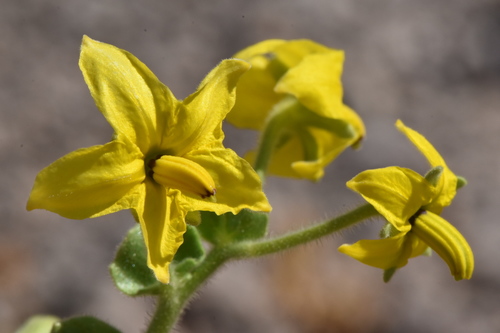
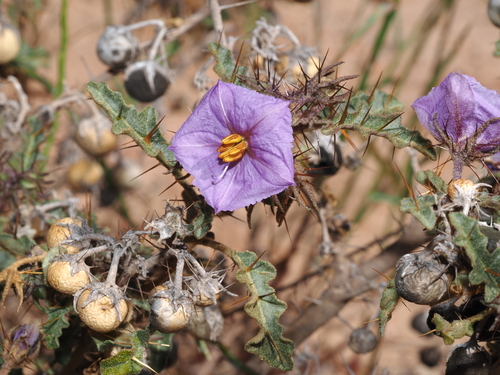
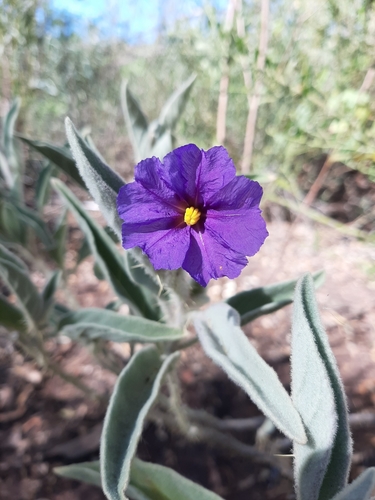
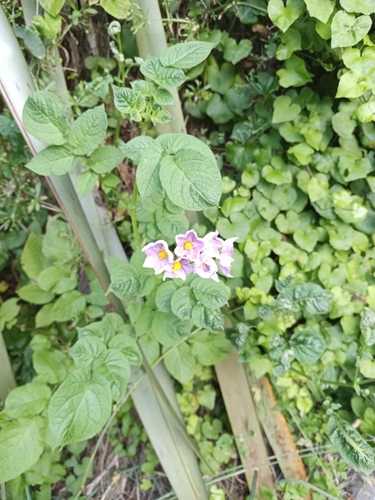
Source: WikipediaSolanum sessiliflorum, the cocona, is a tropical shrub of the family Solanaceae. The cocona plant has sturdy branches and huge, serrate and hairy leaves. Cocona closely resembles a number of close relatives, including naranjilla (S. quitoense) and pseudolulo (S. pseudolulo.) It can be distinguished from those plants by its lack of spines. It will hybridize with those and other close relatives. Cocona also lacks the characteristic purple coloring usually seen in the naranjilla. Its flowers resemble large potato flowers, with light green petals. Cocona is harvested in parts of South America around the Amazon rainforest such as Purús Province in eastern Peru. The fruit of cocona is a red, orange or yellow edible berry. Cocona is native to the Andean region of South America, where it is occasionally cultivated for human consumption. Cocona can also be grown as an indoor ornamental plant in temperate climates, but it seems to be quite sensitive to spider mites, so care should be taken not to keep it in too dry air during winter. Like the naranjilla, coconas are highly sensitive to aphids and nematodes. As subtropical plants, they can endure cool weather, but will be killed or severely damaged by frost. During summer, it can be grown outside or in a cold greenhouse. When grown from seed, coconas can bear fruit in as little as 9 months, or as long as 24. Solanum georgicum and Solanum hyporhodium were (and sometimes still are) included in this species, but they are generally treated as distinct today.
Description
A herb or small shrub. It grows 1-2 m tall. The leaves are oval and large. They are 30-50 cm long by 20-30 cm wide. The lobes taper to the tips. The lobes are triangle shaped and the edges are wavy. The flowers are 4-5 cm across. They are in racemes in the axils of leaves. The fruit is soft and oval. It is orange or red with subacid to sour pulp. There are many seeds. The skin of the fruit has a soft fuzz which can be rubbed off. The fruit are oval and 4-12 cm long by 3-6 cm wide. The fruit are edible.
Edible Uses
The soft fruits are peeled and used for jams, preserves, pies, sauces, and drinks. The leaves are cooked and eaten as a vegetable.
Traditional Uses
The fruit are peeled and used for jams, preserves, pies and sauces. A drink is made from the fruit. The leaves are cooked and eaten.
This uses section is brief — help expand it
Medicinal Uses
No medicinal uses listed in provided data.
Known Hazards
Although providing many well-known foods for people, including the potato, tomato, pepper and aubergine, most species in this genus also contain toxic alkaloids. Whilst these alkaloids can make the plant useful in treaing a range of medical conditions, they can also cause problems such as nausea, vomiting, salivation, drowsiness, abdominal pain, diarrhoea, weakness and respiratory depression. Unless there are specific entries with information on edible uses, it would be unwise to ingest any part of this plant.
Distribution
It is a tropical plant. It suits the hot, wet tropical lowlands. It grows between 200-1,000 m altitude in the Andes. It grows naturally in regions with temperatures between 18-30°C. It is best on light well-drained soils. It cannot tolerate root knot nematodes. The rainfall is 1,500-4,500 mm per year. It needs full sun. It suits hardiness zones 10-12.
Where It Grows
Amazon, Asia, Australia, Brazil, Central America*, Colombia, Costa Rica, Ecuador, Guiana, Guianas, Jamaica, Mexico, North America, Pacific, Peru*, Philippines, Puerto Rico, SE Asia, South America, Suriname, Trinidad, USA, Venezuela, West Indies,
Cultivation
Plants are grown from seed. Seeds are allowed to ferment for a couple of days to remove the flesh then washed and dried before planting. Seeds can be put in a nursery and transplanted when 20-30 cm high. A spacing about 2 m apart is suitable. Plants can be grown by cuttings or air-layering.
Propagation
Seed - sow in trays in a nursery. Prick out the seedlings into individual pots when they are large enough to handle and grow them on fast. Plant them out when 10cm or more tall. Cuttings of half-ripe wood. Very easy, the cuttings root within a couple of weeks. Root cuttings.
Other Uses
The fruit is used as a bath soap and also as a shampoo to clean and shine the hair
Production
Fruit mature about 8 weeks after pollination.
Other Information
It is a cultivated food plant. Fruit are commonly eaten locally.
Notes
There are about 1400 Solanum species.
Nutrition
| Part | Moisture | kJ | kcal | Protein | Vit A | Vit C | Iron | Zinc |
|---|---|---|---|---|---|---|---|---|
| Fruit | — | — | 0.6 | 140 | — | 0.6 | — | — |
Synonyms
Also Known As
Ccujapacco tton'tto, Chope, Coconilla, Cubios, Cubiu, Cucuna, Kukuna, Larajilla tape, Lulo, Miutoahui'ca, Naranjilla de monte, Orinoco apple, Peach tomato, Topiro, Tupiro, Tupiru, Turkey berry, Uwica
References (39)
- Barfod, A. S. & Kvist, L. P., 1996, Comparative Ethnobotanical Studies of the Amerindian Groups in Coastal Ecuador. The Danish Academy of Sciences and Letters. p 79, 83
- 1996, California Rare Fruit Growers, Inc. Pepino dulce Fruit fact
- Coronel, R.E., 1982, Fruit Collections in the Philippines. IBPGR Newsletter p 10 (As Solanum topiro)
- Cundall, P., (ed.), 2004, Gardening Australia: flora: the gardener's bible. ABC Books. p 1348
- Duchelle, A. E., 2007, Observations on Natural Resource use and Conservation by the Shuar In Ecuador's Cordillera del Condor. Ethnobotany Research & Applications 5:005-023
Show all 39 references Hide references
- Etkin, N. L. (Ed.), 1994, Eating on the Wild Side, Univ. of Arizona. p 141
- Facciola, S., 1998, Cornucopia 2: a Source Book of Edible Plants. Kampong Publications, p 237
- Garcia-Serrano, C. R., & Del Monte, J. P., 2004, The Use of Tropical Forest (Agroecosystems and wild Plant harvesting) as a Source of Food in the Bribri and Cabecar Cultures in the Caribbean Coast of Costa Rica. Economic Botany 58(1) pp 58-71 (As Solanum topiro)
- Hedrick, U.P., 1919, (Ed.), Sturtevant's edible plants of the world. p 620 (Also as Solanum topiro)
- Herklots,
- Hermandez Bermejo, J.E., and Leon, J. (Eds.), 1994, Neglected Crops. 1492 from a different perspective. FAO Plant Production and Protection Series No 26. FAO, Rome. p17, 198
- Heywood, V.H., Brummitt, R.K., Culham, A., and Seberg, O., 2007, Flowering Plant Families of the World. Royal Botanical Gardens, Kew. p 306 (As Solanum topiro)
- Hibbert, M., 2002, The Aussie Plant Finder 2002, Florilegium. p 292
- Hunter, D., et al, 2019, The potential of neglected and underutilized species for improving diets and nutrition. Planta (2019) 250:709-729
- Kermath, B. M., et al, 2014, Food Plants in the Americas: A survey of the domesticated, cultivated and wild plants used for Human food in North, Central and South America and the Caribbean. On line draft. p 824
- Kiple, K.F. & Ornelas, K.C., (eds), 2000, The Cambridge World History of Food. CUP p 1759 (As Solanum topiro)
- Lorenzi, H., Bacher, L., Lacerda, M. & Sartori, S., 2006, Brazilian Fruits & Cultivated Exotics. Sao Paulo, Instituto Plantarum de Estuados da Flora Ltda. p 312
- Macbride. J. F., 1962, Flora of Peru. Solanaceae. Field Museum Natural History. Chicago. p 264 (As Solanum topiro)
- Martin, F.W. & Ruberte, R.M., 1979, Edible Leaves of the Tropics. Antillian College Press, Mayaguez, Puerto Rico. p 220
- Martin, F. W., et al, 1987, Perennial Edible Fruits of the Tropics. USDA Handbook 642 p 62 (As Solanum topiro)
- Morton, Julia F., 1987, Fruits of Warm Climates. Creative Resources Systems, Inc. . p. 428
- NYBG Herbarium "edible"
- Paz, F. S., et al, 2021, Edible Fruit Plant Species in the Amazon Forest Rely Mostly on Bees and Beetles as Pollinators. Journal of Economic Entomology, XX(XX), 2021, 1–13
- Penafield Anchundia, D. D., 2017, Traditional food consumption and its nutritional contribution in Guasaganda, Central Ecuador. PhD Ghent University p 72
- J. L. M. Poiret, Encycl. suppl. 3:775. 1814
- Roa, J. A. G. & Boada, D. S. G., 2018, Fundación para el Fortalecimiento de la Fruticultura y Plantas Alimenticias no Convencionales en Colombia.
- Samuels, J., 2015, Biodiversity of Food Species of the Solanaceae Family: A Preliminary Taxonomic Inventory of Subfamily Solanoideae. Resources 2015, 4. 277-322
- Segura, S., et al, 2018, The edible fruit species in Mexico. Genet Resour Crop Evol (2018) 65:1767–1793
- Smith, N., et al, 2007, Amazon River Fruits. Flavors for Conservation. Missouri Botanical Gardens Press. p 240
- Solan. syn. 10. 1816 [As Dunal] (As Solanum topiro)
- Torre, de la, L., et al, 2008, Enciclopedia de las Plantas Útiles del Ecuador. Herbario QCA. Pontificia Universidad Católica del Ecuador. p 595
- Ulian, T., et al, 2020, Unlocking plant resources to support food security and promote sustainable agriculture. Plants, People, Planet. 2020;2:421–445.
- USDA, ARS, National Genetic Resources Program. Germplasm Resources Information Network - (GRIN). [Online Database] National Germplasm Resources Laboratory, Beltsville, Maryland. Available: www.ars-grin.gov/cgi-bin/npgs/html/econ.pl (10 April 2000)
- Vasquez, R. and Gentry, A. H., 1989, Use and Misuse of Forest-harvested Fruits in the Iquitos Area. Conservation Biology 3(4): 350f
- Villachica, H., (Ed.), 1996, Frutales Y hortalizas promisorios de la Amazonia. FAO, Lima. p 99
- Wiersema, J. H. & Leon, B., 2013, World Economic Plants. A Standard Reference CRC Press. 2nd Ed. p 647
- World Checklist of Useful Plant Species 2020. Royal Botanic Gardens, Kew
- www.colecionandofrutas.org
- Zuchowski W., 2007, Tropical Plants of Costa Rica. A Zona Tropical Publication, Comstock Publishing. p 205