Solanum mauritianum
Scop.
Wild tobacco tree
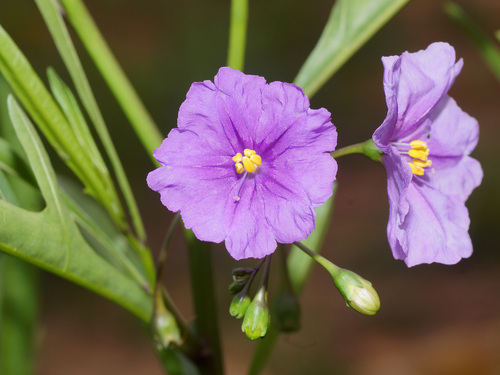
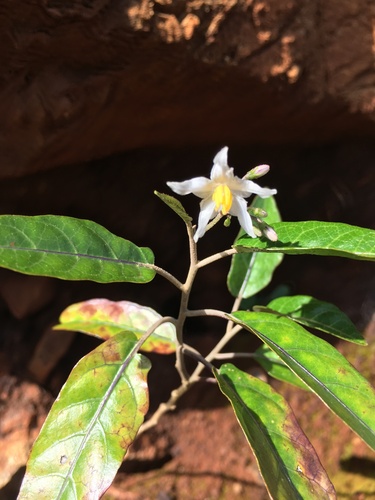
iNaturalist· cc-by-nc-sa
(c) Louisa Billeter, some rights reserved (CC BY-NC-SA)
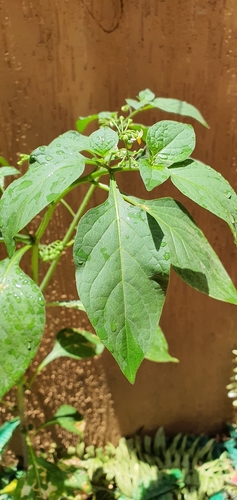
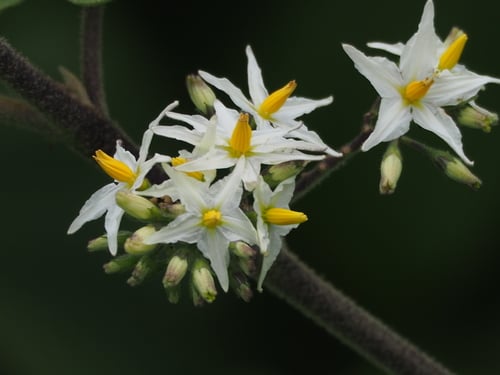
iNaturalist· cc-by-nc-sa
(c) Rob Palmer, some rights reserved (CC BY-NC-SA), uploaded by Rob Palmer
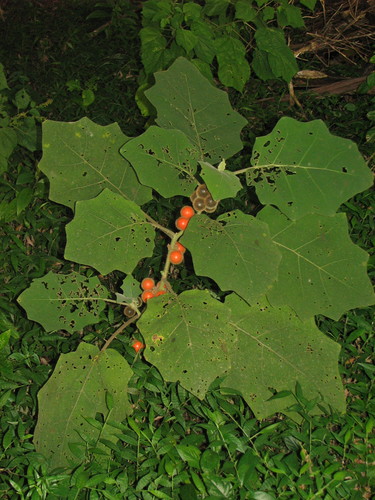
iNaturalist· cc-by-nd
(c) Kyle Campbell, some rights reserved (CC BY-ND), uploaded by Kyle Campbell
Summary
Source: WikipediaSolanum mauritianum is a small tree or shrub native to South America, including Northern Argentina, Southern Brazil, Paraguay and Uruguay. Its common names include earleaf nightshade (or "ear-leaved nightshade"), woolly nightshade, flannel weed, bugweed, tobacco weed, tobacco bush, wild tobacco and kerosene plant.
Description
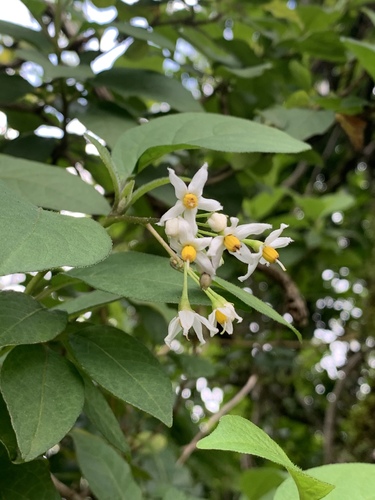
A shrub or small tree. It grows 4 m tall. It has a woolly covering. The leaves are alternate. There are 2 leaf like structures near the base of the leaf. These are 0.5-2 cm long. The leaves are oval to sword shaped and 10-30 cm long by 4.5-14 cm wide. They taper to the tip. There are many flowers together at the tip of the branches or in the axils of leaves. The fruit is a round berry. It is dull yellow and 10-15 mm wide. It is hairy at first. The seeds are 1.5-2 mm long.
Traditional Uses
CAUTION: The fruit are poisonous.
This uses section is brief — help expand it
Known Hazards
It is alleged that all parts of the Solanum mauritianum plant are poisonous to humans, especially the unripe berries, and furthermore that human fatalities have resulted from the consumption of the berries, and cases of fatal poisoning in pigs and illness in cattle have been reported in Queensland. However, mountain possums appear to eat it without ill effect, and stripping of bark, leaves, and terminal shoots has destroyed pure stands of S.mauritianum. Watt & Brandwijk state that horses, domestic chickens and all birds eat the fruit with impunity, and further state that no records of poisoning in children exist, casting doubt on contrary published accounts. The main toxic compound is the alkaloid, solasodine, with the highest content in the unripe green berry (2–3.5% dry weight). Solauricine, solauricidine, and solasodamine have also been found in Solanum mauritianum.
Distribution
A tropical plant. It is native to Argentina. It grows on waste ground. In East Africa it grows between 1,500-2,800 m altitude. It suits hardiness zones 10-12.
Where It Grows
Africa, Angola, Argentina, Asia, Australia, Brazil, Cook Islands, East Africa, East Timor, Eswatini, Fiji, Hawaii, India, Madagascar, Mauritius, Mozambique, New Caledonia, New Zealand, Norfolk Island, Pacific, Papua New Guinea, PNG, Paraguay, SE Asia, Sierra Leone, Solomon Islands, South Africa, Southern Africa, South America, St Helena, Swaziland, Tasmania, Timor-Leste, Uruguay, Vanuatu, West Africa, Zambia, Zimbabwe,
Notes
There are about 1400 Solanum species.
Synonyms
Also Known As
Asian bug tree, Hus, Malulua branca
References (20)
- Borrell, O.W., 1989, An Annotated Checklist of the Flora of Kairiru Island, New Guinea. Marcellin College, Victoria Australia. p 137
- Cabalion, P. and Morat, P., 1983, Introduction le vegetation, la flore et aux noms vernaculaires de l'ile de Pentcoste (Vanuatu), In: Journal d'agriculture traditionnelle et de botanique appliquee JATBA Vol. 30, 3-4
- Cooper, W. and Cooper, W., 2004, Fruits of the Australian Tropical Rainforest. Nokomis Editions, Victoria, Australia. p 522
- Cundall, P., (ed.), 2004, Gardening Australia: flora: the gardener's bible. ABC Books. p 1347
- Dashorst, G.R.M., and Jessop, J.P., 1998, Plants of the Adelaide Plains & Hills. Botanic Gardens of Adelaide and State Herbarium. p 128
Show all 20 references Hide references
- Delic. fl. faun. insubr. 3:16, t. 8. 1788
- Dharani, N., 2002, Field Guide to common Trees & Shrubs of East Africa. Struik. p 272
- Flora of Australia Volume 49, Oceanic Islands 1, Australian Government Publishing Service, Canberra. (1994) p 300
- Jackes, B.R., 2001, Plants of the Tropics. Rainforest to Heath. An Identification Guide. James Cook University. p 83
- Lautenschläger, T., et al, 2018, First large-scale ethnobotanical survey in the province of Uíge, northern Angola. Journal of Ethnobiology and Ethnomedicine (2018) 14:51
- Lazarides, M. & Hince, B., 1993, Handbook of Economic Plants of Australia, CSIRO. p 222
- Lord, E.E., & Willis, J.H., 1999, Shrubs and Trees for Australian gardens. Lothian. p 262
- Low, T., 1992, Bush Tucker. Australia’s Wild Food Harvest. Angus & Robertson. p 78
- Palgrave, K.C., 1996, Trees of Southern Africa. Struik Publishers. p 822
- Recher, P, 2001, Fruit Spirit Botanical Gardens Plant Index. www.nrg.com.au/~recher/ seedlist.html p 7
- Smith, A.C., 1991, Flora Vitiensis Nova, Lawaii, Kuai, Hawaii, Volume 5 p 9
- Swaziland's Flora Database http://www.sntc.org.sz/flora
- Williams, J.B., Harden, G.J., and McDonald, W.J.F., 1984, Trees and shrubs in rainforests of New South Wales and Southern Queensland. Univ. of New England, Armidale. p 90
- World Checklist of Useful Plant Species 2020. Royal Botanic Gardens, Kew
- http://cookislands.bishopmuseum.org