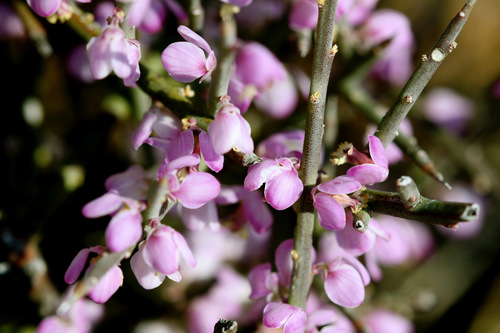
Securidaca longipedunculata
Fresen.
Tree-violet, Violet tree
gbif· cc-by
Meise Botanic Garden
gbif· cc-by
Meise Botanic Garden
Summary
A deciduous tree reaching 6 m tall, hardy to UK zone 10, with hermaphroditic flowers. Adapts to light, medium, and heavy soils with mildly acid to mildly alkaline pH. Grows in semi-shade or full sun and prefers moist soil.
Description
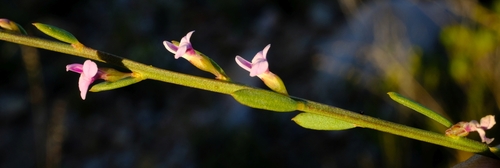
A small tree. It grows up to 6-10 m high. The trunk is twisted. The bark is light grey and smooth. The leaves are alternate or clustered on small side branches. They are simple and vary in size and shape. They are oval. They are 1-5 cm long by 0.5-2 cm wide. The flowers are small. They are 10 mm long. They are pink or purple. They are on long stalks. They occur in sprays at the ends of branches or in the axils of leaves. The sprays are 3-5 cm long. The flowers have a strong smell. The fruit are a more or less round nut. It has a wing around it. The fruit is purplish-green when young and pale brown when mature. They are 12 mm across with a wing 5 cm long and 2.5 cm across.
Edible Uses
Young leaves are cooked and eaten as a vegetable or in sauces.
Traditional Uses
The young leaves are eaten. They are also used to make an alcoholic drink. Caution: Alcohol is a cause of cancer. CAUTION: The roots are very poisonous.
Medicinal Uses
Roots and bark are taken orally as powders or infusions for chest complaints, headaches, inflammation, tuberculosis, infertility, venereal diseases, and constipation. Roots relieve toothache when chewed. Mixed roots with dwarf custard apple treat gonorrhoea. Powdered roots rubbed on the forehead treat headaches; root infusions wash tropical ulcers. Used by the vhaVenda people for mental disorders and protection during breastfeeding, and mixed with maize or sorghum beverage as a male sexual aid. In Zimbabwe, roots treat suspected spirit possession, snakebites, and coughs when pounded with water and salt. The plant has approximately 100 traditional medicinal uses across its range.
Known Hazards
The tree, but especially the roots, are toxic if taken in excess. A saponin found in the roots can cause severe damage to bone marrow and haemolysis when in contact with blood. The solid portion of the root is said to be the most lethal. The root bark also contains 0.42% methyl salicylate. Severe poisoning can result from ingestion of 10 - 30ml of methyl salicylate. In Zambia the crushed and powdered roots are used as an intravaginal or intrarectal poison, and in Gambia as a fish poison. Bark, roots and seeds are used in arrow poison, and root can be used as a snake repellent.
Distribution
It is a tropical plant. In South Africa it grows from sea level to 1600 m altitude. It grows in various types of bushland. It grows in savannah country. It is often in sandy or rocky soils in moist savannah. It can grow on the edges of mangroves. It grows in areas with an annual rainfall between 600-1,000 mm. It can tolerate drought. It can grow in arid places. It grows in the Sahel.
Where It Grows
Africa, Angola, Benin, Botswana, Burkina Faso, Burundi, Cameroon, Central Africa, Chad, Congo DR, Côte d'Ivoire, East Africa, Eritrea, Ethiopia, Gambia, Ghana, Guinea, Guinée, Guinea-Bissau, Ivory Coast, Kenya, Malawi, Mali, Mozambique, Namibia, Niger, Nigeria, Rwanda, Sahel, Senegal, Sierra Leone, South Africa, Southern Africa, Sudan, Tanzania, Togo, Uganda, West Africa, Zambia, Zimbabwe,
Cultivation
A plant of the subtropics and tropics, where it is found in a wide range of climates including hot and arid summer rainfall, and equatorial humid; at elevations up to 1,800 metres. It grows best in areas where annual daytime temperatures are within the range 20 - 30°c, but can tolerate 16 - 36°c. The plant can survive temperatures down to about 1°c. It prefers a mean annual rainfall in the range 600 - 1,000mm, but tolerates 500 - 1,300mm. Requires a sunny position. Grows best in a light, well-drained soil, succeeding even if the fertility is low. Prefers a pH in the range 5 - 7, tolerating 4.5 - 7.5. The plant can survive bush fires. The flowers are extremely attractive to birds, butterflies and insects.
Propagation
Difficult from seed; soak thoroughly and plant in sandy soil where seedlings will remain undisturbed, as they develop fragile taproots easily broken during transplanting. Sow in deep individual containers and plant out while small, or sow in situ with care. Alternatively, propagate from root shoot cuttings.
Other Uses
Bark or pounded seeds produce soap for washing and bleaching. Inner bark fibre resembles cotton and can be woven into coarse cloth; young branch fibre is strong and durable like flax. Used for fishing nets, baskets, and bark cloth threads. Seed oil is used cosmetically or as furniture stain. Light yellow, soft, spongy wood resists termites but splits when drying; used for poles, hut construction, brooms, and charcoal. Functions as an ornamental hedge plant.
Production
The tree is slow growing.
Notes
There are about 80 Securidaca species. It is used in traditional medicine. The roots are poisonous and used for this purpose.
Synonyms
Also Known As
Colodi, Djuro, Djutu, Ediol, Epeta, Fudara, Ilila, Jurtu, Jutu, Lilia, Mamampai, Misunda, Mucaca, Mufufuma, Muluka, Mupupo, Nacunhi, Naquehi, Nkama nsunda, Nsunda, Odyer, Sanya, Tiuti, Tsatse, Tsatso, Uli-elo
References (26)
- Achigan-Dako, E, et al (Eds), 2009, Catalogue of Traditional Vegetables in Benin. International Foundation for Science.
- Assefa, A. & Abebe, T., 2010, Wild Edible Trees and Shrubs in the Semi-arid Lowlands of Southern Ethiopia. Journal of Science and Development 1 (1) 2010
- Batawila, K., et al, 2007, Diversite et gestion des legumes de cueillete au Togo. African Journal of Food, Agriculture, Nutrition and Development 7( 3& 4): 67
- Burkill, H. M., 1985, The useful plants of west tropical Africa, Vol. 4. Kew.
- Dansi, A., et al, 2008, Traditional leafy vegetables and their use in the Benin Republic. Genet Resour Crop Evol (2008) 55:1239–1256
Show all 26 references Hide references
- Food Composition Tables for use in Africa FAO http://www.fao.org/infoods/directory No. 837
- Fowler, D. G., 2007, Zambian Plants: Their Vernacular Names and Uses. Kew. p 53
- Heywood, V.H., Brummitt, R.K., Culham, A., and Seberg, O., 2007, Flowering Plant Families of the World. Royal Botanical Gardens, Kew. p 262 (Genus)
- Jardin, C., 1970, List of Foods Used In Africa, FAO Nutrition Information Document Series No 2.p 10
- Kafoutchoni, K. M., et al, 2018, Species richness, cultural importance, and prioritization of wild spices for conservation in the Sudano-Guinean zone of Benin (West Africa). Journal of Ethnobiology and Ethnomedicine. 14:67
- Keay, R.W.J., 1989, Trees of Nigeria. Clarendon Press, Oxford. p 48
- Latham, P., 2004, Useful Plants of Bas-Congo province. Salvation Army & DFID p 251
- Lautenschläger, T., et al, 2018, First large-scale ethnobotanical survey in the province of Uíge, northern Angola. Journal of Ethnobiology and Ethnomedicine (2018) 14:51
- Martin, F.W. & Ruberte, R.M., 1979, Edible Leaves of the Tropics. Antillian College Press, Mayaguez, Puerto Rico. p 214
- Masters, T., 2021, Traditional food plants of the upper Aswa River catchment of northern Uganda—a cultural crossroads. Journal of Ethnobiology and Ethnomedicine (2021) 17:24
- Maydell, H. von, 1990, Trees and shrubs of the Sahel: their characteristics and uses. Margraf. p 373
- Mbuya, L.P., Msanga, H.P., Ruffo, C.K., Birnie, A & Tengnas, B., 1994, Useful Trees and Shrubs for Tanzania. Regional Soil Conservation Unit. Technical Handbook No 6. p 436
- Molla, A., Ethiopian Plant Names. http://www.ethiopic.com/aplants.htm
- Mus. Senckenberg. 2:275. 1837
- Palgrave, K.C., 1996, Trees of Southern Africa. Struik Publishers. p 388
- Peters, C. R., O'Brien, E. M., and Drummond, R.B., 1992, Edible Wild plants of Sub-saharan Africa. Kew. p 162
- Royal Botanic Gardens, Kew (1999). Survey of Economic Plants for Arid and Semi-Arid Lands (SEPASAL) database. Published on the Internet; http://www.rbgkew.org.uk/ceb/sepasal/internet [Accessed 4th June 2011]
- van Wyk, B, van Wyk, P, and van Wyk B., 2000, Photographic guide to Trees of Southern Africa. Briza. p 285
- Williamson, J., 2005, Useful Plants of Malawi. 3rd. Edition. Mdadzi Book Trust. p 224
- World Checklist of Useful Plant Species 2020. Royal Botanic Gardens, Kew
- www.worldagroforestrycentre.org/treedb/