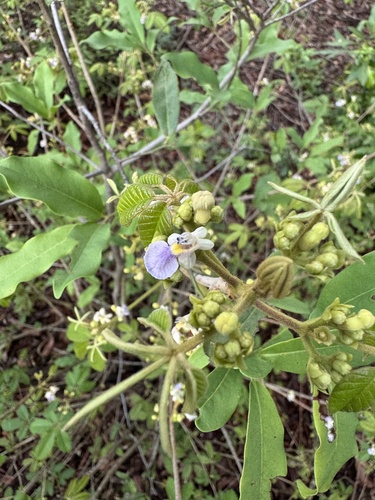
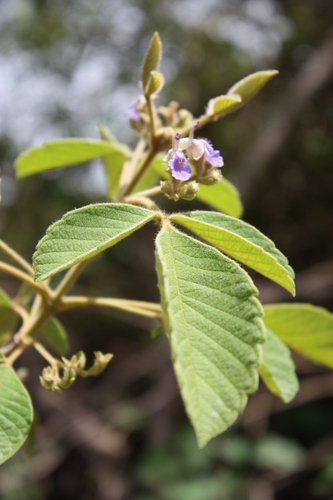
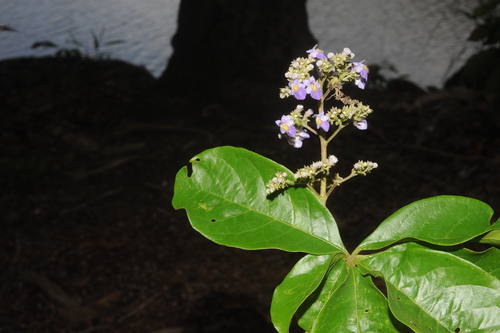
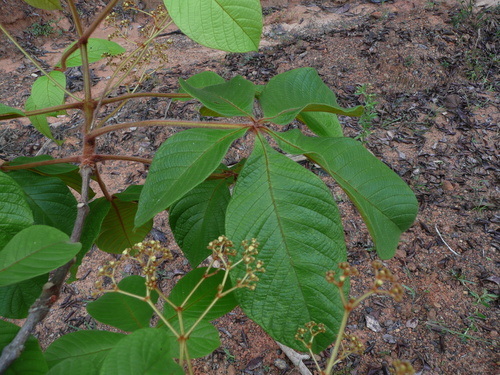
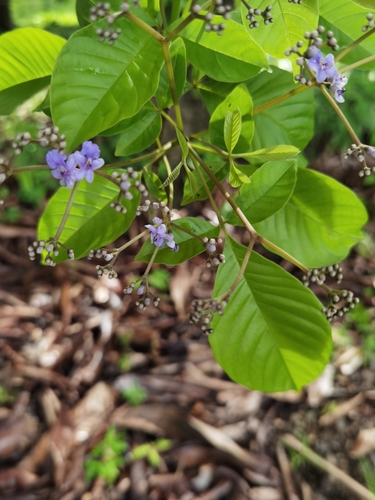
Salvia mellifera
Greene
Californian black sage, Black sage, Button sage
iNaturalist· cc-by-nc
(c) smfang, some rights reserved (CC BY-NC), uploaded by smfang
iNaturalist· cc-by-nc
(c) Ron Vanderhoff, some rights reserved (CC BY-NC)
iNaturalist· cc-by-nc
(c) Ron Vanderhoff, some rights reserved (CC BY-NC)
Summary
Source: WikipediaSalvia mellifera (Californian black sage, also known as seel by the Mahuna) is a small, highly aromatic, evergreen shrub of the genus Salvia (the sages) native to California, and Baja California, Mexico. It is common in the coastal sage scrub of Southern California and northern Baja California. Black sage has a dark resinous appearance and releases a strong herbal scent when it is touched. This is especially apparent in dry seasons.
Description
An evergreen shrub growing to 2 m (6ft 7in) tall, hardy to UK zone 8. Remains in leaf year-round. Hermaphroditic and bee-pollinated. Requires full sun and well-drained, light sandy to medium loamy soil with mildly acidic to mildly alkaline pH. Tolerates dry or moist conditions.
Edible Uses
The aromatic leaves can be brewed into a tea, and both the leaves and stems can be used as a food flavouring. The seeds can be dried, ground into a powder, and prepared as a gruel.
Traditional Uses
The leaves are used to brew tea. The leaves are used to season sausages and stuffings for poultry and meat. The seeds are parched and ground and eaten.
Medicinal Uses
The green leaves are cardiac and carminative. An infusion has been used in the treatment of heart complaints, and the leaves can be chewed to relieve gas pains. A poultice of heated leaves can be applied to the ear for ear pains or to the neck for sore throats. A decoction of the plant has been used for chronic bronchial coughs and as a bath in the treatment of paralysis.
Distribution
It is a warm temperate plant.
Where It Grows
Australia, North America, USA,
Cultivation
Requires a very well-drained light sandy soil in a sunny position. Prefers a rich soil. Soils rich in nitrogen encourage excessive leaf growth at the expense of flowering. This species is not hardy in the colder areas of the country, it tolerates temperatures down to between -5 and -10°c. Plants can be killed by excessive winter wet. Members of this genus are rarely if ever troubled by browsing deer.
Propagation
Sow seed in March or April in a greenhouse; germination usually takes place within 2 weeks. Prick out seedlings into individual pots when large enough to handle and plant out in early summer. In areas at the limits of the plant's hardiness, grow on under glass through the first winter and plant out in late spring the following year. Cuttings of half-ripe wood can be taken at almost any time during the growing season.
Other Uses
None known
Notes
There are about 900 Salvia species.
Synonyms
References (7)
- Beckstrom-Sternberg, Stephen M., and James A. Duke. "The Foodplant Database." http://probe.nalusda.gov:8300/cgi-bin/browse/foodplantdb.(ACEDB version 4.0 - data version July 1994) (As Ramona stachyoides)
- Facciola, S., 1998, Cornucopia 2: a Source Book of Edible Plants. Kampong Publications, p 135
- Hibbert, M., 2002, The Aussie Plant Finder 2002, Florilegium. p 285
- Kermath, B. M., et al, 2014, Food Plants in the Americas: A survey of the domesticated, cultivated and wild plants used for Human food in North, Central and South America and the Caribbean. On line draft. p 779
- Moerman, D. F., 2010, Native American Ethnobotany. Timber Press. p 510
Show all 7 references Hide references
- Pittonia 2:236. 1892
- Plants for a Future database, The Field, Penpol, Lostwithiel, Cornwall, PL22 0NG, UK. http://www.scs.leeds.ac.uk/pfaf/