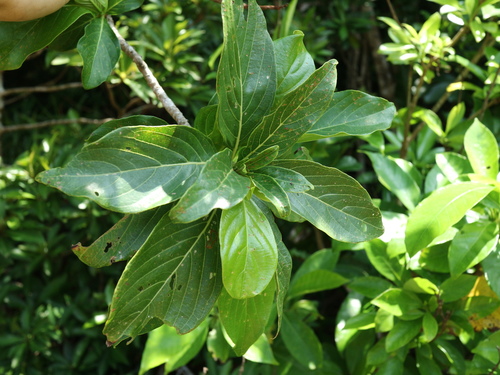
Rubia cordifolia
Linn. sensu Hook.f.
Indian Madder
iNaturalist· cc-by-nc
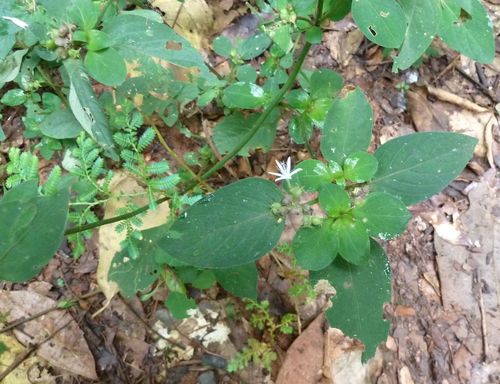
(c) V.S. Volkotrub, some rights reserved (CC BY-NC), uploaded by V.S. Volkotrub
iNaturalist· cc-by-nc
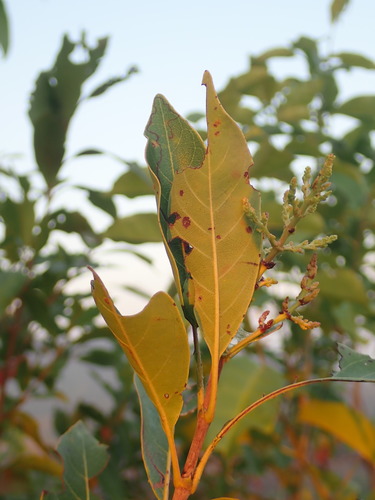
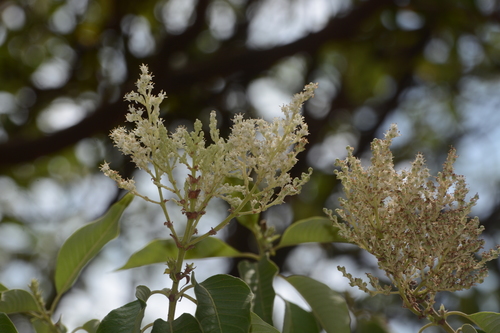
(c) MP Zhou, some rights reserved (CC BY-NC)
Summary
Source: WikipediaRubia cordifolia, known as Indian madder, is a species of flowering plant in the coffee family, Rubiaceae. It has been cultivated for a red pigment derived from roots.
Description
A climber. It is a straggling plant. It grows 1-8 m long. It keeps gorwing from year to year. The stems are angled and have small hooks. The leaves occur as 4 in a ring. The leaves are often heart shaped at the base and are broadest just above the base. They narrow to a long tip. The leaves are 3 cm long by 1 cm wide. The flowers are small and greenish-yellow and on branched stalks at the ends of shoots or in the axils of leaves. The fruit are fleshy and black and divided into halves. The seeds are kidney shaped.
Edible Uses
The leaves are edible when cooked and are used as a side dish with rice; they are highly regarded as a lab-lab by the Javanese. The fruit, about 8mm in diameter, can be eaten raw.
Traditional Uses
The young leaves are eaten as a side dish. They are usually steamed. They are also burnt and used as a vegetable salt. The ash is soaked in water and filtered and this is used to soften other vegetables when cooking. It can be used as a substitute for sodium bicarbonate. The fresh fruit are eaten. The root is dried as a powder and used as flavouring in local liquor.
Medicinal Uses
The roots are alterative, anodyne, antiphlogistic, antitussive, astringent, diuretic, emmenagogue, expectorant, styptic, tonic, and vulnerary. They have an antibacterial action, inhibiting the growth of Staphylococcus aureus, S. epidermidis, and Pneumococci, among others, and are used to lower blood pressure. Internally, the roots are used to treat abnormal uterine bleeding, internal and external haemorrhage, bronchitis, rheumatism, and stones in the kidney, bladder, and gall, as well as dysentery. Roots are harvested in autumn from plants at least 3 years old, then peeled and dried. In Tibetan medicine, the stems are considered to have a bitter taste and cooling potency; they are used as a febrifuge and in treating blood disorders and spreading fever of the kidneys and intestines.
Distribution
It is a tropical plant. It can grow in a wide range of conditions. It grows from sea level to 2,600 m altitude. In Tanzania it grows between 1,100-2,600 m above sea level. In Indonesia it grows from 500 m above sea level to high in the mountains. In Sichuan and Yunnan.
Where It Grows
Afghanistan, Africa, Angola, Asia, Australia, Bhutan, Burundi, Central Africa, China, Congo, East Africa, Eritrea, Eswatini, Ethiopia, Europe, Greece, Himalayas, India, Indonesia, Japan, Kenya, Korea, Malawi, Mediterranean, Mongolia, Mozambique, Myanmar, Nepal, North Africa, Northeastern India, Pakistan, Russia, Rwanda, SE Asia, Siberia, Sikkim, Somalia, South Africa, Southern Africa, Sri Lanka, Sudan, Swaziland, Tanzania, Tibet, Uganda, Zambia, Zimbabwe,
Cultivation
It can be grown by seed or cuttings. Fresh seed grows most quickly. Plants should be grown in light shade.
Propagation
Seed is best sown as soon as it is ripe in a cold frame, as stored seed can be very slow to germinate. Prick out seedlings when large enough to handle and grow on in light shade in the greenhouse for the first year, then plant out into permanent positions in early summer. Divide in spring or at any point during the growing season, keeping divisions well watered until established. Larger divisions can go straight into permanent positions; smaller ones are best potted up and grown on in a lightly shaded cold frame, then planted out once well established in summer.
Other Uses
A red dye is obtained from the stems and roots, though it is inferior to that of R. tinctoria, the madder plant.
Production
Leaves are collected during the rainy season. The ash from burnt plants can be stored for several months.
Other Information
It is cultivated.
Notes
It has anticancer properties. It is used in medicine.
Synonyms
Also Known As
Barheipani, Chenhu, Chiranji, Chwe, Dandu, Enhu, Jamithi, Kala-meshika, Kichangoru, Kifundo, Kletak, Kukarphali, Majathi, Majith, Manjeshta, Manjestateega, Manjistha, Manjit, Manjitti, Manjushtha, Mguira, Mitu, Moyum, Ndusi, Poont, Rang chirta, Rato manjuta, Ringgitan, Runang, Ryhoi, Seregan, Sheni, Shevelli, Siomalate, Siragatti, Soh-misem, Soth, Taamaravalli, Tiuru, Ukakaka, Vhyem
References (19)
- Ambasta S.P. (Ed.), 2000, The Useful Plants of India. CSIR India. p 532
- Bremness, L., 1994, Herbs. Collins Eyewitness Handbooks. Harper Collins. p 211
- Flora of Pakistan. www.eFloras.org
- Fowler, D. G., 2007, Zambian Plants: Their Vernacular Names and Uses. Kew. p 84
- Kintzios, S. E., 2006, Terrestrial Plant-Derived Anticancer Agents and Plant Species Used in Anticancer research Critical Reviews in Plant Sciences. 25: pp 79-113
Show all 19 references Hide references
- Martin, F.W. & Ruberte, R.M., 1979, Edible Leaves of the Tropics. Antillian College Press, Mayaguez, Puerto Rico. p 217
- Masoodi, H. U. R. & Sundriyal, R. C., 2020, Richness of non-timber forest products in Himalayan communities—diversity, distribution, use pattern and conservation status. Journal of Ethnobiology and Ethnomedicine 16:56
- Misra, R. C., et al, 2013, Genetic resources of wild tuberous food plants traditionally used in Similipal Biosphere Reserve, Odisha, India. Genetic Resources and Crop Evolution. Vol. 60 No. 2. Springer
- Ochse, J. J. et al, 1931, Vegetables of the Dutch East Indies. Asher reprint. p 638
- Plants for a Future database, The Field, Penpol, Lostwithiel, Cornwall, PL22 0NG, UK. http://www.scs.leeds.ac.uk/pfaf/
- Ruffo, C. K., Birnie, A. & Tengnas, B., 2002, Edible Wild Plants of Tanzania. RELMA p 574
- Savita, et al, 2006, Studies on wild edible plants of ethnic people in east Sikkim. Asian J. of Bio Sci. (2006) Vol. 1 No. 2 : 117-125
- Savita, et al, 2006, Studies on wild edible plants of ethnic people in east Sikkim. Asian J. of Bio Sci. (2006) Vol. 1 No. 2 : 117-125
- Swaziland's Flora Database http://www.sntc.org.sz/flora (As subsp. conotricha)
- Syst. nat. ed. 12, 3:229. 1768
- Urgamal, M., Oyuntsetseg, B., Nyambayar, D. & Dulamsuren, Ch. 2014. Conspectus of the vascular plants of Mongolia. (Editors: Sanchir, Ch. & Jamsran, Ts.). Ulaanbaatar, Mongolia. “Admon“ Press. 334pp. (p. 79-90).
- World Checklist of Useful Plant Species 2020. Royal Botanic Gardens, Kew
- Zeven, A. C. & de West, J. M. J., 1982, Dictionary of cultivated plants and their regions of diversity. Wageningen. p 79
- Zimudzi, C., 2005. Rubia cordifolia L. [Internet] Record from Protabase. Jansen, P.C.M. & Cardon, D. (Editors). PROTA (Plant Resources of Tropical Africa), Wageningen, Netherlands. < http://database.prota.org/search.htm>. Accessed 22 October 2009