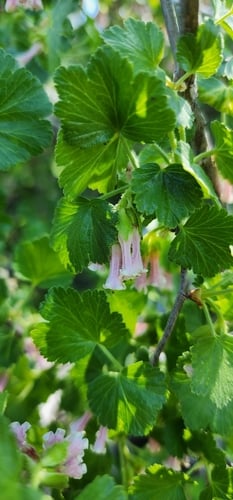
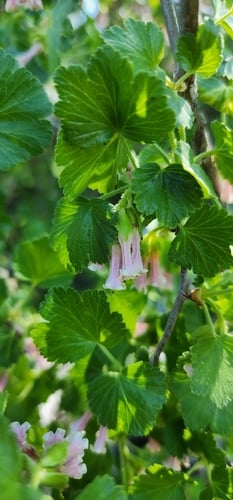
Ribes americanum
Mill.
American blackcurrant
iNaturalist· cc-by-nc
(c) michiganwillie, some rights reserved (CC BY-NC), uploaded by michiganwillie
iNaturalist· cc-by
(c) DITF Observations, some rights reserved (CC BY)
Summary
Source: WikipediaRibes americanum is a North American species of flowering plant in the gooseberry family known as wild black currant, American black currant, and eastern black currant. It is widespread in much of Canada (from Alberta to Nova Scotia) and the northern United States (from New England to Washington, with additional populations in Colorado and New Mexico).
Description
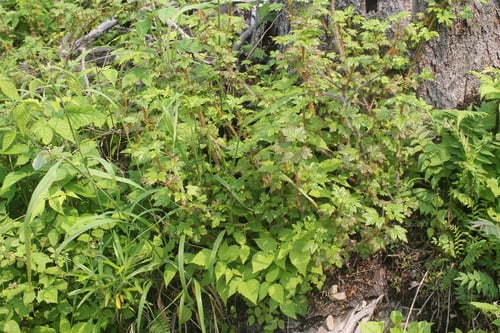
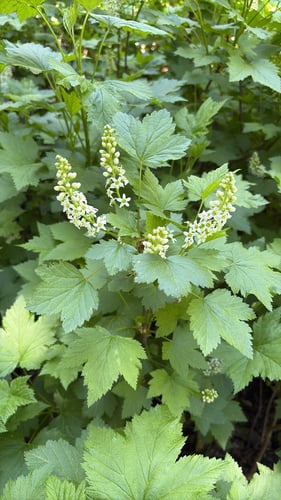
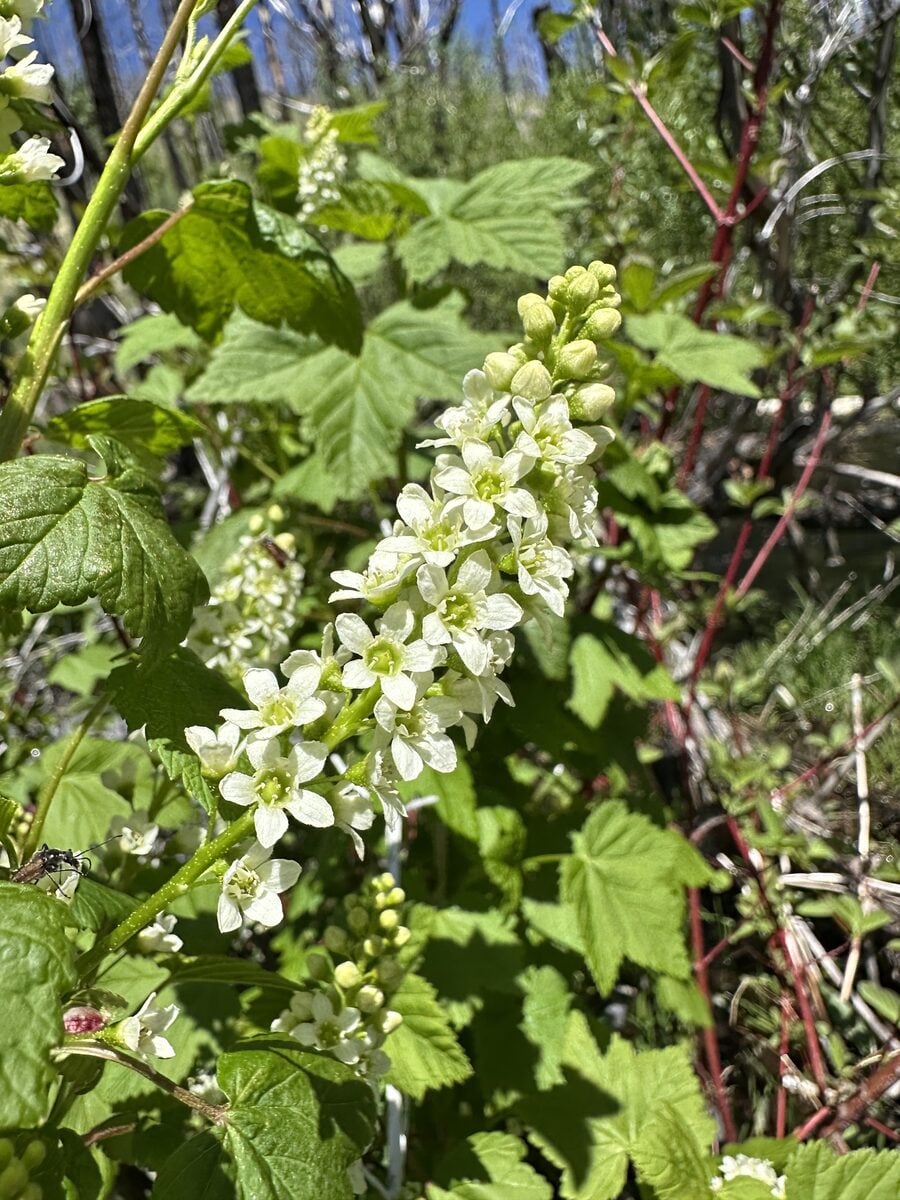
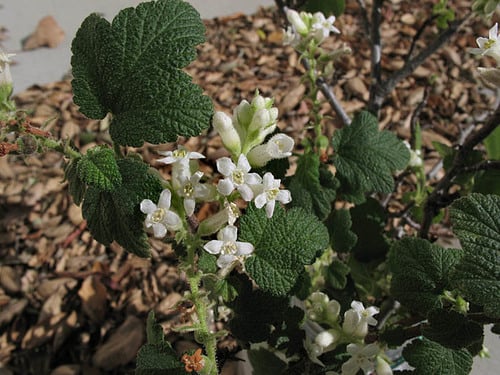
A small shrub. It does not have prickles. It grows about 1 m high. The leaves are simple and alternate. They are rounded with 3-5 pointed lobes. The leaves are 10 cm wide. There are double teeth along the edge. The flowers are creamy white. They are bell shaped and hang in clusters in the axils of the leaves. The fruit are smooth round black berries.
Edible Uses
The fruit, up to 10mm in diameter, can be eaten raw or cooked and is used in jellies, jams, pies, and preserves; it can also be dried for later use. Opinions on flavour vary widely — some sources describe these blackcurrants as esteemed and palatable, others as watery and insipid, and still others note a distinct musky flavour that makes them better suited to cooking than eating fresh.
Traditional Uses
The fruit are eaten after cooking. They can be used in jellies and pies. They are also eaten fresh. They are also dried and stored.
This uses section is brief — help expand it
Medicinal Uses
A decoction of the roots has been used to treat kidney problems and to expel worms. It has also been used by women to treat uterine problems. The root bark is anthelmintic, and a poultice of the root bark has been applied externally to swellings.
Distribution
It is a temperate plant. It grows in damp soil near streams. It suits hardiness zone 3.
Where It Grows
Asia, Canada, Central America, China, Mexico, North America, Slovenia, USA,
Cultivation
Easily grown in a moisture retentive but well-drained loamy soil of at least moderate quality. Quite tolerant of shade though not fruiting so well in such a position. Hardy to about -20°c. Plants can harbour a stage of 'white pine blister rust', so they should not be grown in the vicinity of pine trees.Plants in this genus are notably susceptible to honey fungus.
Propagation
Seed is best sown as soon as it is ripe in autumn in a cold frame. Stored seed requires 3 months of cold stratification at -2 to +2°c and should be sown as early in the year as possible. Under normal storage conditions seed can remain viable for 17 years or more. Prick out seedlings into individual pots when large enough to handle and grow on in a cold frame for their first winter, planting out in late spring the following year. Cuttings of half-ripe wood, 10–15cm with a heel, can be taken in July/August in a frame. Cuttings of mature wood of the current year's growth, preferably with a heel of the previous year's growth, can be taken November to February in a cold frame or sheltered bed outdoors.
Other Uses
None known.
Notes
There are about 150 Ribes species.
Synonyms
Also Known As
Ameriško grozdičje
References (15)
- Beckstrom-Sternberg, Stephen M., and James A. Duke. "The Foodplant Database." http://probe.nalusda.gov:8300/cgi-bin/browse/foodplantdb.(ACEDB version 4.0 - data version July 1994)
- Facciola, S., 1998, Cornucopia 2: a Source Book of Edible Plants. Kampong Publications, p 119
- Fisk, J. R. & Hoover, E., 2015, Wild Fruits of Minnesota. A Field Guide. University of Minnesota p 17
- Flora of China @ efloras.org Volume 8
- Gard. dict. ed. 8: Ribes no. 4. 1768
Show all 15 references Hide references
- Hedrick, U.P., 1919, (Ed.), Sturtevant's edible plants of the world. p 561
- Heywood, V.H., Brummitt, R.K., Culham, A., and Seberg, O. 2007, Flowering Plant Families of the World. Royal Botanical Gardens, Kew. p 160
- http://www.botanic-gardens-ljubljana.com/en/plants
- Jackes, D. A., 2007, Edible Forest Gardens
- Kermath, B. M., et al, 2014, Food Plants in the Americas: A survey of the domesticated, cultivated and wild plants used for Human food in North, Central and South America and the Caribbean. On line draft. p 745
- MacKinnon, A., et al, 2009, Edible & Medicinal Plants of Canada. Lone Pine. p 104
- Medsger, O. P., 1939, Edible Wild Plants. Macmillan Company. p 16
- Moerman, D. F., 2010, Native American Ethnobotany. Timber Press. p 475
- Plants for a Future database, The Field, Penpol, Lostwithiel, Cornwall, PL22 0NG, UK. http://www.scs.leeds.ac.uk/pfaf/
- Toupal, R. S. & Hollenback, K., 2009, An Ethnobotany of Indiana Dunes National Lakeshore: Plant Uses of the Ojibwa People. Bureau of Applied Research in Anthropology. University of Arizona