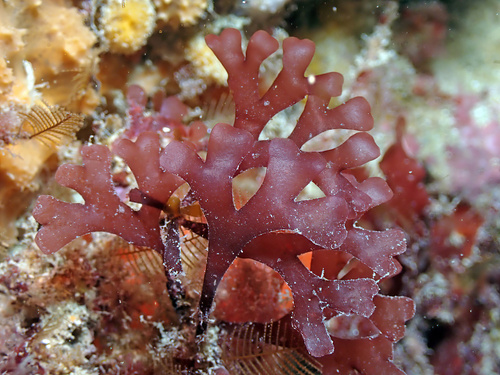
Rhodymenia palmata
(L.) Greville
Dulse, Red kale, Grey Dulse
iNaturalist· cc-by
(c) Ian Manning, some rights reserved (CC BY)
iNaturalist· cc-by-nc
(c) hmw, some rights reserved (CC BY-NC)
iNaturalist· cc-by-nc
(c) hmw, some rights reserved (CC BY-NC)
Description
A red seaweed. The fronds are lobed and purple-red. They vary from a few cm to 25 cm long.
This description is brief — help expand it
Edible Uses
Eaten raw or cooked, the dried or roasted fronds are consumed as a vegetable, added to soups and breads, used as a relish or condiment, dried in the sun then used in salads, and processed as a carragheenan source for food and alcohol production.
Traditional Uses
It is a red seaweed eaten raw or cooked. The dried or roasted fronds are eaten as a vegetable, added to soups and breads, or used as a relish or condiment. It is a carragheenan source. It is made into food and alcohol. Caution: Alcohol is a cause of cancer. It is dried in the sun then used in salads.
Distribution
It grows in temperate places. It grows on rocks near low tide mark.
Where It Grows
Alaska, Arctic, Atlantic, Australia, Britain, Canada, Europe, Iceland, India, Ireland, Mediterranean, North America, North Atlantic, Russia, Scandinavia, Scotland, USA,
Notes
It has a high protein and iron content.
Synonyms
Also Known As
Dillisk
References (13)
- Ambasta, S.P. (Ed.), 2000, The Useful Plants of India. CSIR India. p 422 (As Palmaria palmata)
- Chapman, V.J. and Chapman, D.J., 1980, Seaweeds and their uses. London.
- Cribb, A.B. & J.W., 1976, Wild Food in Australia, Fontana. p 196
- Facciola, S., 1998, Cornucopia 2: a Source Book of Edible Plants. Kampong Publications, p 260
- Hedrick, U.P., 1919, (Ed.), Sturtevant's edible plants of the world. p 559
Show all 13 references Hide references
- Heller, C. A., 1962, Wild Edible and Poisonous Plants of Alaska. Univ. of Alaska Extension Service. p 68
- Kiple, K.F. & Ornelas, K.C., (eds), 2000, The Cambridge World History of Food. CUP p 238, 1769
- Mabey, R., 1973, Food for Free. A Guide to the edible wild plants of Britain, Collins. p 119
- Michael, P., 2007, Edible Wild Plants and Herbs. Grub Street. London. p 79 (As Palmaria palmata)
- Moerman, D. F., 2010, Native American Ethnobotany. Timber Press. p 471
- Porsild, A.E., 1953, Edible Plants of the Arctic, Arctic 6:15-34, page 31
- SAYCE,
- Surey-Gent, S. & Morris G., 1987, Seaweed. A User's Guide. Whirret Books. London. p 70, 137