Rhamnus prinoides
L'Her.
Shiny leaf, South African dogwood
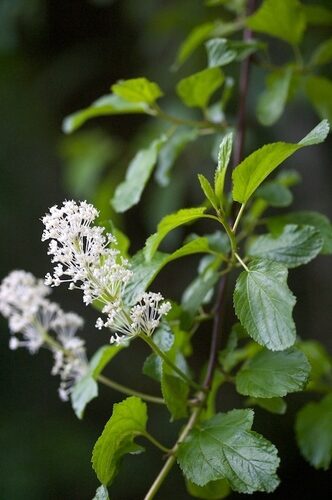
iNaturalist· cc-by-nc
(c) Leighan Mossop, some rights reserved (CC BY-NC), uploaded by Leighan Mossop
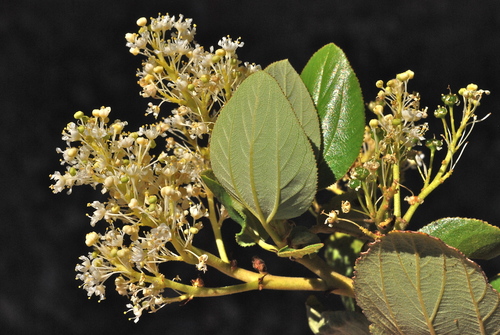
iNaturalist· cc-by-nc
(c) Troos van der Merwe, some rights reserved (CC BY-NC), uploaded by Troos van der Merwe
iNaturalist· cc-by-nc
(c) Richard Gill, some rights reserved (CC BY-NC), uploaded by Richard Gill
Description
A shrub. It can scramble. It can also be a small tree. It can grow to 7-15 m high. The bark is brown. The leaves are alternate and simple. They are oblong and 3-10 cm long by 1.5-4 cm wide. They are very glossy dark green above and dull green below. The edges are finely toothed. The flowers are small and green. They are on slender stalks. They occur in sparse clusters in the axils of leaves. There are 2-10 flowers in a group. The fruit is berry-like. It is oval and 5 mm across. The fruit are red. They are edible.
Edible Uses
The Rhamnus prinoides plant has many uses amongst the inhabitants of Africa. All parts of the plant are harvested and used for nutrition, medicine or religious purposes. In Ethiopia and Eritrea, where the plant is known as gesho or gešo, it is used in a manner similar to hops. The stems are boiled and the extract mixed with honey to ferment a mead called tej in Amharic and myes in Tigrinya. It is also used in the brewing of tella (siwa in Tigrinya), an Ethiopian and Eritrean beer. This local drink is made from gesho as a major ingredient. Gesho leaves are sundried and pounded with mortar and pestle into flour. Barley malt is prepared and sundried and ground. These two ingredients are mixed, in a proportion that varies from maker to maker, and fermented 3 to 5 days on average. Finger millet (or sorghum and maize flour regionally) are baked, and finally mixed with the fermented solution. After 1–2 days of fermentation, the tella can be filtered and consumed in a drink locally called guesh (tsiray in Tigrinya). In Central Kenya the plant is known as "Mûkarakinga" and it is believed to be medicinal. The bark of the plant is cut, boiled and then added to soup.
Traditional Uses
The fruit are eaten raw. The dried leaves are used to flavour drinks. The stems are used as a substitute for hops in beer making. The roots and stems are used in tonic soups.
Medicinal Uses
A decoction of the root is taken as a blood purifier, to treat pneumonia, gonorrhoea rheumatism and stomach-ache and as a gargle. A leaf decoction may be mixed with the bark of Erythrina abyssinica to alleviate colic. The leaves are applied as a liniment to simple sprains.
Known Hazards
Species in this genus contain hydroxyanthracene derivatives which have a stimulant laxative effect upon the body, and many species are used traditionally as laxatives. In small doses, and for short periods, these can be safe and effective, but used over long periods they can weaken the body's natural ability to defecate and can have a range of long-lasting negative effects upon the body, including anaemia, malabsorption, haematuria and weight loss. Large single doses can cause severe purging.
Distribution
A tropical plant. It grows at medium and high altitudes in South Africa. It is often near rivers and on the edges of evergeen forest. Plants are hardy. In Zimbabwe it grows between 1,340-2,270 m above sea level. Mt Lofty Botanical Gardens. It suits hardiness zones 9-11.
Where It Grows
Africa, Angola, Australia, Botswana, Cameroon, Central Africa, Congo, East Africa, Eritrea, Eswatini, Ethiopia, Kenya, Lesotho, Malawi, Mozambique, Namibia, Rwanda, South Africa, Southern Africa, Sudan, Swaziland, Tanzania, Uganda, West Africa, Zambia, Zimbabwe,
Cultivation
Plants are grown from seeds. Seeds are collected fresh from fruit off a tree and the flesh removed. Seed germinate easily. They germinate in 6-8 weeks.
Propagation
Seed - germinates readily when sown fresh. Most of the seeds germinate, taking from 2 - 6 weeks, with some still germinating after 8 weeks. Germination rate is usually 80 - 90%.
Other Uses
All the species of Rhamnus contain a mixture of compounds (mainly rhamnetin, quercitin and rhamnazin) that make a range of good quality dyes. The colour and its intensity depend upon what part of the plant is used as dyeing material (leaves, fruits and bark are most commonly used), at what period of growth it is collected and in what state it is used. With the use of the corresponding mordants (alum, copper and iron vitriols, tin dioxide, chromium, etc.) it is possible to obtain virtually the entire spectrum of colours from lemon-yellow to purple and dark cinnamon-brown, from olive-green to intensive blue and violet. The dye extracts obtained from the bark, leaves and fruits are suitable for dyeing cottons, silks, woollens, leather, paper and wood. These dyes are often exceptional for their fastness. Although we have seen no specific information for this species, the seeds of Rhamnus species are generally rich in fatty oil and several of them are extracted for use as lubricating oils etc. The wood is white to yellow, often streaked with brown, pink, red or green. It is moderately heavy and hard, close-grained and compact. Because of the small size of the timber, it is usually only used to make small articles. The wood is used for fuel. The tree casts a dense shade, often preventing the growth of other plants around it. It also responds well to trimming and can be shaped into a dense shrub. It is used for erosion control, growing well on the banks of streams; to provide shelter; as a low wind break; and as a living fence and hedge. The flowers are a good source of nectar for bees.
Production
Trees grow quickly. Trees are harvested 3 times a year by stripping off the leaves, except the growing tips. Harvesting is started when trees are 3 years old. Trees can continue to be harvested for 50 years. A fruit weighs about 0.3 g.
Other Information
Leaves are sold in local markets. It is cultivated.
Notes
There are over 100 Rhamnus species.
Nutrition
| Part | Moisture | kJ | kcal | Protein | Vit A | Vit C | Iron | Zinc |
|---|---|---|---|---|---|---|---|---|
| Leaves | 9.6 | — | 305 | 8.2 | — | — | — | — |
| Fruit | 77.7 | — | — | — | — | 34.5 | — | — |
Synonyms
Also Known As
Buckthorn, Dogwood, Geesho, Geisho, Geshe, Gesho, Geshoo, Inyenye, Mofifi buckthorn, Musvosvadziva, Sineyi, Woody hops, Xaddo
References (37)
- Bekele-Tesemma A., Birnie, A., & Tengnas, B., 1993, Useful Trees and Shrubs for Ethiopia. Regional Soil Conservation Unit. Technical Handbook No 5. p 380
- Burkill, H. M., 1985, The useful plants of west tropical Africa, Vol. 4. Kew.
- Bussman, R. W., et al, 2011, Plant Use in Odo-Bulu and Demaro, Bale region, Ethiopia. Journal of Ethnobiology and Ethnomedicine. 2011, 7:28
- Cundall, P., (ed.), 2004, Gardening Australia: flora: the gardener's bible. ABC Books. p 1139
- Facciola, S., 1998, Cornucopia 2: a Source Book of Edible Plants. Kampong Publications, p 191
Show all 37 references Hide references
- Food Composition Tables for use in Africa FAO http://www.fao.org/infoods/directory No. 553
- Fowler, D. G., 2007, Zambian Plants: Their Vernacular Names and Uses. Kew. p 83
- Fox, F. W. & Young, M. E. N., 1982, Food from the Veld. Delta Books. p 316
- INFOODS:FAO/INFOODS Databases
- Jardin, C., 1970, List of Foods Used In Africa, FAO Nutrition Information Document Series No 2. p 97
- Lim, T. K., 2015, Edible Medicinal and Non Medicinal Plants. Volume 9, Modified Stems, Roots, Bulbs. Springer p 73
- Long, C., 2005, Swaziland's Flora - siSwati names and Uses http://www.sntc.org.sz/flora/
- Luizza, M. W., et al., 2013, Local Knowledge of Plants and their uses among Women in the Bale Mountains, Ethiopia. Ethnobotany Research & Applications 11:315-339
- Lulekal, E., et al, 2011, Wild edible plants in Ethiopia: a review on their potential to combat food insecurity. Afrika Focus - Vol. 24, No 2. pp 71-121
- Martin, F.W. & Ruberte, R.M., 1979, Edible Leaves of the Tropics. Antillian College Press, Mayaguez, Puerto Rico. p 215
- Molla, A., Ethiopian Plant Names. http://www.ethiopic.com/aplants.htm
- Mutie, F. M., et al, 2023, Important Medicinal and Food Taxa (Orders and Families) in Kenya, Based on Three Quantitative Approaches. Plants 2023, 12, 1145
- Palgrave, K.C., 1996, Trees of Southern Africa. Struik Publishers. p 555
- Peters & Maguire, 1981,
- Peters, C. R., O'Brien, E. M., and Drummond, R.B., 1992, Edible Wild plants of Sub-saharan Africa. Kew. p 165
- Regassa, T., et al, 2014, Ethnobotany of Wild and Semi-Wild Edible Plants of Chelia District, West-Central Ethiopia. Science, Technology and Arts Research Journal. 3(4): 122-134
- Ruiters-Welcome, A. K., 2019, Food plants of southern Africa. Ph.D. thesis. Univ. of Johannesburg p 94
- Senbeta, F., et al, 2013, Diversity of Useful Plants in the Coffee Forests of Ethiopia. Ethnobotany Research & Applications 11:049-069
- Sert. angl. 6, t. 9. 1789
- Sina, B. & Degu, H. D., 2015, Knowledge and use of Wild Edible Plants in the Hula District of the Sidama Zone. International Journal of Bio-resource and Stress Management 6(3):352-365
- Swaziland's Flora Database http://www.sntc.org.sz/flora
- van Wyk, B., 2005, Food Plants of the World. An illustrated guide. Timber press. p 319
- Venter, F & J., 2009, Making the most of Indigenous Trees. Briza. p 256
- von Breitenbach, F., 1985, Southern Cape Tree Guide. Department of Environment Affairs, Forestry Branch. Pamphlet 360 Pretoria p 20
- von Katja Rembold, 2011, Conservation status of the vascular plants in East African rain forests. Dissertation Universitat Koblenz-Landau p 180
- Welcome, A. K. & Van Wyk, B.-E., 2019, An inventory and analysis of the food plants of southern Africa. South African Journal of Botany 122 (2019) 136–179
- White, F., Dowsett-Lemaire, F. and Chapman, J. D., 2001, Evergreen Forest Flora of Malawi. Kew. p 445
- Wilson, A. L. & Downs, C. T., 2012, Fruit nutritional composition and non-nutritive traits of indigenous South African tree species. South African Journal of Botany. 78:30-36
- World Checklist of Useful Plant Species 2020. Royal Botanic Gardens, Kew
- www.worldagroforestrycentre.org/treedb/
- www.zimbabweflora.co.zw 2011
- Zeven, A. C. & de West, J. M. J., 1982, Dictionary of cultivated plants and their regions of diversity. Wageningen. p 118